

Kalshi Opens Early IPO Talks With Investment Banks as Revenue Surpasses $2 Billion
Prediction markets leader Kalshi has quietly begun engaging investment banks about a potential public listing, a development that could mark a milestone moment for an industry that has grown from a regulatory novelty into one of the most debated financial platforms in the United States.
Top executives at Kalshi have engaged in early, informal talks with investment banks about a future IPO, according to The Information, which cited people close to the company’s financials. Kalshi declined to comment when contacted by The Block. While no formal mandate has been awarded, the conversations signal the company is beginning to map out a path to the public markets.
Revenue Triples in Seven Months
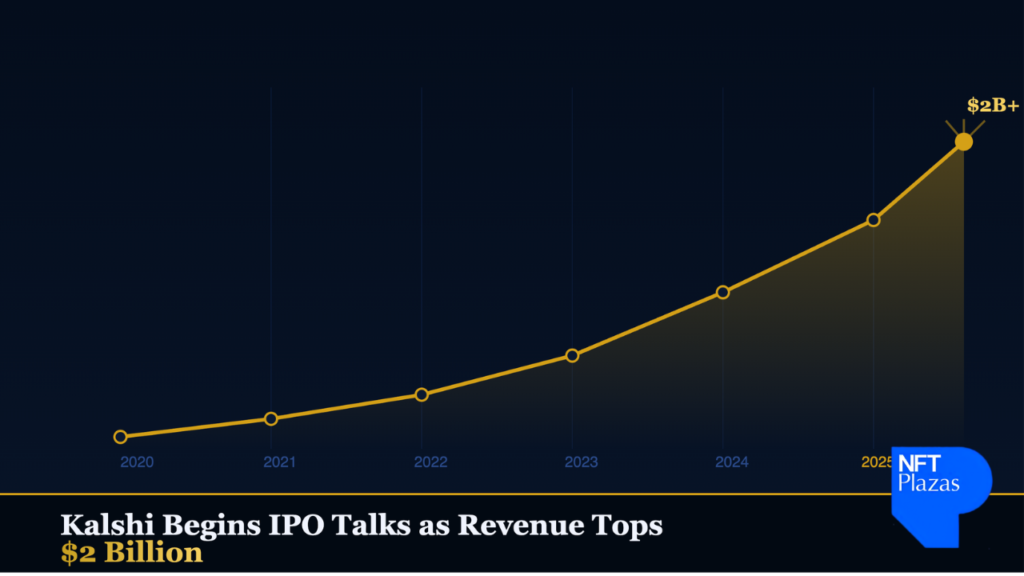
The IPO conversations are being driven by a dramatic acceleration in Kalshi’s financial performance. The platform is now generating annualized revenue north of $2 billion, roughly three times what it was in November, after a wave of NBA and World Cup betting boosted trading volume. That compares to a $1 billion annualized run rate reported by the Wall Street Journal as recently as March — one of the steepest growth trajectories in the fintech sector this year.
As part of the IPO discussions, Kalshi is asking prospective advisers to integrate with its platform, giving banks’ institutional clients access to trade on it. That approach suggests the company is treating the process not just as a capital-raising exercise but as a mechanism to deepen institutional distribution. Any public listing is still likely at least a year away, with late 2027 or 2028 the expected timeframe.

Kalshi and its rival, Polymarket, remain the dominant players in the prediction market sector (Source: The Block)
A $22 Billion Company With Institutional Backing
The IPO discussions follow Kalshi’s $1 billion Series F round completed in May, which brought its valuation to $22 billion. The round was led by Coatue, with participation from Sequoia Capital, Andreessen Horowitz, IVP, Paradigm, Morgan Stanley, and ARK Invest. That fundraise established Kalshi as one of the most heavily capitalized private fintech companies in the United States and provided the runway to pursue product expansion and a public debut on its own timeline.
On the trading volume side, Kalshi continues to outpace its closest rival. Kalshi recorded $16.81 billion in monthly volume in May, up from $14.81 billion in April, according to The Block’s data dashboard. Polymarket posted $7.08 billion in volume last month, down from $9.01 billion in April.

Kalshi making early IPO talks with investment banks
Bitcoin Perpetual Futures and International Push
Kalshi’s revenue surge has been supported by a broadening product suite. The company recently secured CFTC approval to offer Bitcoin perpetual futures, becoming the first U.S.-regulated exchange authorized to launch the product domestically — a development widely viewed as a landmark for regulated crypto derivatives in the country.
The company has also expanded internationally, entering Canada with access to thousands of event contracts covering economic indicators, commodities, and global affairs. Due to local regulatory requirements, Canadian users are not permitted to trade sports-related prediction markets or election contracts. The move signals Kalshi’s intent to build a global footprint while adapting to varying regulatory frameworks across jurisdictions.
A Regulatory Battlefield
Kalshi’s path to a public listing runs through one of the most contested regulatory landscapes in American financial markets. The core dispute — whether prediction market contracts are federal financial derivatives under CFTC jurisdiction or unlicensed gambling subject to state law — remains unresolved.
Kentucky Attorney General Russell Coleman filed a lawsuit against Kalshi and Polymarket, arguing that allowing users to wager on sports and event outcomes constitutes illegal sports betting under state law. The suit also names Coinbase, Robinhood, and Webull, alleging they facilitated illegal gambling without consumer-protection licenses. Coleman’s office noted that sports-related contracts accounted for roughly 70% of Kalshi’s trading volume during a sample period in 2025.
Kalshi has pushed back firmly. A company spokesperson said, “The CFTC is our regulator, not the states.” The CFTC has insisted it holds exclusive federal jurisdiction over licensed platforms under the Commodity Exchange Act, preempting state gambling laws, and has sued multiple states over their attempts to restrict prediction market platforms. In response, 41 state attorneys general have urged CFTC Chairman Michael S. Selig to affirm state authority over gambling within their borders.
Courts have not reached a clear answer. The Third Circuit sided with Kalshi in a New Jersey case, while other courts have allowed state gambling cases to move forward. Kentucky has also become the first state to impose a 14.25% tax on prediction market transaction fees; Kalshi, Crypto.com, and Polymarket have filed a joint lawsuit to block the measure.
What a Public Listing Would Mean
A Kalshi IPO would be a first for the prediction markets sector — a significant test of how public investors value a regulated event-contract exchange operating at the intersection of fintech, derivatives, and sports wagering. The company’s ability to sustain its revenue trajectory and contain the regulatory overhang will be the central questions any underwriter must answer before a listing becomes viable.
For now, the early bank conversations suggest Kalshi’s leadership believes the growth story is compelling enough to begin building toward that moment — even as the legal battles that define the sector’s future continue in courtrooms across the country.