
Consortium Faces Allegations of Faking Key Stablecoin Partnerships
Key Takeaways
Open Standard allegedly listed firms like Samsung without consent, damaging the credibility of its OUSD stablecoin.Multiple companies denied signing agreements, causing industry experts to question the consortium’s reality.Circle’s CEO criticized the misleading announcements, highlighting the lack of integrity in the OUSD launch.
Open USD Immersed in Unapproved Inclusion Scandal With Companies Like Samsung
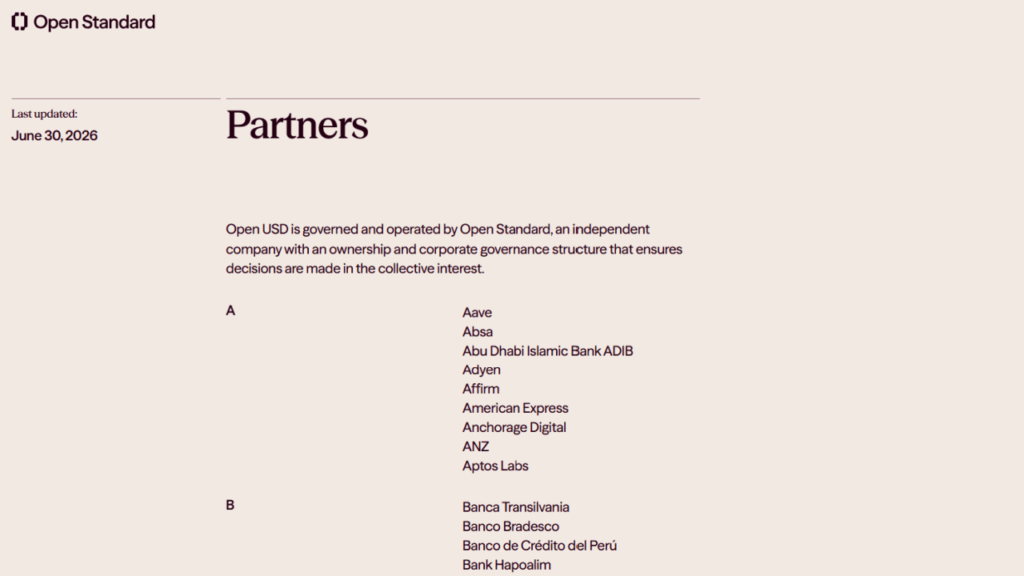
Open Standard, the consortium behind Open USD, a new stablecoin backed by over 140 companies and institutions, faces allegations of sidestepping procedures in adding partners to the initiative.
Reports indicate that some of the firms listed as part of this consortium, which backs the issuance of a new USD stablecoin with support from both traditional and crypto finance companies, did not approve being listed as project supporters.
Blockmedia’s Tony Chung, who first pointed out that 13 Korean firms were partners in the Open USD project, said that some of these companies did not know why they were included in the consortium announcement.
“Samsung Electronics said flatly there was no formal discussion and it doesn’t know what role it would play. Shinhan, Dunamu, and K Bank said Open Standard asked about participation, they said they’d ‘consider it,’ and then found their names listed as consortium members,” he revealed. At the time of writing, these companies remain listed as partners.
Furthermore, Chung disclosed that some of these companies found out about their alleged participation in Korean media and were “baffled,” stressing they would take a look at the project if it worked out.
Tether advisor Gabor Gurbacs also spoke to some of these partners, who told him that they never signed or agreed to anything. “Either the media deeply twisted something or the participant list is misleading,” he assessed.
“One of them said specifically that they were told that Stripe and Visa will change their terms that the new stablecoin will be one of the accepted assets and that may be a way they could potentially interact with it in the future. But no contracts or anything just discussions,” Gurbacs disclosed.
The Big Whale’s CEO, Raphaël Bloch, contacted some of the companies that had posted they would join the initiative, and no one inside the institutions knew what the initiative really was. “It looks like a strong announcement effect with little operational reality behind it,” he stated.
“Integrity matters,” posted Jeremy Allaire, CEO and co-founder of Circle, one of the companies estimated to be affected by the future launch of OUSD. The new stablecoin is expected to be launched later this year.