
Korea’s Stock Market Crashed 33%, Then Jumped 18%: Crypto Traders Still Broke
Key Takeaways
South Korea’s KOSPI rebounded 18% on July 31, its biggest one-day jump ever, after a 33% crash over the rest of the month.Leopold Aschenbrenner’s AI fund sold to Citadel and a Microsoft earnings beat fueled the July 31 rebound.KOSPI still sits about 22% below its June close, and Four Pillar’s Steve Kim says traders remain too broke for crypto.
A Historic Crash, Triggered by a Chip Shock
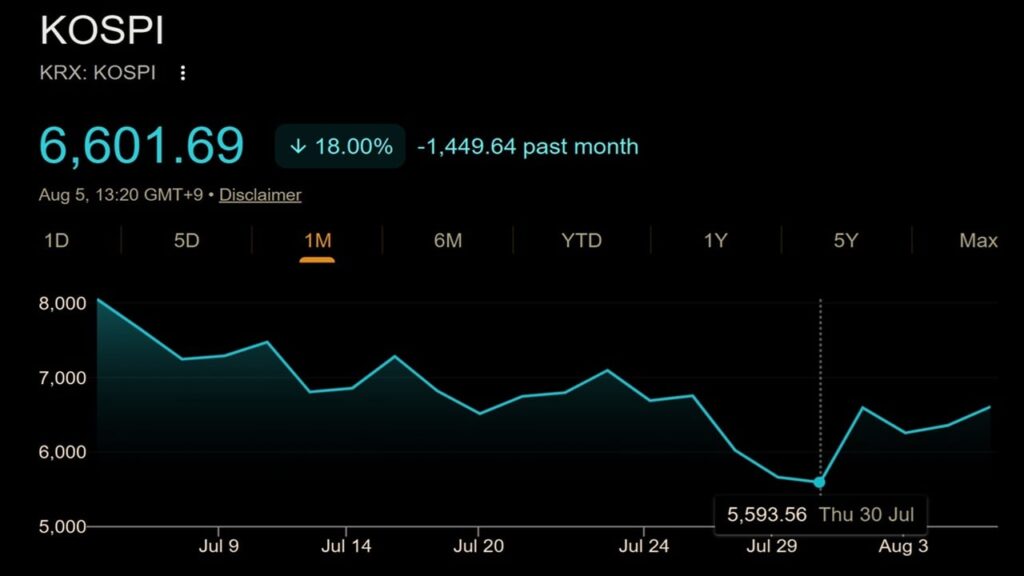
The KOSPI’s July decline surpassed the single-month drops recorded during the 1997 Asian Financial Crisis and the 2008 Global Financial Crisis, making it the worst month in the index’s history. The rout deepened most recently starting July 28, when news that China had begun mass production of homegrown chipmaking tools sent the index down 10.8% in a single session, all while triggering multiple trading halts.
Samsung Electronics and SK Hynix, the two stocks that had powered Korea’s AI-driven rally over the past year, absorbed the worst of it. SK Hynix’s earnings miss, a record quarterly revenue that still fell short of analyst estimates, deepened the panic the following day, which, measured from June’s record high, suggested the drawdown had approached 44%.
The Leverage That Powered the Rally, and the Fall
Steve Kim, chief executive and co-founder of Four Pillars, a Seoul-based blockchain research firm, told Bitcoin.com News that the damage traces back to how the rally itself was built, i.e. outstanding leveraged bets on Korean equities hit a record 29.2 trillion won (roughly $19.7 billion) in early July, with much of it concentrated in single-stock ETFs tied to Samsung and SK Hynix. He further added:
Many younger investors had taken leveraged positions in Samsung Electronics and SK Hynix, expecting the rally to continue. There is definitely a generational divide in sentiment. Younger investors have been hit much harder, while older investors tend to be in a better position.
Moreover, Kim highlighted that Korea’s stock and crypto markets have historically moved largely independently, but the two are connected through a shared pool of traders. “Many of Korea’s most active crypto traders are also the same people who aggressively trade Korean equities with leverage,” he pointed out, while also noting that over the past year, many of them shifted focus away from crypto toward what they saw as a bigger opportunity in Korean stocks.
That shift lines up with data showing Korea’s retail crypto trading volume fell 28% year-over-year as capital rotated into semiconductor and AI names.
“The recent market crash wiped out a significant portion of their capital,” Kim said. “Even if they now want to rotate back into crypto, many simply don’t have the money left to do so.” He drew a direct parallel to the US, where crypto attention has similarly faded as capital and focus concentrated in AI.
Lastly, Kim was blunt about the net effect on the industry, claiming that only a small percentage of investors actually profited from the Korean stock rally, with much of those gains going to foreign investors. “Once again, domestic retail investors effectively became exit liquidity for overseas capital,” he opined.
An 18% Reversal Shows Just How Wild This Market Has Gotten
Four days after posting its worst month on record, the KOSPI staged the wildest single-day reversal in its history. The index gained 17.91% on July 31, closing at 6,595.45 after adding more than 1,000 points, its biggest one-day jump ever. Samsung Electronics rallied 19.57% to 247,000 won, and SK Hynix jumped 24.05% to 1.64 million won, hitting its daily upper limit for the first time in 17 years. The move was sharp enough to trip the Korea Exchange’s “sidecar” mechanism, halting program trading for five minutes, the same kind of circuit breaker that had repeatedly frozen the index on the way down.
Two forces converged to spark the bounce, with the first being the unwinding of Situational Awareness, an AI-focused hedge fund founded by former OpenAI researcher Leopold Aschenbrenner that lost 67% of its value in July on concentrated, leveraged bets. To elaborate, margin calls forced the fund to liquidate its public holdings to Ken Griffin’s Citadel, and once that forced selling was done, one source of pressure on Samsung and SK Hynix disappeared.
The second was an overnight rally on Wall Street where Microsoft’s earnings beat reignited confidence in AI infrastructure spending and sent the Philadelphia Semiconductor Index up 8% (while Amazon’s results reaffirmed demand for AI monetization). Meta topped revenue estimates too, though its own shares fell on capex-driven cash-flow concerns, a reminder that even the earnings calming Korea’s market were themselves fueling investor whiplash elsewhere.
The relief didn’t last, however, and the KOSPI dropped 4.86% the very next session and by August 4, the index had slipped further to 6,153.55 (a trend that has continued since), still down about 22% from its late-June level.
Looking ahead, Kim does not see the reversal as a hidden positive for crypto because, rather than freeing up capital for a rotation, he believes the broader wipeout (now compounded by a market that can swing 18% in either direction inside 24 hours) leaves Korean retail investors more risk-averse and with less money to deploy anywhere, crypto included.