

Ethereum Devs Want ETH Staking Rewards to Hit 0% at 50% Staked
Key Takeaways
Ethereum developers proposed tapering validator issuance to 0% near a 50% staking ratio.Aave’s Stani Kulechov warns the 50% cap could hurt institutional staking and DeFi demand.Ethereum may phase the change over 18 months, with debate shaping its next network upgrade.
Aave Founder Warns 50% Staking Cap Could Weaken ETH Demand
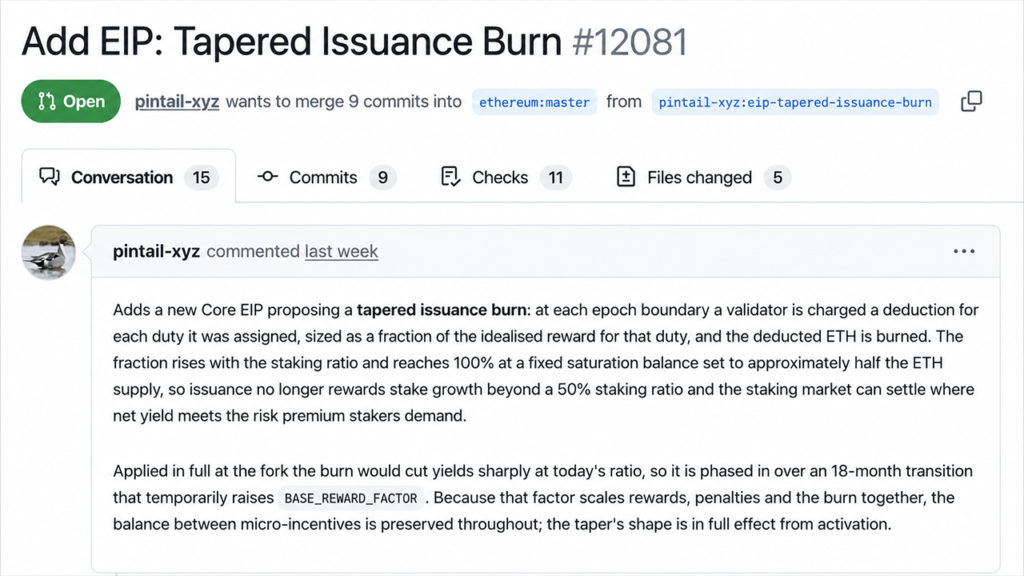
Ethereum’s long-running debate over staking economics has taken a sharper turn, with developers proposing a new mechanism that would gradually eliminate validator issuance as the share of staked ETH approaches 50%.
The draft proposal, called “Tapered Issuance Burn,” would deduct and burn part of validators’ idealized duty rewards. The burn rate would rise with staking participation until net issuance reaches zero at about half of ETH supply.
Ethereum’s staking ratio passed one-third of supply in April, according to the proposal’s authors. They argue that the current reward curve provides little incentive for staking growth to stop, since yields would remain near 1.5% even if almost all ETH were staked.
Developer Jerome de Tychey wrote on X that more than 70 million ETH could be staked by January 2028, accounting for over 55% of supply, if nothing is done.
Developers Target Dilution and Validator Concentration
Supporters say excessive staking could eventually make Ethereum less decentralized rather than more secure.
Their concern is that smaller solo validators could become uneconomic first, leaving more stake concentrated among custodians and large staking providers. Rising issuance also dilutes ETH holders who choose not to stake.
Under the proposed taper, issuance would peak at roughly 0.5% of supply annually around a 20% staking ratio, then fall toward zero at 50%.
“The staking market finally settles where yield equals the risk premium stakers demand,” de Tychey said. The change would phase in over 18 months, with developers pointing to roughly another six months of lead time before a potential network upgrade.
Supporters also argue that lower issuance, combined with Ethereum’s existing transaction-fee and blob burns, could make ETH supply more predictable and more frequently deflationary.
Kulechov Warns of Institutional and DeFi Costs
Aave founder Stani Kulechov strongly opposed the proposal, saying it could make ETH yield too uncertain for institutions and DeFi users.
“It caps Ethereum staking rewards to 0% when over 50% of supply [is] staked,” Kulechov wrote. He argued that unpredictable returns could make ETH less attractive than competing networks with clearer yield profiles.
He also warned that lower staking rewards could undermine ETH borrowing strategies across DeFi. Investors seeking yield might instead move into stablecoins or other income-producing assets.
“This just makes ETH less viable as an asset and restricts its potential,” Kulechov said. “Ethereum should not be punished for its growth.”
The debate comes as Ethereum trading activity has weakened. Cryptorank said monthly spot volume on Ethereum decentralized exchanges fell to $29 billion in July, down 76% from its August 2025 peak.
The proposal remains preliminary. But the dispute captures a larger question for Ethereum: how to limit dilution and concentration without making ETH less useful as a productive asset.