

Tether’s USDT Supply Shrinks by $4B in 60 Days as Crypto Demand Cools
Key Takeaways
Tether’s USDT supply fell by about $4B over 60 days, including $870M in the past 11 days.USDT still holds 60% of stablecoins, but shrinking supply may signal weaker crypto liquidity.Tron hosts $91.2B+ of USDT; the next test is whether falling balances drag trading activity.
Tether Sheds $870M in 11 Days as Stablecoin Demand Weakens
Tether’s USDT supply is shrinking after years of rapid expansion, adding to signs that some crypto capital is moving offchain rather than simply rotating between stablecoins.
Cryptoquant data shows USDT’s 60-day rolling supply change at roughly negative $4 billion. About $870 million of that decline occurred over the past 11 days.
USDT remains the dominant stablecoin, with around $184 billion in circulation and an estimated 60% share of total stablecoin supply. Still, the recent contraction has raised questions about whether investors are reducing exposure to crypto altogether.
Analyst Stacy Muur said part of the move appears to be a direct exit into fiat following bitcoin’s retreat from its 2025 peak. “Some investors are redeeming stablecoins for fiat and leaving crypto entirely,” she said.
Yield Competition Is Only Part of the Story
Changing stablecoin economics may also be contributing. USDC offers a broader rewards ecosystem through platforms such as Coinbase, while lending protocols, including Morpho and Aave provide additional yield opportunities.
However, Muur noted that USDC supply has also fallen sharply. That weakens the argument that capital is simply switching from Tether into Circle’s stablecoin.
“I think it’s just a mix of things,” she said. “Some capital chasing yield, some rotating back into fiat, and less demand for stablecoins as speculative activity cools.”
That distinction matters because stablecoins are often treated as a proxy for deployable crypto liquidity. A broad decline across major issuers can signal that capital is leaving digital-asset markets rather than waiting on the sidelines.
Tron and Ethereum Still Dominate USDT
Despite the decline in supply, USDT remains heavily concentrated on two networks. Tron and Ethereum each host roughly $90 billion of Tether, together accounting for about 97% of the token’s circulating supply.
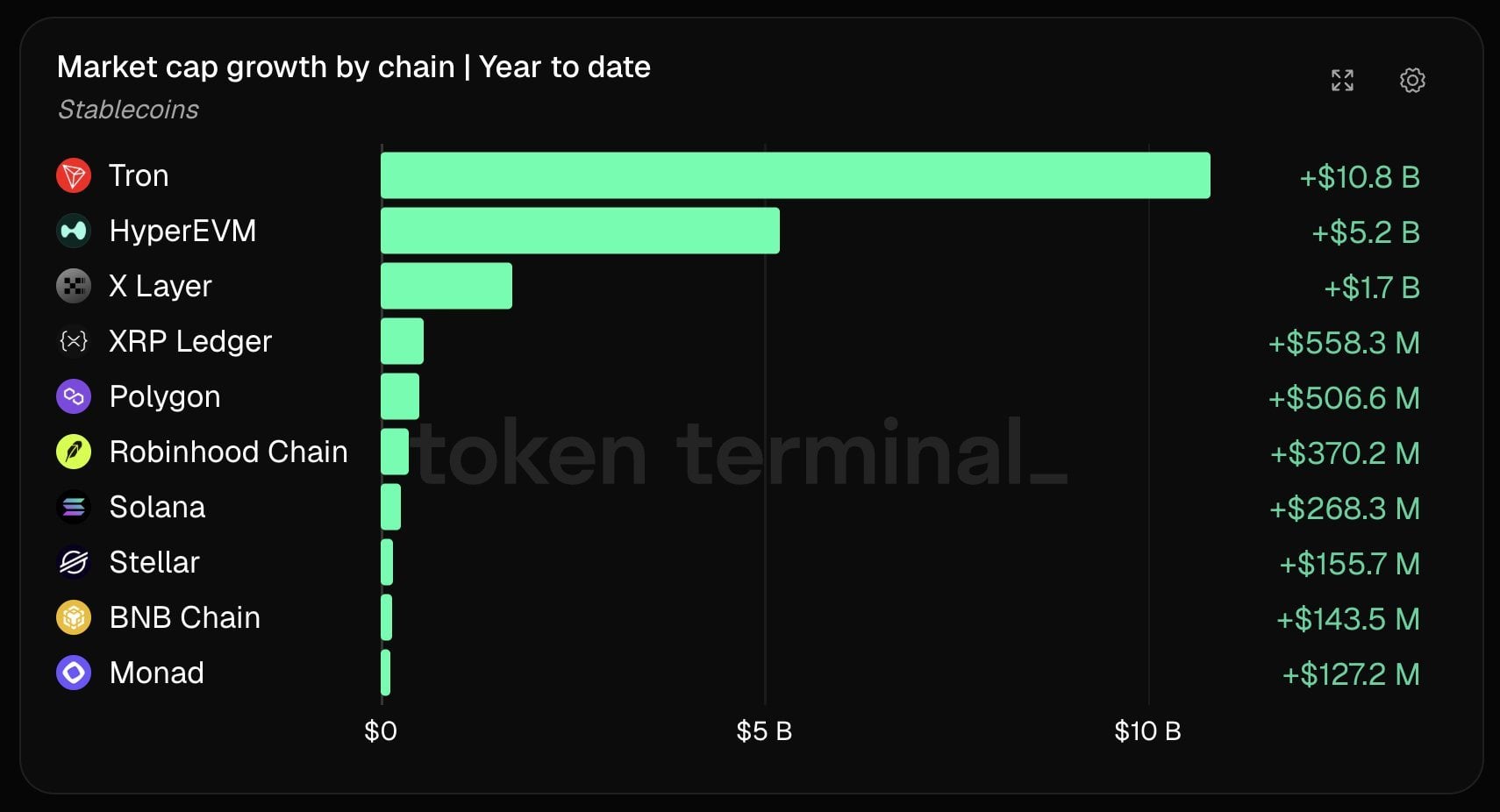
Tron has also led stablecoin growth so far this year. Its stablecoin market capitalization has increased by about $10.8 billion, ahead of HyperEVM at $5.2 billion and X Layer at $1.7 billion.
The broader picture is therefore mixed. Tether remains deeply embedded in crypto payments, trading, and emerging-market dollar demand, but aggregate supply is no longer expanding in a straight line.
For investors, the more important signal may be whether shrinking stablecoin balances are followed by weaker trading activity and liquidity. If so, the latest USDT contraction could mark a broader cooling in crypto risk appetite rather than a temporary reshuffling of digital dollars.