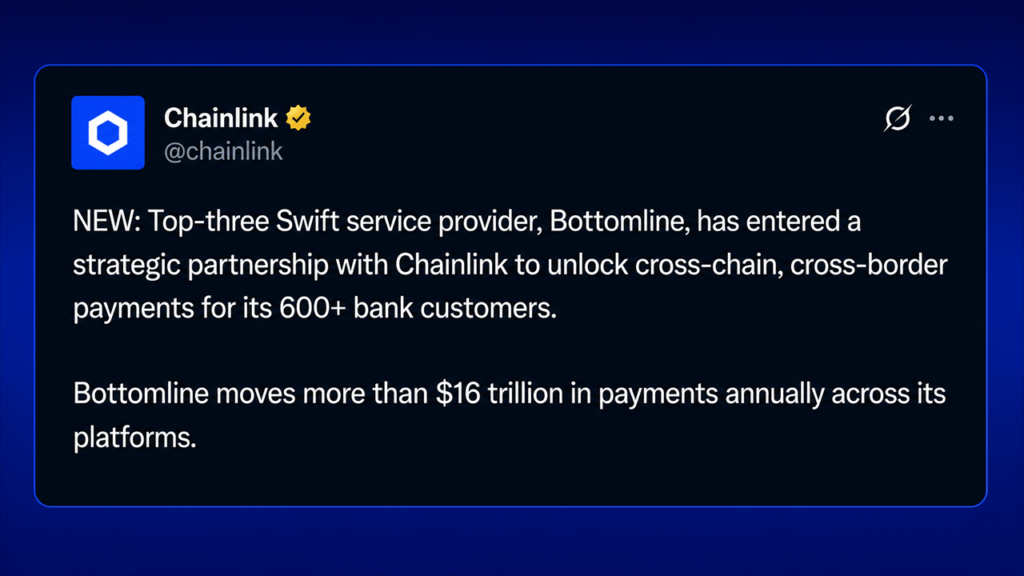
SWIFT Services Provider Taps Chainlink to Bring 600 Banks Onchain
Key Takeaways
Bottomline connects Chainlink technology to a network serving 600-plus banks.Chainlink targets friction in a Bottomline ecosystem processing $16 trillion yearly.Chainlink and Bottomline face a key test as tokenization heads toward $16 trillion by 2030.
Bottomline Brings Blockchain Rails to a $16 Trillion Payments Network
The recently announced partnership puts Chainlink technology inside a significant piece of global financial infrastructure. Bottomline, a top-three provider of SWIFT services, processes more than $16 trillion in payments annually and serves 600-plus banks, 1,200 financial institutions, and 10,000 businesses globally.
The deal is designed to bridge traditional finance, otherwise known as TradFi, with public and private blockchains. Banks can continue sending instructions using ISO 20022, the global standard that determines how financial institutions structure and exchange payment information, rather than rebuilding their core systems.
Chainlink Turns Familiar Bank Messages Into Cross-Chain Transactions
Under the integration model, a bank can send a standard SWIFT message and have Chainlink’s infrastructure connect that instruction to blockchain settlement. Its Cross-Chain Interoperability Protocol, known as CCIP, provides a way to communicate and move tokenized value between otherwise separate blockchain networks.
Chainlink’s Runtime Environment, or CRE, handles another part of the process. It coordinates payment workflows, transaction routing, and operational changes, essentially helping determine what needs to happen and in what order as a payment moves through the system.
That combination matters because today’s TradFi banks generally cannot afford to abandon established infrastructure simply to experiment with blockchain. Instead, the partnership gives them a single, network-agnostic connection, meaning they are not tied to one blockchain. CCIP has been logging mainnet activity since July 2023 and now connects more than 60 blockchain networks.
Cross-Border Costs Give Banks a Reason to Test New Settlement Rails
The bigger target is a longstanding problem in global finance. Cross-border transactions can still take days to settle, while fees can consume 5% or more of a transfer’s value. Payments often travel through several intermediary banks, with each step potentially adding time and cost.
Blockchain-based settlement could streamline a great deal of that process by allowing tokenized assets to move across digital networks. On the flip side, financial institutions still need infrastructure that works with regulated banking systems and existing operational processes. The Bottomline partnership is aimed at closing that gap rather than asking banks to start over.
Interestingly, the agreement also fits a broader institutional push by Chainlink. Its Project Pangea involves more than 50 banking institutions across Europe and South Korea, whose participants collectively manage more than $10 trillion in assets. The initiative targets T+0 foreign exchange settlement, meaning transactions could settle on the same day they are made.
JPMorgan Chase, ANZ Bank, UBS Asset Management, and the Hong Kong Monetary Authority have also used CCIP for activities including cross-chain settlement, tokenized funds, and cross-border transactions in regulated settings. Interestingly, technology associated with decentralized finance (DeFi) crypto markets is increasingly being positioned as plumbing for established financial institutions.
Banks Now Decide How Far the Integration Goes
The potential market is also clocking significant growth expectations. Tokenization, the process of representing assets such as money or securities as digital tokens, is projected in the report to become a $16 trillion market by 2030. For payment providers operating at Bottomline’s scale, connecting traditional systems with blockchain networks is therefore becoming a competitive infrastructure issue.
On the other hand, the partnership itself does not establish that every Bottomline banking customer will immediately move payments onchain or that projected cost savings will materialize. What it provides is the technical connection that can allow participating institutions to use blockchain settlement without abandoning existing messaging standards. Today, the project’s native crypto asset LINK is the 13th largest digital currency in terms of market cap.
LINK’s price rose 6.4% today alongside the broad crypto rally on Thursday, Sept. 3, and from the latest news. Chainlink’s LINK also recently got a boost from Charles Schwab, as Schwab Crypto plans to list LINK alongside SOL and AVAX. What comes next depends on adoption and innovative strides.
Banks, payment providers, and regulators will determine how extensively the new connection is used, while Chainlink and Bottomline will have to show that blockchain settlement can deliver practical improvements in speed, cost, and interoperability. Weirdly enough, the biggest sign of success may be that banks barely notice the blockchain layer at all. If tokenized finance continues expanding toward the projected $16 trillion market by 2030, more integrations between established payment systems and blockchain networks could be in the cards.
SoFi Opens Banking Rails to Kraken in Sweeping Crypto Alliance
On Thursday, SoFi Technologies, Inc. and Payward, the parent company of Kraken, announced a partnership aimed at enhancing digital asset…


SoFi Opens Banking Rails to Kraken in Sweeping Crypto Alliance
On Thursday, SoFi Technologies, Inc. and Payward, the parent company of Kraken, announced a partnership aimed at enhancing digital asset…
SoFi Opens Banking Rails to Kraken in Sweeping Crypto Alliance
On Thursday, SoFi Technologies, Inc. and Payward, the parent company of Kraken, announced a partnership aimed at enhancing digital asset…