
GitHub Introduces Project HydraFusion: Runtime Multi-Model Orchestration That Builds a Workflow Per Coding Task in Copilot CLI
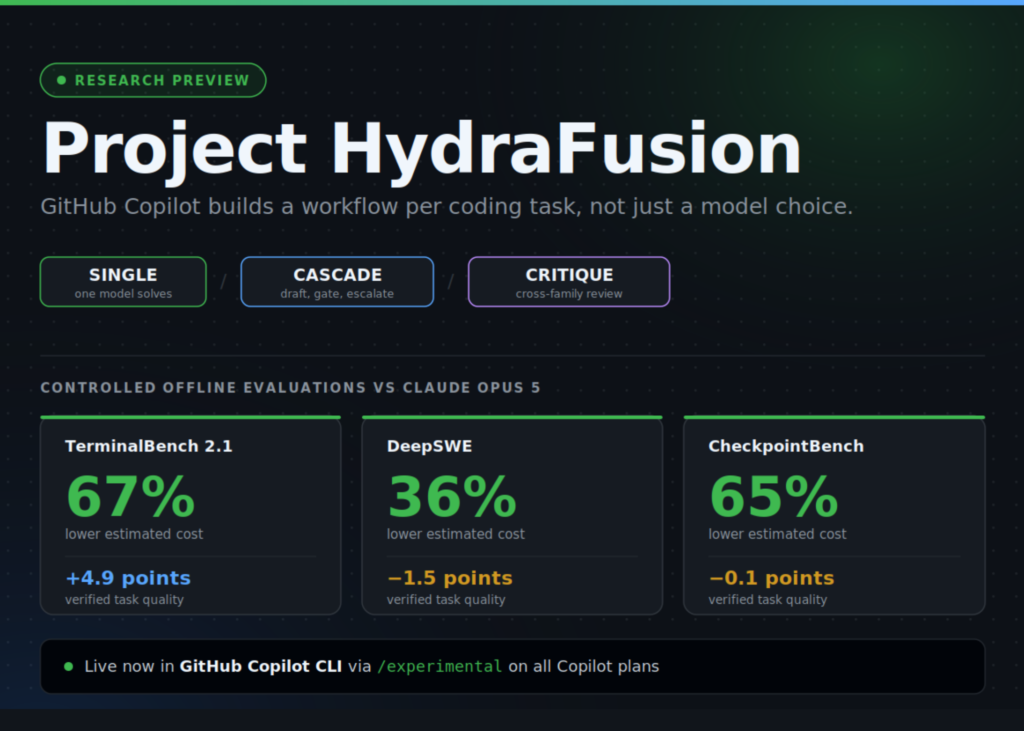
GitHub has released Project HydraFusion, a research preview that stops treating model choice as a one-time setting. Instead of routing your prompt to a single model, HydraFusion builds an execution plan per request. It can draft with one model, have a second model critique the draft, or escalate to a stronger model when a quality gate rejects the first attempt. Models come from multiple providers. The developer picks HydraFusion once, the same way they would pick any other model.
Is it deployable? Yes, but narrowly. HydraFusion is live as a research preview for users on all GitHub Copilot plans, inside GitHub Copilot CLI only. There are no open weights and no self-hosted path. Run /update, then /experimental on, then /model and select HydraFusion (Research Preview). Billing is per token consumed by whichever models the workflow invokes, at each model’s standard rate.
What the system actually does
HydraFusion follows Auto model selection, which GitHub shipped earlier in 2026 to match a task to one best-suited model. HydraFusion goes a step further and treats workflow selection as an optimization problem.
It reads capability signals for reasoning, code generation, debugging, and tool use. It then picks the least complex workflow expected to clear the quality bar, spending extra model calls only where they are likely to help.
The three execution patterns
For each request, HydraFusion currently selects one of three patterns:
Single: One selected model solves the task directly.
Cascade: An efficient model drafts a solution. A quality gate then either accepts it or escalates to a stronger model.
Critique: One model drafts, an independent read-only critic from a different model family reviews it, and the drafting model revises once. The review follows the same pattern as Rubber Duck.
Each pattern trades quality against cost differently. Single preserves speed. Cascade keeps a path to stronger inference open. Critique adds an outside perspective where review beats another unaided attempt.
Engineering guardrails
GitHub built the runtime around five operating principles that matter for repository-level work:
Complete accounting across every leg, including drafting, critique, revision, escalation, retry, and fallback.
Bounded execution with explicit timeout and cancellation per leg.
Isolated review, where critics run in tool-less contexts and cannot modify the repository.
Fail-safe application, applying no patch when a workflow is cancelled or fails validation.
Validated routing, verifying model bindings, fallback behavior, and availability before execution starts.
Internally the runtime logs role, outcome, cost, latency, and diagnostics per leg. Externally the developer sees one coherent response and one permission-aware change set.
Benchmark results
GitHub team evaluated fixed HydraFusion policies on three agentic coding benchmarks, using Claude Opus 5 and GPT-5.6 Sol as baselines. All models ran at medium reasoning level. The reported figures below are relative to Opus 5.
CheckpointBench is GitHub’s internal multi-turn set, curated from real Copilot sessions and anchored to immutable public commits so runs are replayable.
Key Takeaways
HydraFusion picks a workflow per request, not just a model, across multiple providers.
Three patterns ship today: Single, Cascade with a quality gate, and Critique with a cross-family reviewer.
Best result: +4.9 quality points at 67% lower estimated cost on TerminalBench 2.1.
On DeepSWE and CheckpointBench it trails Opus 5 slightly while cutting cost 36% and 65%.
Available now in Copilot CLI via /experimental, billed at each underlying model’s standard rate.
Check out the GitHub Blog announcement, and GitHub Community discussion #206492. Also, feel free to follow us on Twitter and don’t forget to join our 150k+ML SubReddit and Subscribe to our Newsletter. Wait! are you on telegram? now you can join us on telegram as well.
Need to partner with us for promoting your GitHub Repo OR Hugging Face Page OR Product Release OR Webinar etc.? Connect with us
Asif Razzaq is the CEO of Marktechpost Media Inc.. As a visionary entrepreneur and engineer, Asif is committed to harnessing the potential of Artificial Intelligence for social good. His most recent endeavor is the launch of an Artificial Intelligence Media Platform, Marktechpost, which stands out for its in-depth coverage of machine learning and deep learning news that is both technically sound and easily understandable by a wide audience. The platform boasts of over 2 million monthly views, illustrating its popularity among audiences.