You Helped Build the CLARITY Act, Now Vote for It – Bitcoin News

Key Takeaways
Lummis says Democrats got 100-plus CLARITY Act changes, but the Senate still needs 60 votes.Polymarket gives the CLARITY Act just 23% odds of becoming U.S. law before 2027.Kalshi puts enactment before Jan. 1, 2028, at just 46% as Tuesday’s Senate vote looms.
Democrats Got Their Changes. Now Lummis Wants Their Votes
After more than a year of hearings, negotiations, amendments, and political horse-trading, the Digital Asset Market Clarity Act is heading toward one of those Washington moments where hundreds of pages of legislative compromise can live or die over a handful of votes. On Saturday, Sept. 12, Lummis came out swinging.
Her argument was fairly straightforward. She stated that Democrats demanded changes, Republicans gave them a great deal of what they wanted, and now Democrats have to decide whether they’re actually willing to vote for the thing.
“If the Clarity Act fails, Democrats own what comes next: more 100 Democratic-directed changes wasted, consumers with zero federal protection, no disclosure rules, no delisting requirements for bad actors, stuck in the same unregulated system that has already cost Americans billions. They wrote the fix. They must pass it,” Lummis wrote on the social media platform X.
Patrick Witt, executive director of the President’s Digital Assets Advisory Council, was considerably less wordy.
“Bad day to be a Clarity Act doomer.”
Maybe. Prediction traders haven’t received the memo.
More Than 100 Changes and Still Seven Votes Short
The revised draft circulated Sept. 10 runs roughly 630 pages and incorporates more than 100 Democratic-requested changes from negotiations during the August recess.
Those aren’t all cosmetic edits, either.
The draft includes a felony restriction intended to keep convicted fraudsters out of regulated digital asset markets and allocates $150 million to the Commodity Futures Trading Commission (CFTC) to expand supervision and enforcement. It also takes aim at crypto platforms that call themselves decentralized while someone behind the curtain still holds meaningful control.
Under the revised language, protocols that can be materially controlled or altered by a person or coordinated group could face CFTC registration and Bank Secrecy Act requirements. The decentralized finance (DeFi) provisions were also narrowed to spot and cash digital commodity transactions, while credit unions received clarification on using digital assets and distributed ledger technology for activities they can already perform.
Lummis put the bargain more pointedly in her Saturday post:
“Democrats helped write the Clarity Act, securing more than 115 wins in the text. They demanded the felony bar on fraudsters, $150M for the CFTC, the crackdown on platforms like Binance, and they got almost everything they asked for. Now they need to vote for the bill they built. Anything less is walking away from their own work.”
Here’s the catch. Those concessions aren’t really where the remaining fight is.
The Fight Is Over What Didn’t Change
Seven Democratic senators associated with the holdout bloc include Angela Alsobrooks, Cory Booker, Catherine Cortez Masto, Ruben Gallego, John Hickenlooper, Mark Warner, and Raphael Warnock.
Their objection centers heavily on ethics and conflicts of interest, particularly provisions governing public officials and their spouses issuing or sponsoring digital assets. Democrats have pushed for stronger enforcement authority and changes to a 2029 sunset provision, while the White House has opposed extending the restrictions and warned that doing so could cost Republican support. That makes the politics slightly stranger than Lummis’ ultimatum suggests.
Republicans can point to a mountain of Democratic-requested revisions and ask, with some justification, what more it takes to get a yes vote. Democrats can turn around and say the remaining dispute isn’t about the concessions Lummis is advertising. It’s about an ethics provision they still consider unfinished. And all of this matters because Republicans cannot do it alone.
Tuesday Comes Down to the Number 60
The Senate is scheduled to hold a cloture vote on the motion to proceed at 2:15 p.m. ET on Tuesday, Sept. 15. This is not final passage. It is essentially the Senate deciding whether the bill gets to keep moving. Cloture requires 60 votes. Republicans hold 53 Senate seats, meaning roughly seven Democrats need to cross the aisle if Republicans remain united. There is no complete public whip count showing that those votes are in the bag.
The bill has already traveled a surprisingly long way. The House passed it 294-134 in July 2025, with 78 Democrats voting yes, and the Senate Banking Committee advanced its version 15-9 in May. Yet after all that, the entire effort is walking a tightrope over seven votes.
If Tuesday’s cloture attempt gets smoked, the congressional calendar becomes another problem. With the 2026 midterms approaching, another serious run at comprehensive crypto market structure legislation could slide into 2027 or later. Prediction traders are betting heavily on exactly that sort of delay.
Prediction Markets Aren’t Buying the Happy Ending
Polymarket traders currently give the CLARITY Act only a 23% chance of being signed into law before Dec. 31, despite more than $15.2 million changing hands on the contract.
Earlier this year, sentiment looked radically different. Polymarket odds reached roughly 82% in February before collapsing into the teens by late August. After the revised text arrived Sept. 10, one year-end reading moved from roughly 16% to 19%. It has since climbed to 23%, but that still leaves traders pricing failure at roughly four times the probability of success.
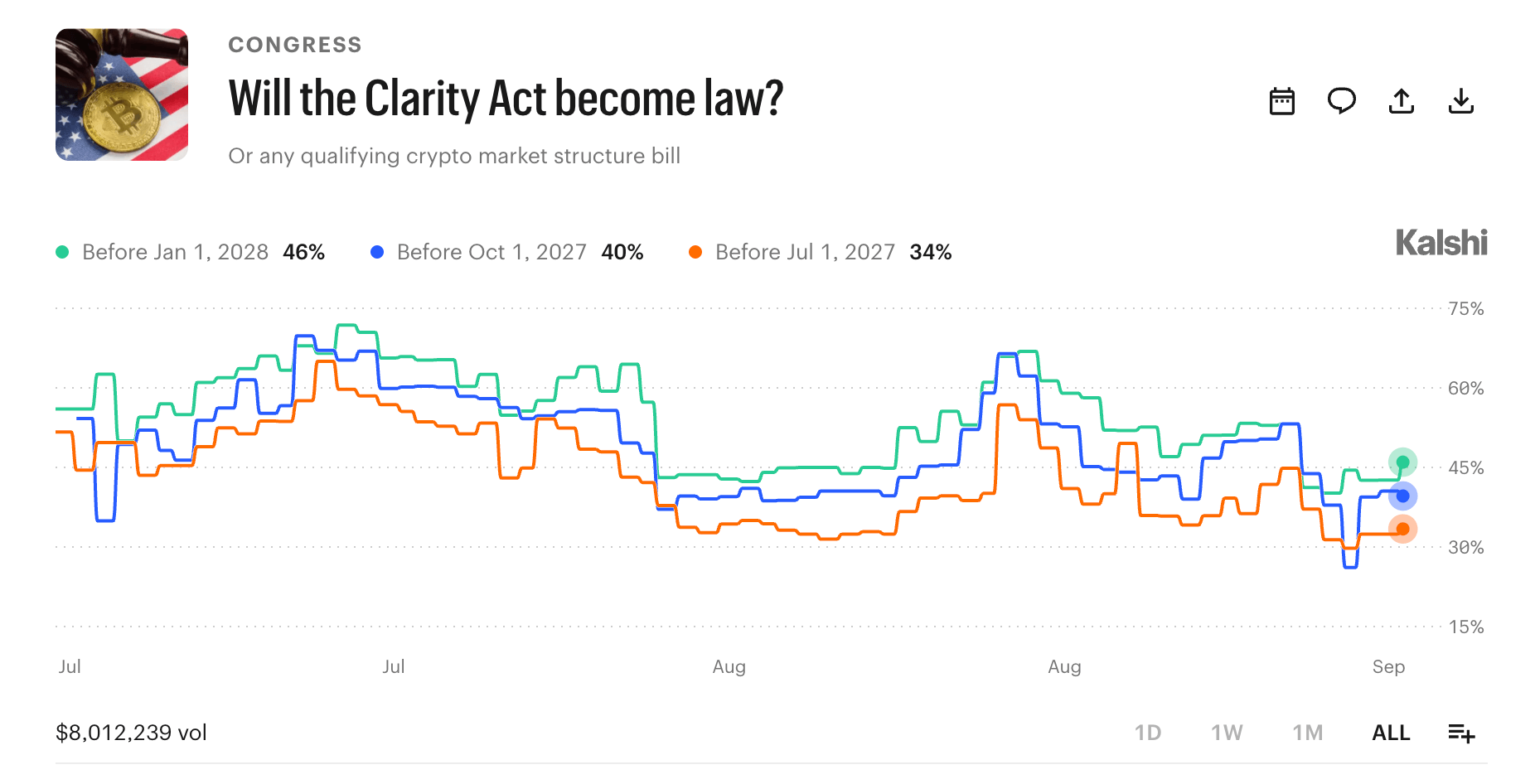
Kalshi traders aren’t particularly optimistic about a quick rescue, either. The platform prices comprehensive crypto market structure legislation at a 34% chance of enactment before July 1, 2027, 40% before Oct. 1 and 46% before Jan. 1, 2028. More than $8 million has traded across that market. Put another way, even when traders are given until 2028, the odds still don’t quite reach a coin flip.
Polymarket’s senator-by-senator market gets even more interesting. It gives Gallego a 20% implied chance of voting yes on final passage, Warner 18%, Cortez Masto 12% and Gillibrand 39%. Fetterman sits at 31%, Rosen at 22% and Padilla at 19%. These contracts concern final passage rather than Tuesday’s cloture vote, but they offer a pretty blunt snapshot of how traders see the Senate math.
Seven Votes Between 630 Pages and the Trash Can
That brings everything back to Tuesday. The revised CLARITY Act now contains hundreds of pages defining how U.S. digital asset markets could be regulated, more than 100 Democratic-directed changes, $150 million for the CFTC and new rules covering fraudsters, platforms and DeFi. The House has already approved the legislation, and the Senate Banking Committee has moved its version forward.
Yet none of that guarantees the next 60 votes. Lummis is trying to turn the Democrats’ own requested revisions into political leverage, essentially arguing that walking away now means walking away from language they helped write. Democrats still have an answer: The part they’re fighting over isn’t settled.
Meanwhile, prediction markets have already placed their bets. Polymarket says 22% for enactment this year. Kalshi doesn’t get to 47% even when the clock stretches to 2028. So after 630 pages, more than 100 changes and months of negotiations, the future of U.S. crypto market structure may come down to something considerably smaller. Seven senators.