

L-BTC Peg-Out Still Shut Down as Blockstream Refuses Hacker Demand – Bitcoin News
Key Takeaways
Liquid’s hackers gave back 3,400 BTC, but they’re still sitting on 598.50 BTC worth over $45 million.Blockstream says L-BTC’s 1:1 peg is covered, but 11 days later, holders still can’t use peg-outs.Liquid, Symbiosis and Nomic have now faced 3 exploits, putting BTC-backed projects under the microscope.
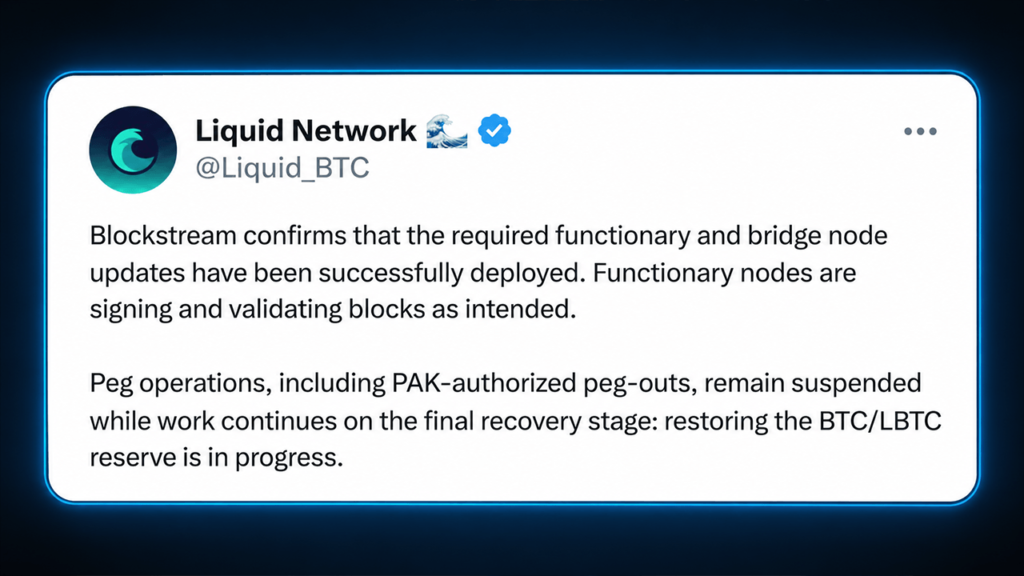
Following the Sept. 6 exploit, around 85% of the drained bitcoin has been returned, but the remainder is still held by the protocol’s attackers. Blockstream, Liquid Network’s maintainer, has refused to pay for the remaining coins and wants the 598.50 BTC returned. The Liquid Network’s L-BTC reserves still have a hole, as the protocol shows 4,234.76 L-BTC in circulation, but there’s only 3,632.23 BTC held.
Liquid’s Peg-Outs Remain Frozen as 598.50 BTC Stays With Hackers
While the Liquid Network has resumed, L-BTC peg-outs are still shut down, and Sideswap disclosed that “L-BTC cannot yet be redeemed for bitcoin.” Sideswap added that “Blockstream has said the peg will be covered 1:1 and peg-out returns in a later step.” Blockstream founder Adam Back posted on X and insisted that the 1:1 L-BTC to BTC peg will be covered, and he told holders not to dump L-BTC over-the-counter (OTC) at a discount.
There has been no official “peg-out is live” post since then. The hackers continue to see a large slew of OP_RETURN messages onchain, including encrypted messages that cannot be seen unless you have the private key. The wallet has also been hit with poisoning attacks, where scammers generate a fraudulent wallet address that visually mirrors the first and last characters of a legitimate address held by the owner.
The entity or attackers that created the poison wallets hope the owner inadvertently copies and pastes the spoofed address from their recent transaction ledger the next time they transfer funds, which permanently diverts the assets to them. In addition to alleged poisoning attacks flagged by blockchain explorers like mempool.space, there’s also a wide range of scammy messages sent to the Liquid Network hacker’s wallet.
BTC-Backed Projects Face a Growing Trust Problem
What happens next is anyone’s guess. Moreover, the Liquid Network hack was also followed by exploits against Symbiosis’s bitcoin bridge and an attack against Nomic’s nBTC. All three put a bad taste in people’s mouths in regard to BTC-backed token projects, bridges, and layer two (L2) platforms. Lightning Network capacity dipped from 3,850 BTC at the end of August to the current 3,720 BTC.
The Liquid hacker saga is still not over, but it exposes an uncomfortable truth. BTC-backed token protocols wholeheartedly rely on fragile human trust and slow governance. Blockstream’s refusal to concede puts L-BTC holders in a state of paralysis until something is worked out. If attacks, discovered exploits, and AI-assisted contract drains like these continue, BTC-backed projects and L2s will start looking less like innovation and more like a hostage negotiation.