
Bitcoin Behemoths Strategy and IBIT Amass 1.65 Million BTC Worth $140B
Key Takeaways
Strategy’s record 848,000 BTC is worth $72.23 billion at $85,179 per coin.IBIT holds 805,222.42 BTC, but in-kind outflows don’t necessarily mean bitcoin sales.Strategy and IBIT control 1.65 million BTC, or 7.87% of Bitcoin’s 21 million supply cap.
Strategy and Blackrock’s Bitcoin Trust ETF, dubbed IBIT, have quietly arrived at a rather extraordinary destination. Strategy owns 848,000 BTC, while IBIT holds 805,222.42 BTC. After the latest Strategy purchase, just 42,777.58 BTC separates the two, meaning a public company and a single ETF trust now command roughly comparable mountains of bitcoin.
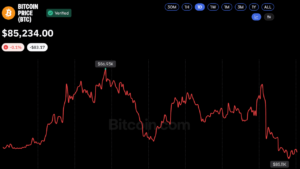
At the recent bitcoin price of $85,179 per coin on Monday, Strategy’s pile is worth about $72.23 billion and IBIT’s roughly $68.59 billion. Together, that’s $140.82 billion. But give the machinery underneath those numbers the once-over and the resemblance disappears fast. Strategy’s pile belongs to a corporate treasury vehicle. The other, IBIT’s ETF, backs shares in a Delaware statutory trust.
Two Bitcoin Giants
The digital asset treasury (DAT) firm Strategy’s 848,000 BTC is actually a fresh company record. Its latest purchase added 334 BTC for $28.7 million at an average $85,838.80 per coin, including fees and expenses, pushing holdings from 847,666 BTC to exactly 848,000 BTC.
Strategy reports an aggregate acquisition cost of about $63.97 billion and an average purchase price of $75,440.70. At $85,179, its stash sits roughly $8.26 billion above that reported cost—a rebound after being underwater earlier this year as the price of bitcoin tumbled.
IBIT’s number comes with a twist. Blackrock’s ETF cache of 805,222.42 BTC is enormous, but it isn’t a record. The trust topped 806,000 BTC earlier this year in April and held 805,466.7097 BTC on Oct. 13, 2025. Today’s balance is therefore close to its historical high-water mark without actually setting one.
Together, Strategy and IBIT control 1,653,222.42 BTC, equal to roughly 7.87% of Bitcoin’s theoretical 21 million maximum supply. Strategy is only about 5.3% larger than IBIT by coin count. With Bitcoin becoming scarcer by the day, these two behemoths represent an extremely large share of BTC’s supply.
IBIT’s Bitcoin Isn’t Blackrock’s Corporate Treasury
Calling the 805,222 BTC “Blackrock’s bitcoin” works as shorthand, but technically misses an important distinction. IBIT is a Delaware statutory trust whose investors own shares representing fractional beneficial interests in its net assets. The trust owns the bitcoin. Blackrock doesn’t hold those coins as a corporate treasury asset the way Strategy does.
Coinbase Custody Trust Company is IBIT’s primary bitcoin custodian, while Anchorage Digital Bank became an additional custodian in April 2025. Blackrock has said Coinbase is responsible for safeguarding the bitcoin and that it had no current plans to transfer IBIT coins to Anchorage. Bank of New York Mellon handles cash custody and administration, while Coinbase Prime serves as the Prime Execution Agent.
Strategy spreads its eggs among more baskets. Its disclosed custodians are Coinbase Custody, Anchorage Digital, and Fidelity Digital Assets. A July 24 snapshot, when Strategy held 843,775 BTC, showed 350,471 BTC at Coinbase, 325,689 BTC at Anchorage, and 167,615 BTC at Fidelity. Those dated figures shouldn’t be applied directly to today’s 848,000 BTC because Strategy can move coins among custodians, and the company made a few sales this year.
The ETF Exit Door Isn’t Open to Everybody
An ordinary investor holding IBIT shares cannot stroll up to Blackrock, hand over the stock, and walk away with bitcoin. IBIT creates and redeems shares through 40,000-share blocks known as Baskets. Only Authorized Participants can deal directly with the trust at that level. Its roster includes Wall Street heavyweights such as Goldman Sachs, JPMorgan Securities, Citigroup Global Markets, Jane Street Capital, BofA Securities, UBS Securities, and Virtu Americas.
The club gets smaller when actual bitcoin enters the picture. IBIT identifies Jane Street Capital, Virtu Americas, JPMorgan Securities, and Marex Capital Markets as participants with agreements permitting in-kind bitcoin creations and redemptions. That mechanism became possible after the Securities and Exchange Commission (SEC) approved in-kind creations and redemptions for crypto exchange-traded products on July 29, 2025.
An IBIT Outflow Doesn’t Necessarily Mean Bitcoin Was Sold
This is where things get interesting. Under a cash creation, an authorized participant brings cash into the process and IBIT ultimately needs bitcoin corresponding to the new shares. Under an in-kind creation, bitcoin itself can be delivered into the trust in exchange for ETF shares. Of course, not all the players have the means to do this.
The reverse-styled redemption matters even more. With a cash redemption, bitcoin associated with redeemed shares may need to be sold so cash can be returned. With an in-kind redemption, bitcoin itself can leave IBIT and be delivered against the redeemed basket. No bitcoin sale is inherently required.
That knocks the old assumption that “ETF inflow equals bitcoin bought” and “ETF outflow equals bitcoin sold” off the beam. IBIT’s balance can rise because an institution delivered coins it already owned. It can fall because bitcoin was transferred out rather than sold on the spot market. The coins simply change hands.
Strategy Plays an Entirely Different Game
Strategy has no authorized participants, ETF baskets, or mechanism allowing an MSTR shareholder to exchange stock for a piece of the company’s 848,000 BTC. Basically, the board and management call the shots on the treasury.
The company also takes a conservative approach to custody solutions. Substantially all of its bitcoin is held with U.S.-based custodians, with agreements generally calling for private keys to remain in cold storage. Strategy says its due diligence covers key management, multifactor authentication, access controls and offline key storage. It also reserves the right to add or remove custodians and potentially use self-custody in the future.
IBIT has another wrinkle. Its 0.25% annual sponsor fee and certain expenses can be satisfied using bitcoin, meaning the amount of BTC backing each share gradually declines. An IBIT share, therefore, doesn’t represent a permanently fixed quantity of bitcoin.
$140 Billion, Two Completely Different Machines
So, while the eye-popping number is 1.653 million BTC, the more interesting story is what happens when those coins move. Strategy decides what happens to its treasury. IBIT operates through an ETF creation-and-redemption machine in which approved institutions can move actual bitcoin through the wrapper.
Two piles separated by only 42,777.58 BTC. On paper, they look like neighbors. Under the hood, they might as well live across town.