
Google Achieves ‘Magic State’ Quantum Breakthrough; Top 5 Quantum-Proof Blockchains to Watch
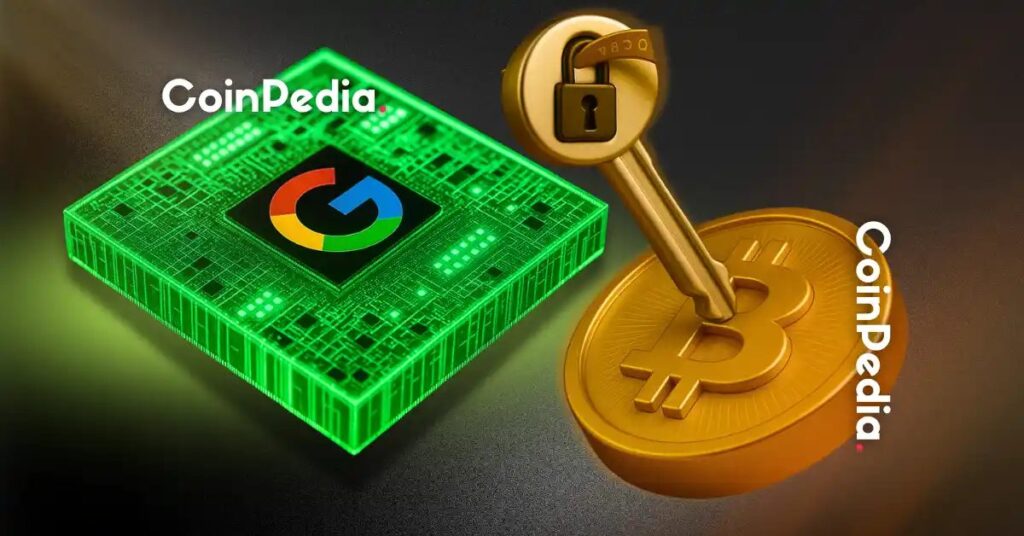
Google has achieved the “magic state cultivation” breakthrough, once again raising curiosity about the leading quantum-ready blockchains and cryptocurrencies in the digital ecosystem.
Google’s quantum milestone and its impact on blockchain
Google has accomplished a 99.99% accuracy in producing magic states, a key ingredient required by a quantum computer for it to produce meaningful results.
According to the Google Quantum AI paper published in Science journal, the company is now able to implement magic state cultivation on its Willow quantum processor, with a 40-fold reduction in errors compared to uncultivated states.
Previously, making magic states for a fault-tolerant quantum computer demanded 95% of its capacity, leaving just 5% for computation. Google’s development utilizes only about half of the 105 physical qubits of the computer, making it more efficient at a lower cost.

Google’s milestone achieved a magic state error of 1 in 10,000. Cryptocurrencies remain safe for now because breaking the Elliptic Curve Cryptography (ECC) that secures wallets and signatures requires the current architecture to be scaled by 100,000x. Additionally, breaking Bitcoin would require at least 1,200-1,450 stable logical qubits against the current 105.
Quantum-proof blockchains
With the development bringing us a little closer to Q-Day, several blockchains have already implemented the Post-Quantum Cryptography (PQC) measures approved by the National Institute of Standards and Technology (NIST).
Quantum Resistant Ledger (QRL)
This is one of the networks built with native quantum resistance from the very beginning, eliminating the need for future hard forks to patch weak points. It uses a hash-based cryptographic method and has been live since 2018. According to the Blockchain Quantum Readiness Index, it is one of the most quantum-safe of all blockchains in the ecosystem.
Algorand (ALGO)
Algorand has the highest market cap ($1.07 billion) on the list because it is a well-established institutional-grade Layer-1 ecosystem. It utilizes lattice-based digital signatures to enforce quantum security.
Abelian (ABEL)
This is a Layer-1 blockchain also designed from the ground up with lattice-based cryptography and customizable levels of privacy.
Mochimo (MCM)
Mochimo is a native post-quantum network running a live mainnet since 2018 with hash-based cryptography.
QANplatform (QAN)
This is a developer-focused Layer-1 network that incorporates both lattice-based and hash-based mechanisms to protect EVM-compatible smart contracts.
Others closely following are Cellframe (CELL) and Nervous Network (CKB). Meanwhile, leading cryptocurrencies Bitcoin and Ethereum both have quantum security execution proposals. The latter has one of the most active roadmaps for this particular goal.
Was this writing helpful?
Story Ends Here
Trust with CoinPedia:
CoinPedia has been delivering accurate and timely cryptocurrency and blockchain updates since 2017. All content is created by our expert panel of analysts and journalists, following strict Editorial Guidelines based on E-E-A-T (Experience, Expertise, Authoritativeness, Trustworthiness). Every article is fact-checked against reputable sources to ensure accuracy, transparency, and reliability. Our review policy guarantees unbiased evaluations when recommending exchanges, platforms, or tools. We strive to provide timely updates about everything crypto & blockchain, right from startups to industry majors.
Investment Disclaimer:
All opinions and insights shared represent the author’s own views on current market conditions. Please do your own research before making investment decisions. Neither the writer nor the publication assumes responsibility for your financial choices.
Sponsored and Advertisements:
Sponsored content and affiliate links may appear on our site. Advertisements are marked clearly, and our editorial content remains entirely independent from our ad partners.
Read the Next News