

Who’s Next? OneKey CEO Warns Hackers Will Target Blackrock’s Bitcoin ETF
Key Takeaways
OneKey CEO warns BlackRock’s IBIT could be North Korea’s next crypto hack target after the Binance breach.IBIT’s sole reliance on Coinbase creates a single failure point for its massive $63B Bitcoin holdings.Unlike stablecoins, stolen BTC cannot be frozen, and limited insurance leaves ETF holders vulnerable.
BlackRock’s IBIT on North Korean Hackers’ Shortlist, Says OneKey Founder
As the crypto industry still recovers from Thursday’s $6.3 billion hack of Binance, the largest cryptocurrency exchange, industry heads speculate on which entity North Korean hackers will target next.
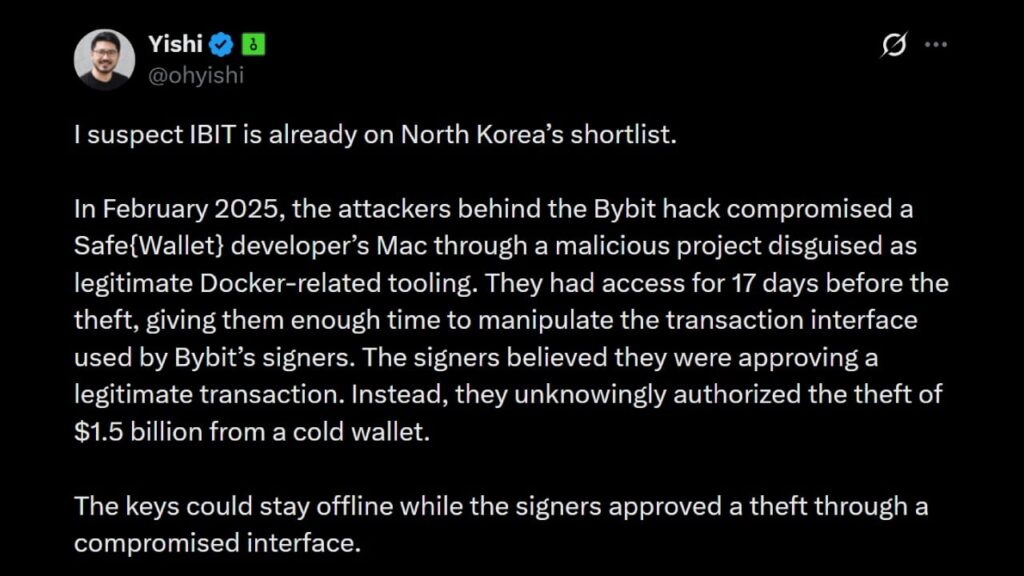
Yishi Wang, founder and CEO of OneKey, a Hong Kong-based open-source hardware wallet company, believes BlackRock’s iShares Bitcoin Trust (IBIT)—the world’s largest bitcoin exchange-traded fund (ETF)—might be the next target of these threat actors.
On social media, Wang highlighted that as the largest fund of its kind, IBIT held 815K BTC, worth nearly $63 billion, becoming a large target for threat actors. The fund has Coinbase as its sole custodian, which Wang qualifies as an extraordinary concentration for just one entity.
“Regardless of how large or well-funded that provider is, a critical failure in its security infrastructure could put the entire fund at risk,” he declared.
Wang highlighted that if IBIT faced a similar attack to the one Binance suffered on Thursday, it would wipe out 9.5% of the fund’s assets, causing losses that could be socialized at $4 per share at current valuations.
To make matters worse, an attack on IBIT would compromise only BTC, which cannot be blocked by centralized issuers. Shortly after Binance’s hack, Circle and Tether collectively froze over $2.3 billion in swiped stablecoins, cushioning the company from further losses.
Furthermore, while Coinbase has disclosed $320 million in criminal insurance coverage, Wang said this is shared across its customers, with custody agreements limiting liabilities to $100 million per cold storage address. If a major attack were to happen, then IBIT holders would bear the brunt of the loss.
While Bitcoin ETFs are convenient for institutions and individuals who don’t want to bear the burden of self-custody, they are not a final solution to the digital asset vulnerability problem.
“The larger these pools become, the more attractive they are to attackers. A compromise at any critical point could have consequences far beyond a single institution,” Wang assessed, as even the most sophisticated setups will depend on several factors that could be vulnerable.
“There are no silver bullets in security, and no permanent guarantees. Stay vigilant, keep verifying, and never mistake a clean track record for proof that you’re safe. Bunker mode,” he concluded, referring to the term recently coined by blockchain researcher Justin Drake.