

Kava Lend Exploit Drains $3.8M in KAVA as Token Price Plunges Nearly 40%

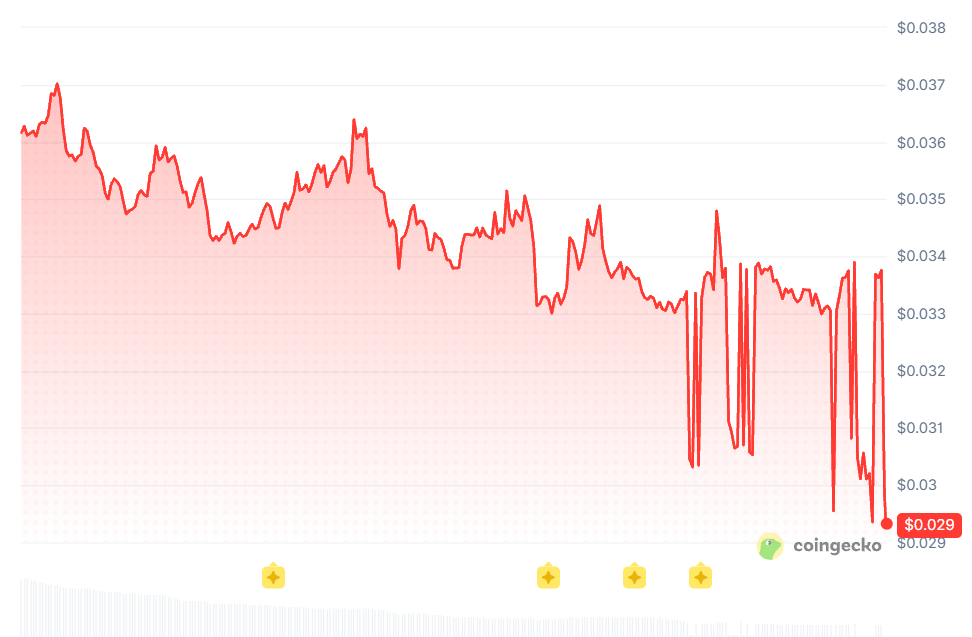
Kava Lend, the decentralized lending protocol operating on the Kava blockchain, has suffered an exploit that allowed an attacker to drain approximately 55.2 million KAVA tokens, worth around $3.76 million before the incident. The attack triggered a sharp sell-off, sending KAVA down nearly 40% as concerns spread across the ecosystem.
The exploit occurred late Friday, November 13, and involved manipulating a largely inactive BUSD lending market to artificially inflate the value of deposited collateral. The attacker then repeatedly borrowed KAVA against the inflated deposits, according to on-chain data reviewed by The Block.
Approximately 49.2 million of the stolen tokens were subsequently transferred to BNB Chain through LayerZero, where most were sold for roughly $2.1 million in BNB and USDT. Kava confirmed the incident but said it was contained within Kava Lend and did not involve an unlimited token mint.
Kava Lend Exploit Targets Dormant BUSD Market
The attack exploited a weakness in Kava Lend’s BUSD market, which had very little activity and liquidity before the incident. BUSD, the Binance-branded stablecoin issued by Paxos, has not been minted since 2023. However, its market remained operational on Kava Lend, creating an opportunity for the attacker to manipulate the protocol’s calculations.
According to the public source code, Kava Lend calculates deposit interest using the market’s net supply. Although the system prevents calculations when that figure reaches exactly zero, it does not adequately account for extremely small positive values. The attacker reportedly used a small BUSD loan to reduce the market’s net supply to an almost negligible amount. This caused the protocol to dramatically overestimate the value of deposits, multiplying their recorded value by approximately 243,000 times.
As a result, collateral deposited by the attacker was treated as worth roughly 1.25 billion BUSD, despite its actual value being substantially lower. The inflated collateral then allowed the attacker to borrow large quantities of KAVA from the lending pool.
Attacker Borrows 55.2 Million KAVA and Moves Funds to BNB Chain
After manipulating the BUSD market, the attacker borrowed KAVA 127 times, using a second account to clear individual loans and bypass the protocol’s borrowing limits.
On-chain activity suggests the operation was prepared in advance. The attacker had reportedly conducted repeated deposit and borrowing transactions in the BUSD market beginning November 8, several days before the exploit. The consequences became visible when Kava Lend’s pooled account, which held approximately 55.33 million KAVA before the incident, was left with just 0.19 KAVA.
At around 4:59 a.m. ET on Saturday, the attacker began transferring the stolen tokens to BNB Chain through Kava’s LayerZero bridge. Approximately 49.2 million KAVA was moved across the network, with most of it sold within an hour. The transactions generated roughly 3,006.5 BNB and 231,557 USDT, worth approximately $2.09 million combined. Another 4.58 million KAVA was distributed across five addresses that had not been identified publicly.
KAVA Falls Nearly 40% as Exchanges Suspend Transfers
The exploit triggered an immediate reaction across the Kava ecosystem, with KAVA experiencing a sharp decline in market value.
The token was trading near $0.042 at the time of the report, representing a drop of approximately 39% over 24 hours. Before the attack, KAVA was valued at around $0.068, placing the 55.2 million drained tokens at approximately $3.76 million.
Several partner exchanges also suspended KAVA deposits and withdrawals as a precautionary measure. Kava described the exchange restrictions as standard security measures following the incident.
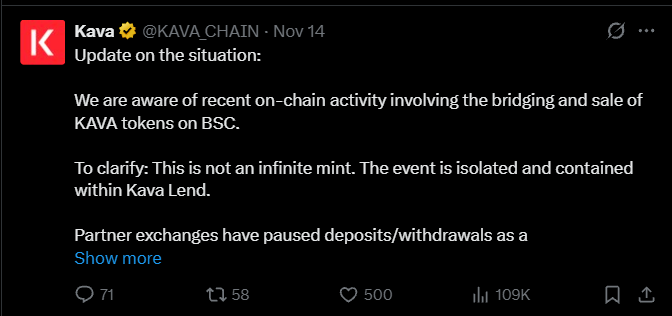
The team additionally announced that it had paused the Axelar bridge to reduce potential risks while investigating the situation. Although the stolen tokens were transferred through LayerZero rather than Axelar, the decision was presented as a precaution.
Kava stated that the incident was isolated to Kava Lend and emphasized that it did not involve an infinite mint. However, the project had not published an official loss assessment or a complete post-incident report at the time.
Kava Exploit Adds to Growing DeFi Security Concerns
The incident highlights the risks associated with poorly maintained lending markets and vulnerabilities in the calculations used by decentralized finance protocols.
Dormant markets can remain exposed even when their underlying assets have little liquidity or trading activity. In this case, an extremely small net supply value allowed the attacker to manipulate collateral calculations and borrow tokens against deposits that were significantly overvalued.
For Kava, the immediate priorities will be completing its investigation, assessing the impact on users, and explaining how the vulnerability will be addressed. The recovery of KAVA’s market value may also depend on whether the team can restore confidence in the protocol and provide greater clarity about potential losses.
Are dormant lending markets becoming a major security weakness for DeFi protocols, and should platforms disable markets with little or no activity?

Editorial Process for bitcoinist is centered on delivering thoroughly researched, accurate, and unbiased content. We uphold strict sourcing standards, and each page undergoes diligent review by our team of top technology experts and seasoned editors. This process ensures the integrity, relevance, and value of our content for our readers.