
What Investors Need to Know Now

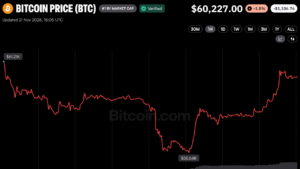
Bitcoin’s sell-off has entered a critical phase after BTC plunged below $58,000, extending its decline to levels last seen in September 2024. The cryptocurrency has fallen sharply from its record high, while persistent selling threatens to extend its weekly losing streak to seven weeks.
The breakdown is coinciding with a broader retreat from risk assets, heavy Bitcoin ETF withdrawals and mounting concerns over technology-stock valuations. With several major support levels now broken, investors are increasingly watching whether Bitcoin price can stabilize or whether the next leg of the correction could take prices toward $50,000.
Why Is Bitcoin Crashing Below $58,000?
Bitcoin’s latest decline reflects a broader deterioration in risk appetite across financial markets. A sharp sell-off in AI and technology stocks has triggered investors to reduce exposure to volatile assets, with cryptocurrencies facing additional pressure from institutional withdrawals and leveraged liquidations.
The institutional demand picture has also weakened significantly. US spot Bitcoin ETFs recorded approximately $582 million in net outflows in a single session, while BlackRock’s IBIT accounted for around $541 million of the withdrawals. November ETF outflows have approached $3.5 billion, removing a major source of buying support from the market.

Meanwhile, falling prices have triggered liquidations of leveraged positions, accelerating Bitcoin’s downward momentum. The combination of ETF redemptions, weaker equity markets and forced selling has created a difficult environment for BTC bulls.
Bitcoin Price Analysis: Can BTC Defend $55K?
Bitcoin’s daily chart shows a decisive breakdown from its previous consolidation range. BTC initially lost support around the $75,000 region before accelerating lower through the $68,000–$64,000 zone. The subsequent breakdown below $60,000 further weakened the technical structure.
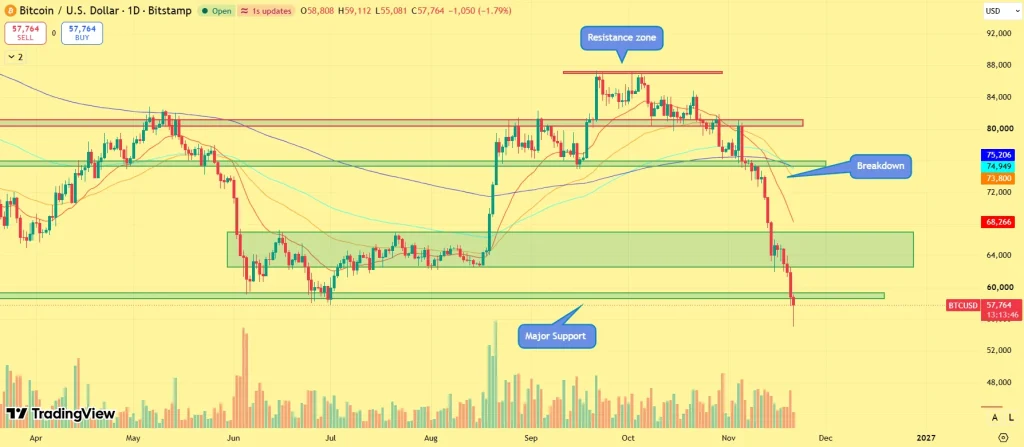
The latest move below $58,000 leaves Bitcoin trading near a critical support region, with the $50,000 level emerging as the next major downside target if selling pressure continues. Bitcoin’s ability to reclaim $60,000 could provide short-term relief. However, a broader recovery would require BTC to regain previously broken support zones and attract renewed buying demand.
Is Bitcoin Headed for $50,000 Next?
The $50,000 level is increasingly entering the market conversation as Bitcoin loses support and momentum remains bearish. A sustained breakdown below the current support region could expose BTC to further downside, particularly if ETF outflows continue and global risk sentiment deteriorates.
However, an extended sell-off could also create conditions for a sharp relief rally as short positions increase and investors begin looking for value at lower prices. For now, Bitcoin’s immediate direction depends on whether buyers defend the $55,000–$58,000 region or selling pressure pushes BTC toward $50,000. Until key resistance levels are reclaimed, the technical outlook remains tilted toward the downside.
Was this writing helpful?
Story Ends Here
Trust with CoinPedia:
CoinPedia has been delivering accurate and timely cryptocurrency and blockchain updates since 2017. All content is created by our expert panel of analysts and journalists, following strict Editorial Guidelines based on E-E-A-T (Experience, Expertise, Authoritativeness, Trustworthiness). Every article is fact-checked against reputable sources to ensure accuracy, transparency, and reliability. Our review policy guarantees unbiased evaluations when recommending exchanges, platforms, or tools. We strive to provide timely updates about everything crypto & blockchain, right from startups to industry majors.
Investment Disclaimer:
All opinions and insights shared represent the author’s own views on current market conditions. Please do your own research before making investment decisions. Neither the writer nor the publication assumes responsibility for your financial choices.
Sponsored and Advertisements:
Sponsored content and affiliate links may appear on our site. Advertisements are marked clearly, and our editorial content remains entirely independent from our ad partners.
Read the Next News