
21shares Dissects Bitcoin’s Selling Spiral as the Market Eyes $53K
Key Takeaways
21shares attributes bitcoin’s steepest losses to weakening demand and forced selling rather than the Binance hack itself.November bitcoin exchange-traded fund (ETF) withdrawals have reached a record $4.71 billion as Monday’s Nvidia-driven rally evaporated.Kalshi traders assign a 59% probability to bitcoin falling below $55,000 before 2027.
21shares Identifies Three Forces Behind Bitcoin’s Deepening Bear Market
The Binance hack lit the match, but evaporating demand and excessive leverage supplied the fuel. In a research report published Tuesday, Nov. 24, crypto asset manager 21shares dissected the mechanics behind bitcoin’s latest downturn, identifying three distinct phases of market deterioration.
The market assessment, authored by Eliezer Ndinga with additional analysis from Karim Abdelmawla, Maximiliaan Michelsen and Matthew Mena, suggests the cryptocurrency economy remains vulnerable to prolonged defensive positioning.
Bitcoin initially lost 5.1% in the two days following the Binance breach before recovering to $80,488 by Nov. 4. Even by Nov. 9, the leading cryptocurrency remained just 7% below its pre-hack valuation. The analysis notes that the heavier damage followed as capital began draining from the market. Between Nov. 4 and 11, bitcoin fell 8.3% to $73,806 as stablecoin liquidity and institutional demand deteriorated.
Stablecoin supply contracted by $10.7 billion following the breach, marking the largest 18-day dollar-denominated reduction since Terra’s 2022 collapse. Exchange-held stablecoin balances declined 15%, while U.S. spot bitcoin and ethereum exchange-traded funds (ETFs) collectively lost $3.9 billion between Oct. 30 and Nov. 13.
Forced selling subsequently accelerated the decline. Bitcoin dropped another 13.5% between Nov. 11 and 14, with $1.6 billion in leveraged bitcoin longs liquidated over three days. Across cryptocurrency markets, weekly liquidations reached $5.8 billion through Nov. 15, with longs accounting for 81%.
Bitcoin’s Failed Nvidia Rally Exposes Fragile Demand
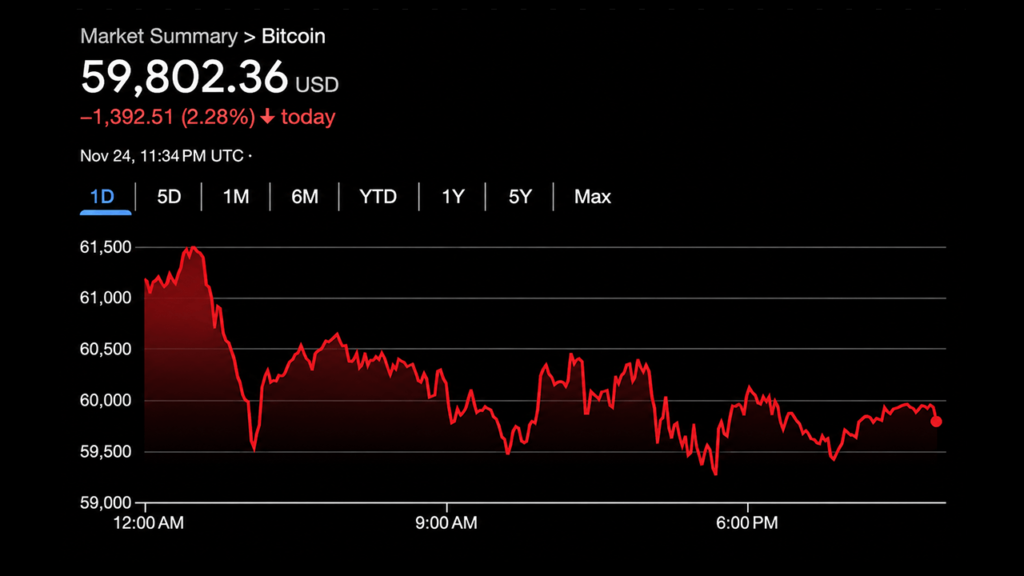
Monday’s trading session offered a timely illustration of the conditions described by the 21shares researchers. Bitcoin climbed to approximately $65,200 after Nvidia reinstated Jensen Huang as president and CEO, triggering a broad recovery across financial markets.
While technology stocks largely retained their gains, bitcoin surrendered its advance, returning back under the $60,000 region Tuesday afternoon. November’s institutional withdrawals have also reached unprecedented levels.
U.S. spot bitcoin ETFs recorded $569.7 million in withdrawals Monday, with Blackrock’s IBIT accounting for approximately $509 million. November’s cumulative outflows reached a record $4.71 billion.
Glassnode data indicates bitcoin investors are realizing their heaviest losses since the FTX collapse. “Bitcoin losses are the heaviest since FTX,” Glassnode analysts wrote on Tuesday. “Set against the money that flowed into Bitcoin over the past year, they have almost doubled in a week. Spikes like this often came close to past lows, but some came early.”
Meanwhile, Cryptoquant figures show long-term holders selling into the recovery at losses of approximately 33%. “Long-term holders sold at a 33% loss into bitcoin’s rebound, a level last seen at the June bottom,” Cryptoquant shared on X.
Community sentiment remains deeply fractured, with some cryptocurrency enthusiasts anticipating further capitulation toward $40,000 and others interpreting distressed selling as evidence that the prolonged bear market may be approaching exhaustion.
Bitcoin’s $53,250 Realized Price Emerges as Key Level
Having already breached $60,000, bitcoin faces another significant threshold identified by 21shares: its realized price of approximately $53,250. The metric measures bitcoin’s aggregate cost basis using the valuation at which coins last moved onchain.
Applying historical bear market discounts produces illustrative downside scenarios of $40,400 and $37,200. The researchers consider such declines relatively unlikely for now, citing institutional participation absent from earlier cycles.
Interestingly, the assessment follows 21shares’ Nov. 19 digital asset outlook, which anticipated a new bitcoin all-time high in 2027. As Bitcoin.com News previously reported, historical comparisons in that publication illustrated valuations between $129,000 and $146,000 by mid-2027.
The latest analysis does not explicitly abandon that longer-term outlook, instead emphasizing the immediate obstacles standing between bitcoin and a sustainable recovery.
Prediction Market Traders Anticipate a $53K Floor
Kalshi’s annual bitcoin minimum-price market, which has accumulated $9.91 million in trading volume, currently indicates a projected floor of $53,000, closely aligning with the realized price highlighted by 21shares. Participants assign a 59% probability to bitcoin falling below $55,000 before 2027, a 32% probability to breaching $50,000 and a 16% chance of slipping beneath $45,000.
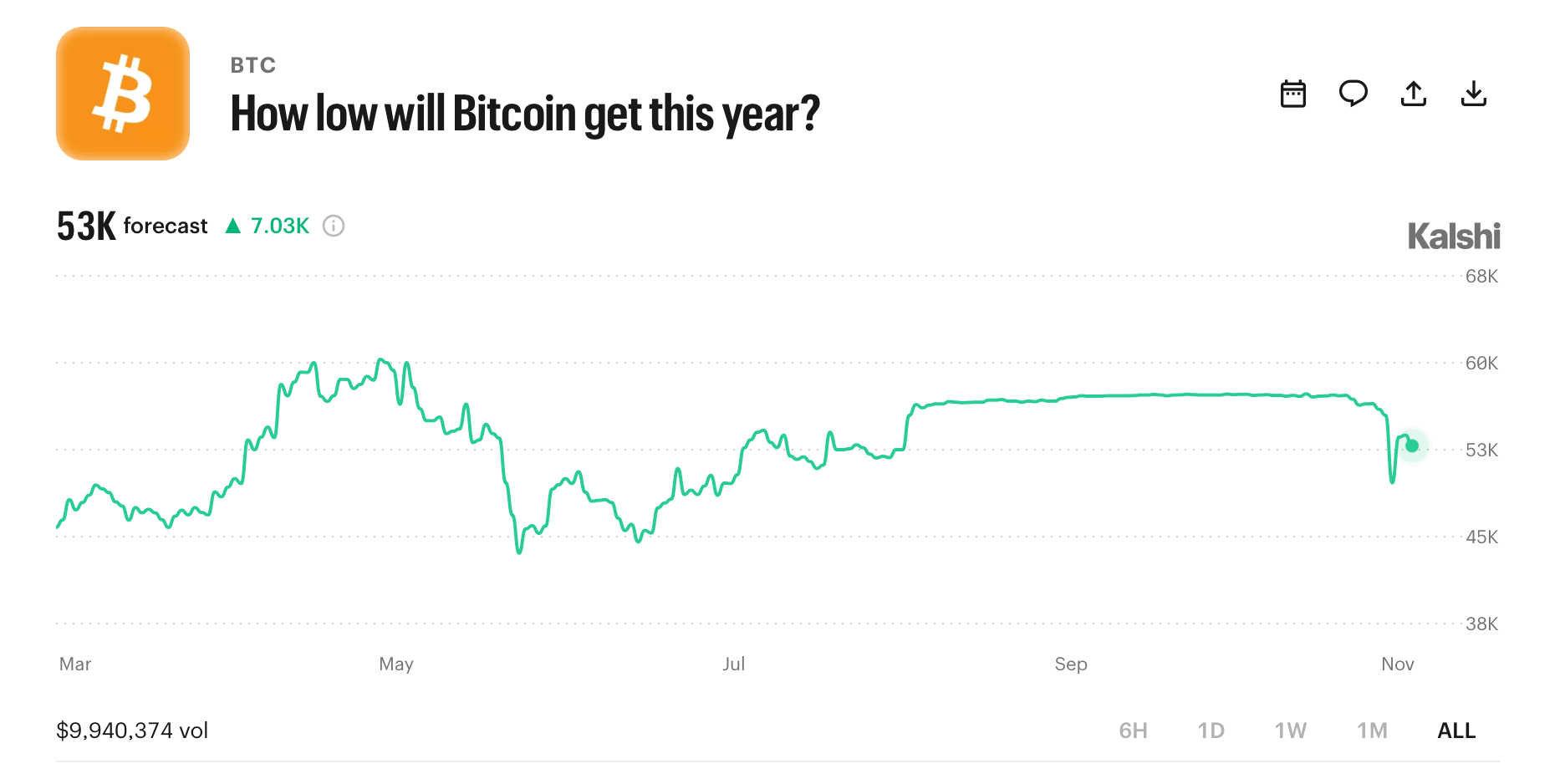
Kalshi’s November-specific market assigns a 27% probability to sub-$55,000 bitcoin before December, with nearly $2 million in trading volume. On Polymarket, traders assessing bitcoin’s price at noon Eastern time on Dec. 1 favor two adjacent brackets: $58,000 to $60,000 and $60,000 to $62,000, each carrying a 19% implied probability. However, the market’s modest $1,456 trading volume warrants caution when interpreting those readings.
Bitcoin Veterans Debate What Could Ignite the Next Bull Market
The deteriorating market has also reignited debate over bitcoin’s long-term investment thesis. Trinary AI co-founder and CEO Vinny Lingham took to X, questioning what catalysts remain after years of monetary expansion, institutional adoption, elevated inflation and declining bitcoin issuance. Lingham pointed out that bitcoin is trading below its valuation five years ago despite many of the bullish narratives from 2021 having materialized. “What’s the catalyst for the bull case in light of this?” he asked.
The question elicited divergent responses from industry veterans. Former Bitinstant CEO Charlie Shrem challenged the tendency to retrospectively assign catalysts to market cycles, stating, “We don’t know why those bull markets happened, we lived through them and then assigned reasons postmortem.” Stacks co-founder Muneeb Ali identified native bitcoin yield, credible quantum-resistant upgrades, artificial intelligence (AI) safeguards and the 2028 halving as potential catalysts.
Meanwhile, Bloomberg commodity strategist Mike McGlone, who has floated a $10,000 bitcoin price scenario, offered a decidedly more bearish perspective: “Don’t fight the Fed, especially with highly volatile and correlated to beta assets within a space of unlimited supply.”
For 21shares, expanding stablecoin liquidity and sustained ETF inflows remain essential ingredients for a meaningful reversal. Monday’s fleeting recovery demonstrated that favorable headlines can temporarily interrupt a bear market, but without fresh capital entering the cryptocurrency economy, even the most encouraging catalysts may accomplish little beyond postponing the next round of selling.