
Global Markets Bleed Trillions as Bitcoin, Gold and Wall Street Tumble
Key Takeaways
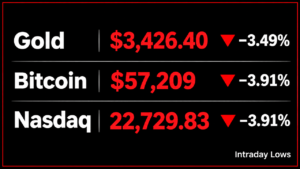
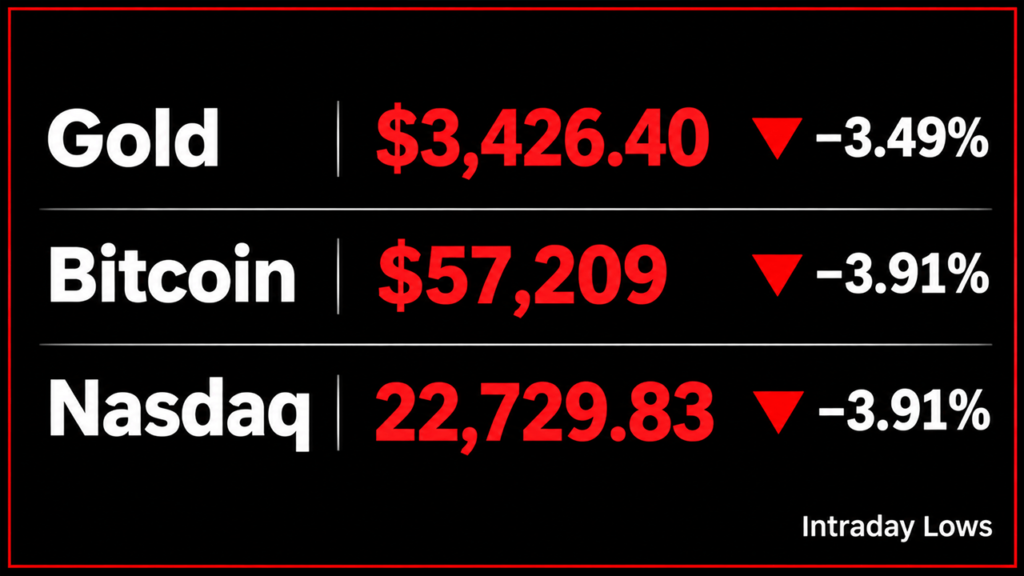
Just after 10 a.m., bitcoin’s price touched $57,209 on Bitstamp Wednesday as reported cryptocurrency liquidations reached $2.55 billion over 24 hours.The Nasdaq Composite fell 3.91%, while gold and silver shed 3.49% and 6.53%, respectively, during morning trading at 10:30 a.m. ET.Persistent inflation, artificial intelligence valuation concerns and a 94% probability of a December Federal Reserve rate hike intensified market pressure.
Global Market Rout Deepens as Investors Dump Stocks, Crypto and Precious Metals
Wednesday delivered another punishing session for investors as selling swept through virtually every major asset class ahead of Thanksgiving. Monday’s Nvidia-led recovery has largely disintegrated, leaving market participants confronting renewed concerns about artificial intelligence (AI) spending, monetary tightening and international trade.
At approximately 10:20 a.m. Eastern time, the Nasdaq Composite had fallen 3.91% to 22,806.06, while the S&P 500 shed 2.72% to 7,004.89. The Dow Jones Industrial Average declined 1.74% to 49,149.61, and the NYSE Composite dropped 0.92% to 23,139.59.
Earlier readings showed the S&P 500 breaking below 7,000 and the Nasdaq falling to 22,729.83. Still, the figures represent intraday observations rather than Wednesday’s closing valuations as the day’s session has just begun. The destruction extended well beyond Wall Street. U.S. equities saw nearly $2 trillion lost, precious metals like gold and silver shed nearly a trillion, and digital assets across the board tanked as well.
Bitcoin Breaks Below $58,000 as Gold and Silver Offer Little Refuge
Bitcoin (BTC) descended to $57,209 on Bitstamp Wednesday morning before recovering modestly to $57,746 at 10:30 a.m. Eastern time. The leading cryptocurrency by market valuation had traded above $61,000 Tuesday, while November’s accumulated losses have reached approximately 23%.
At the same time, the Crypto Fear & Greed Index registered 13 on Wednesday, indicating “extreme fear.” According to Coinglass data, derivatives liquidations reached $510.96 million over 24 hours on Wednesday morning, with 126,557 traders caught in the crossfire. Long positions accounted for $422.73 million, or 82.7% of the total, while short positions absorbed $88.23 million.
Bitcoin definitely led the liquidation tally with $172.40 million, followed by ethereum at $80.82 million and gold-linked contracts at $28.82 million. The largest individual liquidation occurred on Binance, where an $11.71 million bitcoin long position was wiped out at $57,693.01. In the preceding hour alone, traders suffered $168.57 million in forced liquidations.
Precious metals offered investors little shelter, according to stats collected by Kitco. At 10:20 a.m., spot gold’s bid price stood at $3,435.30 per ounce, down 3.49%, after touching $3,426.40. Silver declined 6.53% to $38.14, making it the worst performer among the five precious metals tracked in the supplied pricing data.
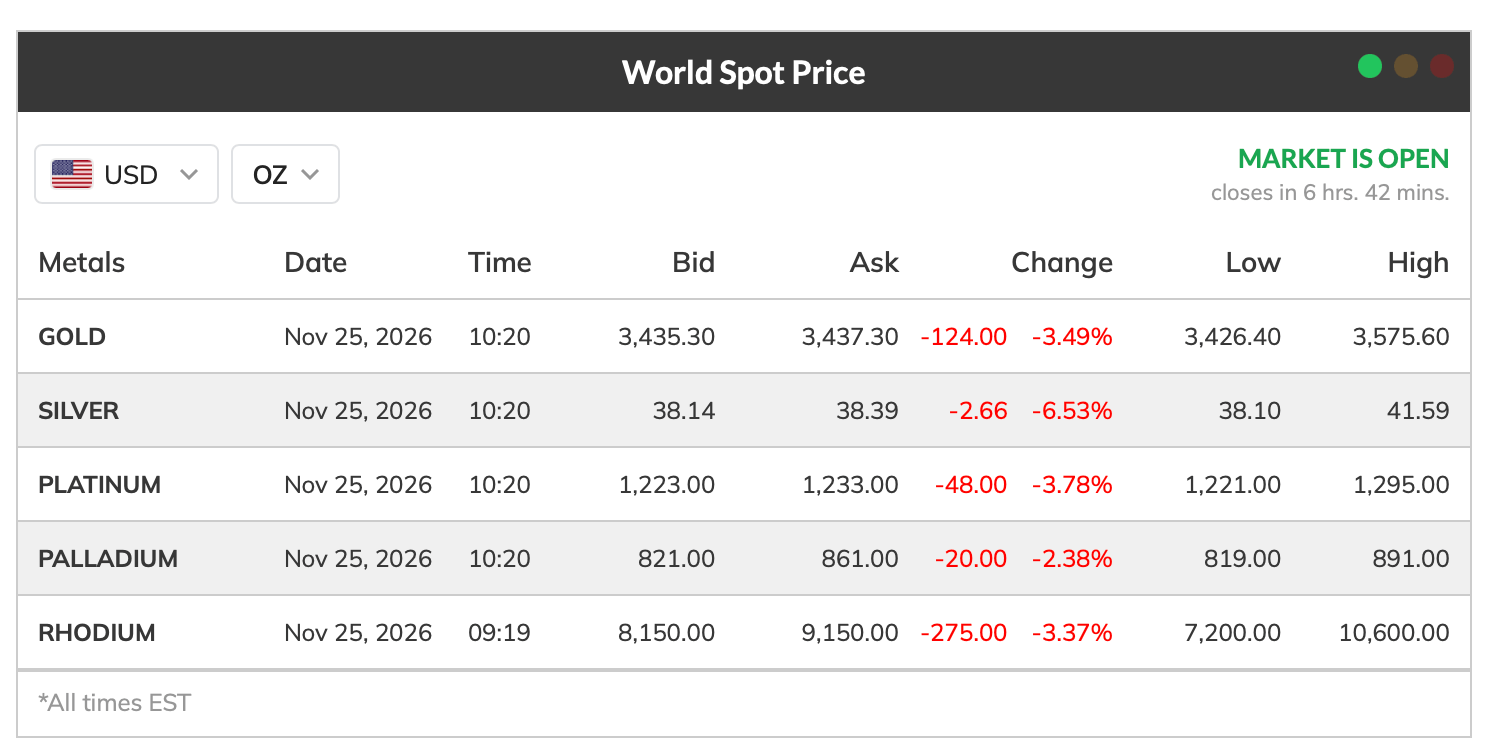
Platinum surrendered 3.78% to $1,223 per ounce, palladium lost 2.38% to $821 and rhodium declined 3.37% to $8,150. The simultaneous deterioration of speculative assets and traditional havens suggests investors may be prioritizing liquidity over portfolio diversification.
Selling gold alongside technology stocks and bitcoin is consistent with efforts to raise cash, reduce leverage or satisfy margin requirements, although price movements alone cannot establish investors’ motives.
AI Valuations, Inflation and Tariff Fears Batter Global Markets
Semiconductor stocks remained at the center of Wednesday’s equity rout. Nvidia fell approximately 8% during early trading after losing 6% Tuesday, effectively dismantling much of Monday’s extraordinary rally following Jensen Huang’s reinstatement as chief executive.
The Ishares Semiconductor ETF (SOXX) dropped 7%, while Advanced Micro Devices, Intel, Marvell, Applied Materials and Arm each registered declines exceeding 8%. The Cboe Volatility Index (VIX), commonly called Wall Street’s fear gauge, climbed nearly 20% to just below 32.
Economic figures complicated matters further. The personal consumption expenditures (PCE) price index increased 0.3% in October, bringing annual inflation to 3.8%. Core PCE inflation reached 3.3%, exceeding expectations, while third-quarter gross domestic product growth was revised upward to an annualized 4.3%.
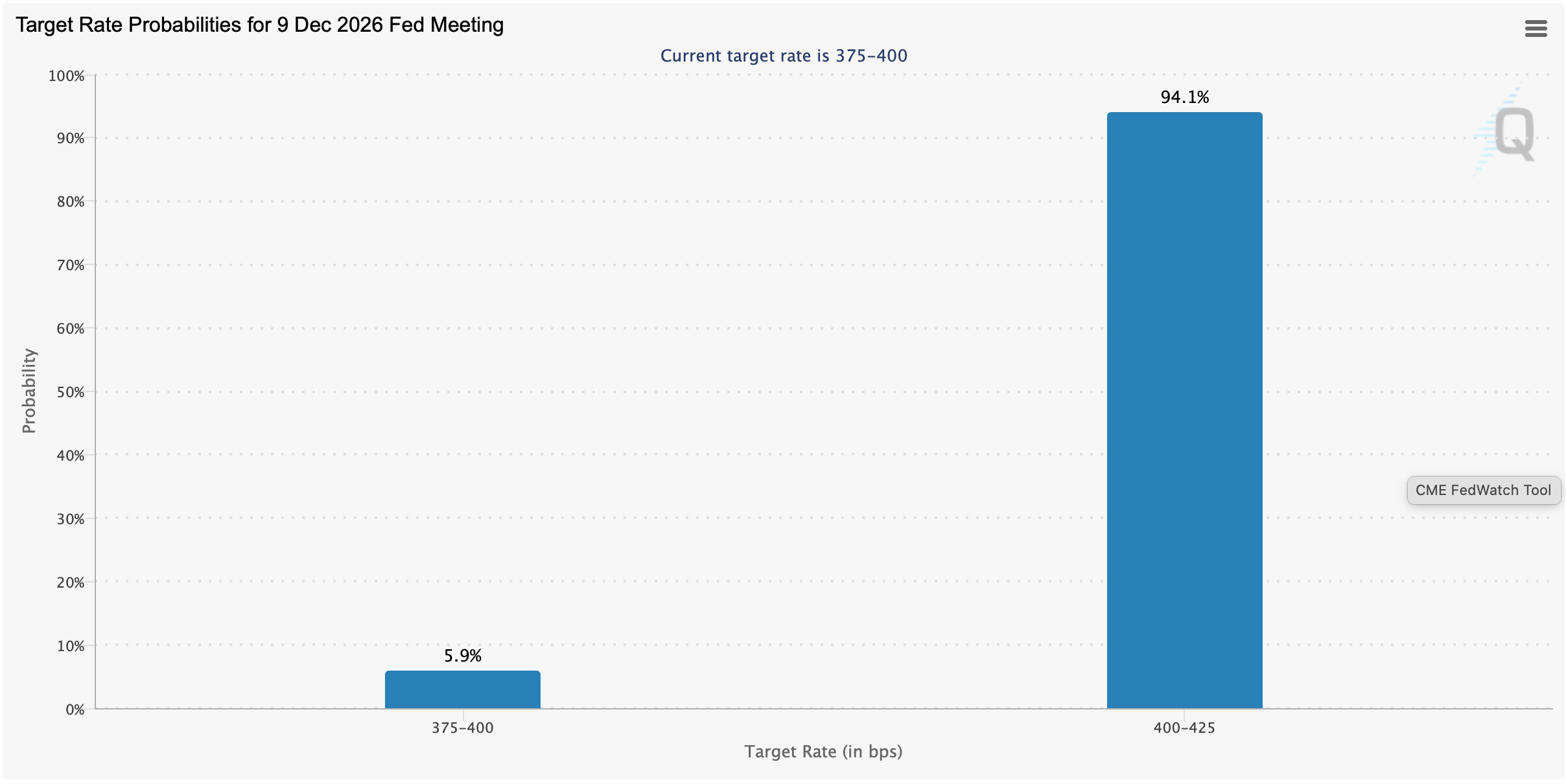
According to CME Fedwatch figures, traders assigned a 94% probability to a December interest rate increase and a 63% probability to another hike in January. Expectations of tighter monetary policy present another obstacle for assets whose valuations benefited from abundant liquidity.
International trade tensions compounded the pressure. Reuters reported that the U.S. Trade Representative’s office was preparing findings concerning excess industrial capacity among 16 trading partners, including China and the European Union, potentially paving the way for additional tariffs.
Government bonds provided a rare exception to Wednesday’s selling, with the 10-year U.S. Treasury yield retreating toward 4.83%.
With American equity markets closed Thursday and operating on a shortened schedule Friday, investors face diminished trading liquidity during an exceptionally turbulent period. Wednesday’s losses reveal a market increasingly concerned with capital preservation, where even assets traditionally purchased for protection are finding themselves on the liquidation block.
By 11 a.m., bitcoin’s price managed to climb back above the $58,000 line. How long that lasts is anyone’s guess. Curiously, despite the punishing market drawdown, TradFi giant JPMorgan still anticipates an AI supercycle in 2027.