
Bitcoin Market At Uncertain Phase As Stagflation Fears In The US Rises — Details
In their latest post on CryptoQuant, XWIN Research Japan explores how developing affairs in the United States could affect the trajectory of Bitcoin and other risk assets in the near-term. According to the education institute, concerns of a potential stagflation period have begun to come up, which could potentially boost or mar Bitcoin’s growth.
Unemployment Rate Rises To 4% As Inflation Builds Up
For context, stagflation is a rare economic condition that combines two concerning events at the same time: high inflation and high unemployment. In their QuickTake post on CryptoQuant, XWIN Research Japan reveals that the number of people who are employed in the United States declined by 92,000 in February, indicating a 4% rise in unemployment rates.
This was followed by a rising state of tension in the United States, owing to the geopolitical strife caused by a combined US-Israeli attack on Iran. This conflict has resulted in heightened oil prices, leading energy sources to become even more expensive. According to XWIN Research Japan, this increase in energy costs could also significantly trigger inflation, thereby completing the stagflation equation.
Notably, a shared historical example of stagflation occurred in the United States during the period of oil shocks in the 1970s; there was a surge of inflation into double digits, with unemployment rates following in such a destructive path. According to XWIN Research, the inflation was eventually subdued by the Federal Reserve Chairman Paul Volcker, who raised interest rates to nearly 20%, with a severe recession as the ensuing consequence.

How Bitcoin Has Fit Into Past Stagflation Periods
XWIN Research Japan further notes that the Bitcoin relationship with US stagflation is a complicated one, rather than a linear, straightforward relationship.
The analysts explain that the early phases of stagflation are marked by headwinds to risk assets. When inflation heightens sharply (as was seen in 2022), both the NASDAQ and the Bitcoin price would decline sharply, indicating that Bitcoin has attained a high-beta asset title.
However, the dynamic could see a quick turnaround in cases where stagflation triggers financial instability, as was the case in the 2023 US banking crisis. In this scenario, capital moved into high-risk assets like Bitcoin, causing a more than 80% bullish rally. Also, Bitcoin’s unique supply structure has to be considered while predictions are being made.
Unlike fiat currencies, the issuance of Bitcoin is in line with a fixed algorithm where periodic halving events reduce the rate of new supply entering circulation. This means that Bitcoin’s inflation rate continues to fall, thereby potentially increasing its appeal in a market where traditional currencies are suffering the effects of inflation.
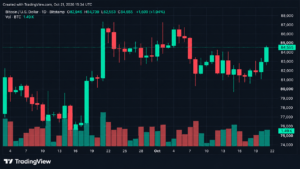
If this scenario holds now, the Bitcoin market could witness a significant amount of inflows in the mid term. As of this writing, Bitcoin trades for $68,225, recording a more than 4% loss since the past day.

Featured image from Flickr, chart from Tradingview

Editorial Process for bitcoinist is centered on delivering thoroughly researched, accurate, and unbiased content. We uphold strict sourcing standards, and each page undergoes diligent review by our team of top technology experts and seasoned editors. This process ensures the integrity, relevance, and value of our content for our readers.