
Agent-Infra Releases AIO Sandbox: An All-in-One Runtime for AI Agents with Browser, Shell, Shared Filesystem, and MCP
In the development of autonomous agents, the technical bottleneck is shifting from model reasoning to the execution environment. While Large Language Models (LLMs) can generate code and multi-step plans, providing a functional and isolated environment for that code to run remains a significant infrastructure challenge.
Agent-Infra’s Sandbox, an open-source project, addresses this by providing an ‘All-in-One’ (AIO) execution layer. Unlike standard containerization, which often requires manual configuration for tool-chaining, the AIO Sandbox integrates a browser, a shell, and a file system into a single environment designed for AI agents.
The All-in-One Architecture
The primary architectural hurdle in agent development is tool fragmentation. Typically, an agent might need a browser to fetch data, a Python interpreter to analyze it, and a filesystem to store the results. Managing these as separate services introduces latency and synchronization complexity.
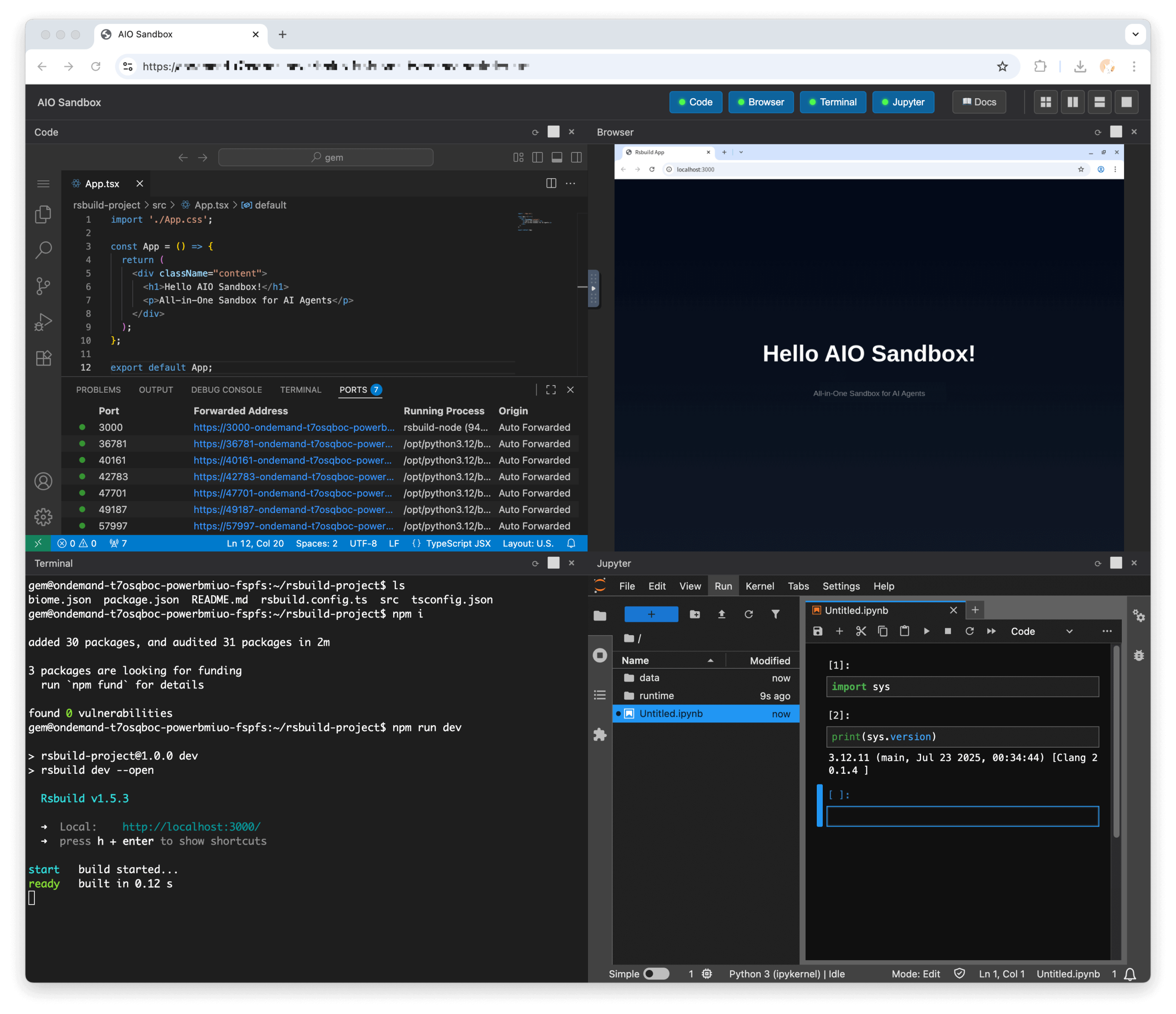
Agent-Infra consolidates these requirements into a single containerized environment. The sandbox includes:
Computer Interaction: A Chromium browser controllable via the Chrome DevTools Protocol (CDP), with documented support for Playwright.
Code Execution: Pre-configured runtimes for Python and Node.js.
Standard Tooling: A bash terminal and a file system accessible across modules.
Development Interfaces: Integrated VSCode Server and Jupyter Notebook instances for monitoring and debugging.
The Unified File System
A core technical feature of the Sandbox is its Unified File System. In a standard agentic workflow, an agent might download a file using a browser-based tool. In a fragmented setup, that file must be programmatically moved to a separate environment for processing.
The AIO Sandbox uses a shared storage layer. This means a file downloaded via the Chromium browser is immediately visible to the Python interpreter and the Bash shell. This shared state allows for transitions between tasks—such as an agent downloading a CSV from a web portal and immediately running a data cleaning script in Python—without external data handling.
Model Context Protocol (MCP) Integration
The Sandbox includes native support for the Model Context Protocol (MCP), an open standard that facilitates communication between AI models and tools. By providing pre-configured MCP servers, Agent-Infra allows developers to expose sandbox capabilities to LLMs via a standardized protocol.
The available MCP servers include:
Browser: For web navigation and data extraction.
File: For operations on the unified filesystem.
Shell: For executing system commands.
Markitdown: For converting document formats into Markdown to optimize them for LLM consumption.
Isolation and Deployment
The Sandbox is designed for ‘enterprise-grade Docker deployment,’ focusing on isolation and scalability. While it provides a persistent environment for complex tasks—such as maintaining a terminal session over multiple turns—it is built to be lightweight enough for high-density deployment.
Deployment and Control:
Infrastructure: The project includes Kubernetes (K8s) deployment examples, allowing teams to leverage K8s-native features like resource limits (CPU and memory) to manage the sandbox’s footprint.
Container Isolation: By running agent activities within a dedicated container, the sandbox provides a layer of separation between the agent’s generated code and the host system.
Access: The environment is managed through an API and SDK, allowing developers to programmatically trigger commands, execute code, and manage the environment state.
Technical Comparison: Traditional Docker vs. AIO Sandbox
Scaling the Agent Stack
While the core Sandbox is open-source (Apache-2.0), the platform is positioned as a scalable solution for teams building complex agentic workflows. By reducing the ‘Agent Ops’ overhead—the work required to maintain execution environments and handle dependency conflicts—the sandbox allows developers to focus on the agent’s logic rather than the underlying runtime.
As AI agents transition from simple chatbots to operators capable of interacting with the web and local files, the execution environment becomes a critical component of the stack. Agent-Infra team is positioning the AIO Sandbox as a standardized, lightweight runtime for this transition.
Check out the Repo here. Also, feel free to follow us on Twitter and don’t forget to join our 120k+ ML SubReddit and Subscribe to our Newsletter. Wait! are you on telegram? now you can join us on telegram as well.

Michal Sutter is a data science professional with a Master of Science in Data Science from the University of Padova. With a solid foundation in statistical analysis, machine learning, and data engineering, Michal excels at transforming complex datasets into actionable insights.