Revolut users report Bitcoin price glitch showing 2 cents before recovery

Imagine checking your portfolio and seeing Bitcoin priced at two cents. Not two thousand. Not two hundred. Two pennies. That’s what some Revolut users say they experienced on Friday, in what appears to be one of the more spectacular display glitches in recent crypto app history.
The price snapped back to normal levels almost immediately, and no major exchange tracked by CoinGecko or CoinMarketCap showed any corresponding anomaly. Bitcoin was trading just above $79,000 during Asian afternoon hours on Friday. The incident appeared entirely isolated to Revolut’s platform.
What actually happened
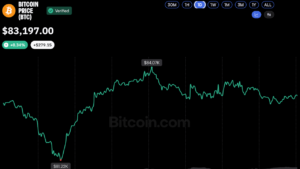
Revolut’s official Bitcoin page showed BTC briefly marked around £29,414 on its one-day chart before returning near £58,600. That alone would have been a jarring drop. But social media posts from users painted an even wilder picture, with some claiming they saw prices as low as $0.02.
CoinDesk reported it could not independently verify those near-zero prints or confirm whether any trades were actually executed at those levels. Revolut had not responded to CoinDesk’s request for comment by the time that report was published.
Some users on X claimed buy orders executed during the disruption. Those reports also remain unconfirmed. If trades were indeed filled at those levels, Revolut would face the unenviable task of determining whether the prints reflected legitimate liquidity, stale quotes, a routing issue, or a straight-up pricing error on the platform’s side.
Here’s the thing. The day before the incident, Bitcoin was trading at around $81,022. So even the “less extreme” dip to £29,414 visible on Revolut’s chart represented a massive disconnect from reality. The $0.02 figure, if accurate, would be the kind of number that makes risk managers lose sleep for weeks.
Why this can happen on apps like Revolut
Revolut is not a traditional crypto exchange. It’s a neobank that offers crypto trading as one of many features, alongside currency exchange, stock trading, and budgeting tools. That distinction matters when things go sideways.
Flash moves in crypto apps can occur for several reasons. A display glitch can show an incorrect price without any actual market execution taking place. Think of it like a scoreboard malfunction at a football match: the game didn’t actually change, but the numbers on the screen told a very different story.
Then there’s the liquidity explanation. Thin liquidity on a specific venue or internal pricing rail can produce sharp wicks if an order sweeps through a shallow order book. In English: if there aren’t enough buy orders stacked up at various price levels, a single large sell order can theoretically crash through all of them like a bowling ball through pins.
“Revolut operates with limited liquidity depth compared to a full exchange, and if a large enough sell order hit a thin book at the wrong moment, it could exhaust all available bids down to that level before the price recovered,” Ranveer Arora, co-founder and CEO of Altura, told CoinDesk.
In other scenarios, market makers can briefly pull their quotes, causing spreads to widen dramatically. When that happens on a platform with already limited depth, the results can look apocalyptic on a chart even if the broader market hasn’t budged.
The key question is whether this was purely cosmetic, a display-layer bug showing garbage data, or whether the platform’s actual pricing engine momentarily lost its grip on reality. The difference between those two scenarios has enormous implications for any users who may have had open positions or triggered orders during the incident.
Revolut’s scale makes this a bigger deal
This isn’t some scrappy startup with a few thousand users. Revolut serves over 70 million customers across 140 countries. The company generated £3.1 billion in revenue in 2024, a 72% increase year-over-year. Its valuation reached $45 billion. It processed over £1 trillion in transactions during 2024.
At that scale, a pricing glitch on a major asset like Bitcoin isn’t just an awkward bug report. It’s a trust issue. And Revolut’s trust account has already taken some hits recently. Italy fined the company €11 million in April 2026 for unfair commercial practices. Lithuania imposed a €3.5 million penalty for anti-money laundering failures.
The neobank is also navigating a shifting regulatory landscape. New cryptoasset regulations are scheduled to take effect in 2027, and incidents like Friday’s glitch are exactly the kind of thing regulators point to when arguing for stricter oversight of non-traditional trading platforms.
Look, pricing errors happen across financial services. Traditional brokerages have displayed wrong stock prices before. But crypto operates in a market that trades 24/7, where automated orders can trigger at any moment, and where there’s no universal circuit breaker to pause trading when things look insane. A two-cent Bitcoin print on a platform used by tens of millions of people is a different animal than a brief display hiccup on a Bloomberg terminal.
For investors, the takeaway is straightforward but easy to ignore: platform risk is real, and it’s distinct from market risk. You can be completely right about Bitcoin’s direction and still get burned by infrastructure failures on the app you’re using to trade it. The fact that no major exchange showed any corresponding price movement on Friday confirms that this was a Revolut-specific event, not a market-wide flash crash.
Diversifying across multiple trading platforms isn’t just about getting better fees or access to more tokens. It’s insurance against exactly this kind of scenario, where one platform’s internal plumbing springs a leak. As institutional money continues flowing into Bitcoin through ETFs and other vehicles, the gap between exchange-grade infrastructure and app-layer trading services is becoming harder to overlook. Revolut may have 70 million users and a $45 billion valuation, but on Friday, its Bitcoin chart briefly looked like it belonged to a broken calculator.