What Comes Next for the CLARITY Act? Grayscale Flags Key Hurdles
Key Takeaways
CLARITY faces several remaining hurdles after gaining Senate committee support in a 15-9 vote, Grayscale says.Lawmakers must combine it with another Senate crypto bill before resolving differences with the House version.Senate passage may require at least seven Democratic votes if Republicans stay united.
CLARITY Act’s Next Phase Hinges on Consolidation
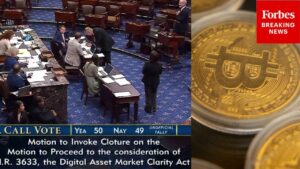
Crypto asset manager Grayscale Investments shared on May 15 what comes next for the CLARITY Act after the Senate Banking Committee advanced the digital asset market bill in a 15-9 vote. Two Democrats joined Republicans, giving the measure bipartisan support before a more difficult full Senate process. Zach Pandl, head of research at Grayscale, noted:
“The CLARITY Act has cleared a key hurdle in the Senate Banking Committee on a bipartisan vote.”
That next phase starts with consolidation. CLARITY must be combined with the Digital Commodity Intermediaries Act (DCIA), which cleared the Senate Agriculture Committee on Jan. 29 in a 12-11 party-line vote. That combined Senate package also must be reconciled with the House version of CLARITY, which passed last July.
The two Senate bills overlap, but they approach market structure differently. CLARITY is the broader framework. It covers token classifications, investor disclosures, intermediary registration, banking integration, anti-money laundering (AML) rules, and the division of authority between the Securities and Exchange Commission (SEC) and Commodity Futures Trading Commission (CFTC). It also includes a three-tier digital asset taxonomy, Regulation Crypto, and Bank Secrecy Act rules for crypto intermediaries.
The DCIA is narrower. It focuses on digital commodities, CFTC rules for brokers, custodians, exchanges, spot markets, customer fund segregation, disclosures, conflicts, and SEC coordination.
Senate Must Merge Two Crypto Market Bills
The two bills also differ in how they divide oversight between regulators. CLARITY keeps the SEC involved in digital asset securities and certain ancillary asset offerings, while DCIA shifts more oversight of digital commodity spot markets toward the CFTC. CLARITY also includes broader rules tied to banking integration, custody, payments, anti-money laundering protections, and Treasury authority over high-risk foreign crypto transfers.
Grayscale cited Polymarket and Kalshi contracts that placed passage odds near 70%. Those odds still depend on lawmakers merging the Banking and Agriculture bills, aligning the Senate package with the House measure, and securing enough Democratic support to clear the chamber.
Pandl noted:
“Odds of passage this year are high, in our view, but the bill will require bipartisan support to clear the full Senate and become law.”
Senate math is now the key constraint. Republicans hold 53 seats, so at least seven Democrats would need to support the legislation if Republicans remain united. Senators Ruben Gallego of Arizona and Angela Alsobrooks of Maryland backed the CLARITY Act during the Senate Banking Committee vote. The GENIUS Act’s 68-30 Senate approval offers a recent model for bipartisan crypto legislation.