CME and NYSE lobby CFTC against Hyperliquid amid USDC liquidity risks
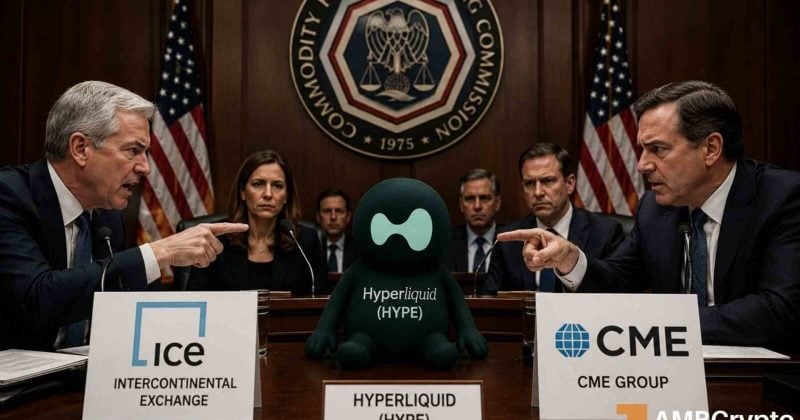
Two of the largest traditional exchanges in the world are asking US regulators to put a leash on a decentralized platform that didn’t exist a few years ago.
CME Group and Intercontinental Exchange, which operates the New York Stock Exchange, are lobbying the Commodity Futures Trading Commission to impose tighter regulations on Hyperliquid, the on-chain perpetual futures exchange that currently dominates decentralized derivatives trading. Their stated concerns include potential market manipulation, sanctions evasion, and the risk of undermining traditional commodity price discovery, particularly in oil markets.
The platform they want to rein in
Hyperliquid commands roughly 53% of fees in the on-chain derivatives sector, with over $2.45 billion in open interest. It’s processing more perpetual futures volume than every other decentralized competitor combined, and it’s doing so without a traditional exchange license.
The HYPE token dropped between 9% and 14% following reports of the lobbying effort.
The USDC dependency problem
Hyperliquid’s market infrastructure is built around Circle’s stablecoin. Through integrations with both Coinbase and Circle, USDC serves as the foundational collateral asset for trading on the platform. If the CFTC or other regulators lean on Circle to restrict USDC flows to Hyperliquid, the platform’s liquidity could evaporate without regulators ever having to touch the protocol itself.
Circle is a US-regulated entity that has historically cooperated with law enforcement and regulatory directives. The company has previously frozen USDC addresses linked to sanctioned entities.
The policy response
Jake Chervinsky, CEO of the Hyperliquid Policy Center, is actively working to find a pathway for US users to access the platform while addressing regulatory concerns.
US derivatives law requires that platforms offering leveraged futures contracts to American users be registered with the CFTC. CME and ICE are framing their lobbying around market integrity concerns, specifically the potential for Hyperliquid to be used for market manipulation in commodity markets and as a tool for sanctions evasion.
What this means for investors
For USDC holders and Circle investors, this situation highlights an underappreciated dynamic. Circle’s regulatory compliance also makes it a potential chokepoint. Any platform built primarily on USDC collateral carries the implicit risk that Circle could be compelled to restrict access, whether through formal regulation or informal guidance from agencies like the CFTC or Treasury Department.
If Hyperliquid faces restrictions on US user access or USDC liquidity constraints, that 53% fee share in on-chain derivatives becomes contested territory. Rival platforms that use non-US stablecoins or alternative collateral structures could benefit.