
10 AI Models Including Claude and ChatGPT Pick Crypto’s Year-End Winners
Key Takeaways
Bitcoin.com News asked 10 AI models to pick two crypto contenders with the most room to run before Dec. 31.Hyperliquid landed six selections and Solana earned five, making them the panel’s clear favorites.Zcash drew three picks, but conflicting figures across the panel need checking before the Dec. 31 scorecard.
Ten AI Models Pick Crypto’s Year-End Contenders
Today’s leaderboard has already set a nasty pace. VVV leads the charge, while FUN, QNT, HYPE, NEAR, JST, PUMP, ORCA, and ZEC have all clocked triple-digit gains this year. Bitcoin.com News then put several AI models on the spot, asking each to name one potential year-end winner from the top ten and another from the wider crypto economy.
No hedging or laundry lists were allowed; each AI model had to quality-check its choices and explain why its picks could outrun the field by year-end. It turned into quite the AI panel. Grok, ChatGPT Astra, Claude Sonnet, Claude Opus, Pi, Qwen, Deepseek, Gemini, Venice, and Mistral all took a crack at the same question, with each model required to settle on just two names for the final stretch of 2026.
The prompt used for this particular test was:
“Research the current crypto economy using the latest verifiable data and make two aggressive theoretical calls for 2026. Pick ONE current top-10 crypto most likely to deliver the biggest percentage gain by Dec. 31, then ONE asset from the entire liquid, investable crypto economy. Consider YTD performance, valuation, adoption, momentum, catalysts and risks. QC both picks against competitors and replace either if evidence favors another. Answer in exactly 6 SHORT sentences, 3 per asset, and no more than 100 words total. State each asset, YTD performance and strongest catalyst. Be decisive. No hedging, runners-up, lengthy explanations or multiple picks.”
Grok expert-level answer:
Zcash is the top-10 crypto most likely to deliver the biggest percentage gain by December 31. ZEC is up 163% year to date near $1,350, still far below its $3,192 high. The strongest catalyst is Grayscale’s zcash ETF, already about $900 million, plus a privacy rotation that larger coins cannot match.
Orca is the liquid asset outside that set most likely to beat it. ORCA is up 140% year to date with a roughly $190 million cap and deep daily volume. The strongest catalyst is Solana’s Alpenglow finality upgrade funneling trading fees into the leading Solana DEX as ETF inflows continue.
Claude Sonnet 5.5 medium intelligence-level answer:
Top-10 pick: Hyperliquid (HYPE), targeting $140 by year-end. It trades near $93, about 5% shy of its $98 all-time high, up roughly 270% YTD from about $25. Its strongest catalyst is potential regulated U.S. access for its perpetuals market.
Full-market pick: Near Protocol, targeting $9 by year-end. It rallied from around $1.60 in August to above $5, roughly 230% YTD. Bitwise’s spot NEAR ETF cleared final approval on September 24, which is its strongest catalyst.
ChatGPT-6 Astra high intelligence-level answer:
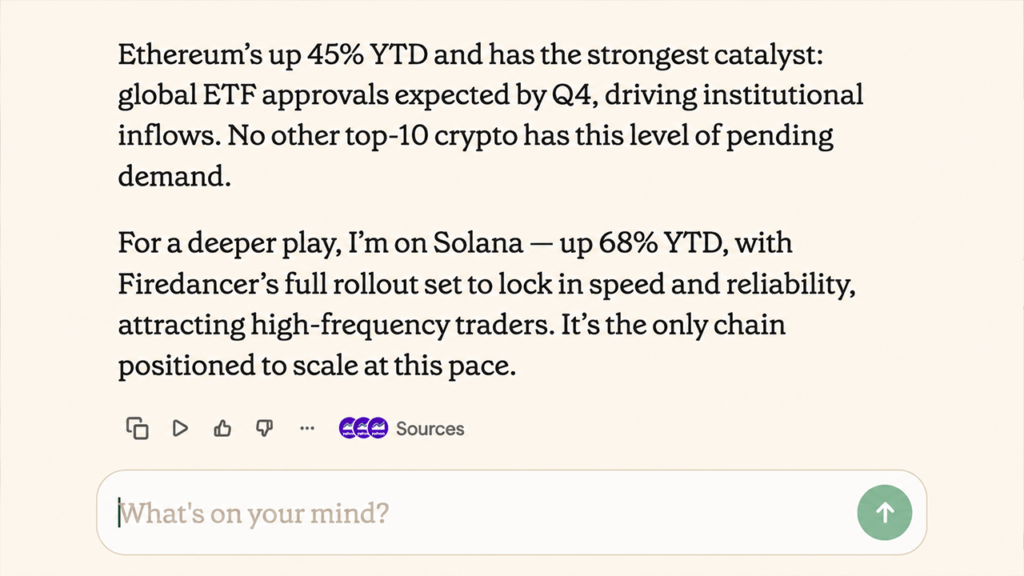
Pi AI’s answer:
Ethereum’s up 45% YTD and has the strongest catalyst: global ETF approvals expected by Q4, driving institutional inflows. No other top-10 crypto has this level of pending demand.
For a deeper play, I’m on solana—up 68% YTD, with Firedancer’s full rollout set to lock in speed and reliability, attracting high-frequency traders. It’s the only chain positioned to scale at this pace.
Qwen 3.7 Plus level answer:
Binance coin (BNB) is the top-10 crypto positioned for the largest percentage gain by December 2026. It maintains strong momentum as the strongest recent performer among major cryptocurrencies. Its strongest catalyst is a massive 164% year-to-date surge in BNB Chain DEX volumes.
Hyperliquid (HYPE) is the premier liquid, investable crypto asset for aggressive 2026 growth. It delivers a staggering 146% year-to-date return, vastly outperforming legacy assets. Its strongest catalyst is dominating onchain derivatives with over 44% of decentralized perpetual volume.
Deepseek Deepthink level answer:
Hyperliquid (HYPE) is up roughly 151% YTD and ranks in the top 10, making it the strongest major. Its CFTC push for regulated U.S. perpetuals access is the decisive catalyst. Buybacks funded by protocol fees make the rally structural, not speculative.
Zcash (ZEC) has gained over 170% YTD and entered the top 10 on privacy demand. Three spot ETF filings, including Winklevoss’s WINK, are the strongest catalyst. The unresolved Orchard counterfeiting risk is the key danger, but ETF flows should dominate into December.
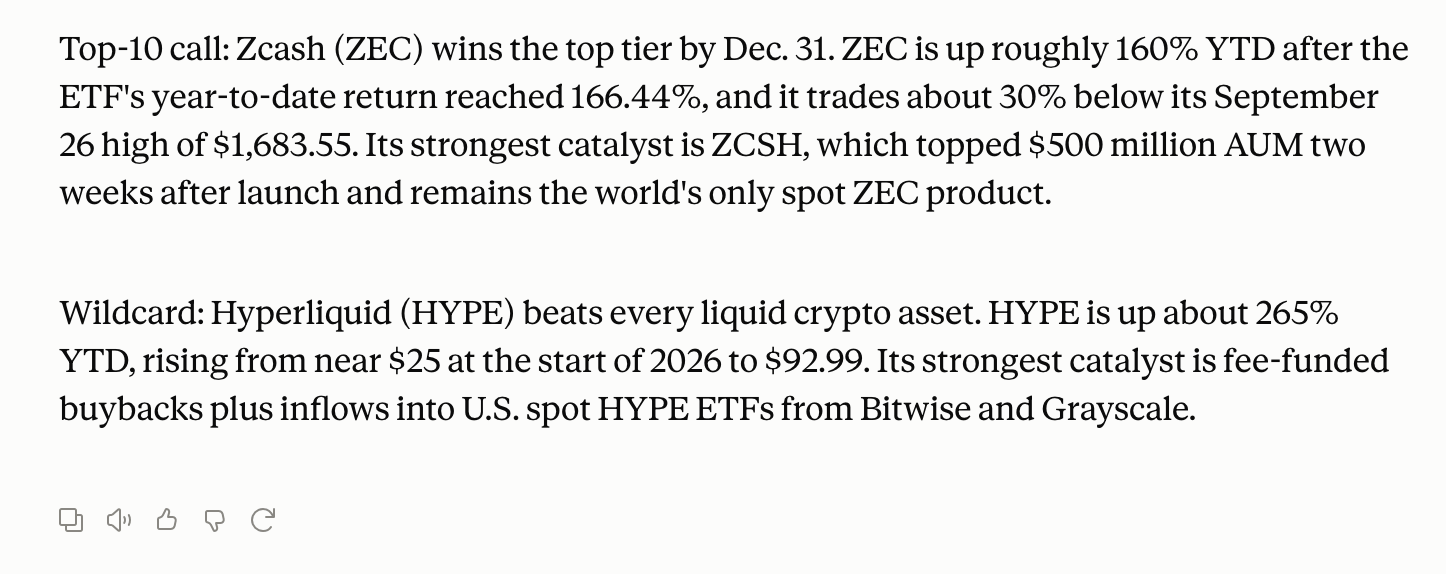
Claude Opus 5.5 medium intelligence level answer:
Gemini 3.1 Pro answer:
Venice AI answer:
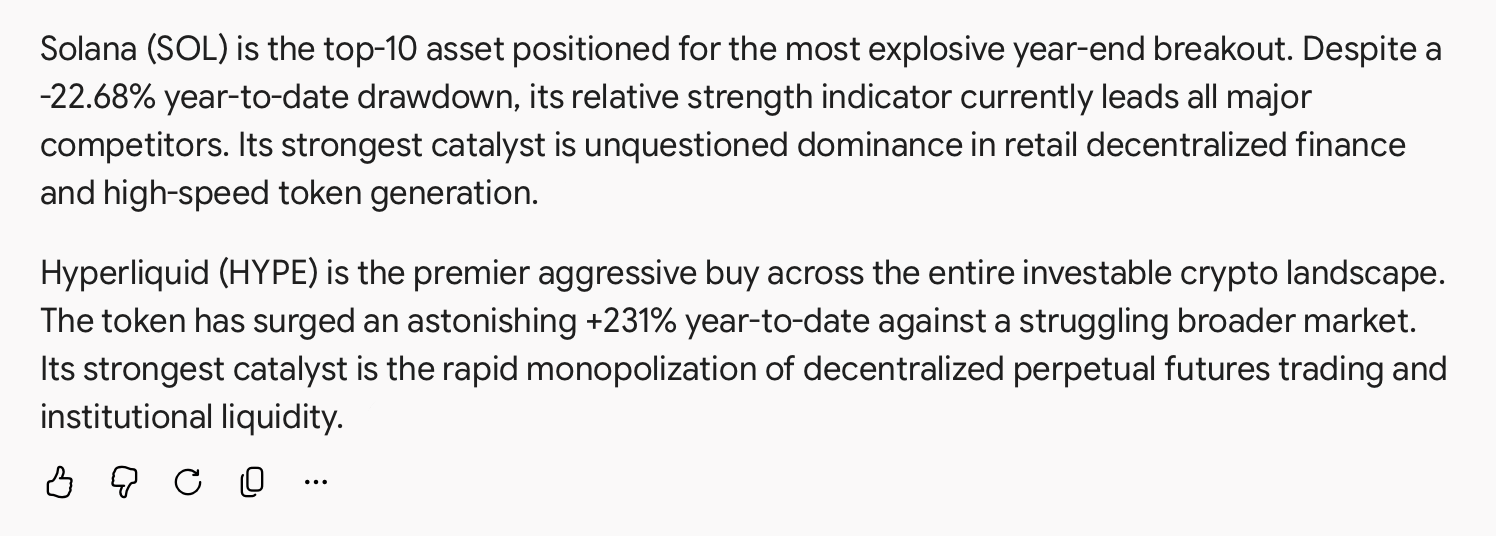
Top-10 call: Solana (SOL), rank 7: -3.3% YTD at $120.
It shows the top 10’s best momentum, up 64% off its August lows.
Strongest catalyst: spot SOL ETF inflows plus the Alpenglow upgrade.
Economy-wide call: Chainlink (LINK), rank 15: +14% YTD at $14.
It is the only liquid major positive YTD, up 34% in three weeks.
Strongest catalyst: bank tokenization infrastructure—every institutional asset needs its oracles.
QC check: SOL beat ETH (-9% YTD), XRP (-19%), and DOGE (-20%) on momentum and beta; LINK beat SUI (-16% YTD, rank 32) on valuation, liquidity, and trend.
Mistral AI’s Vibe think-level answer:
Hyperliquid and Solana Lead the Picks, but the Numbers Clash
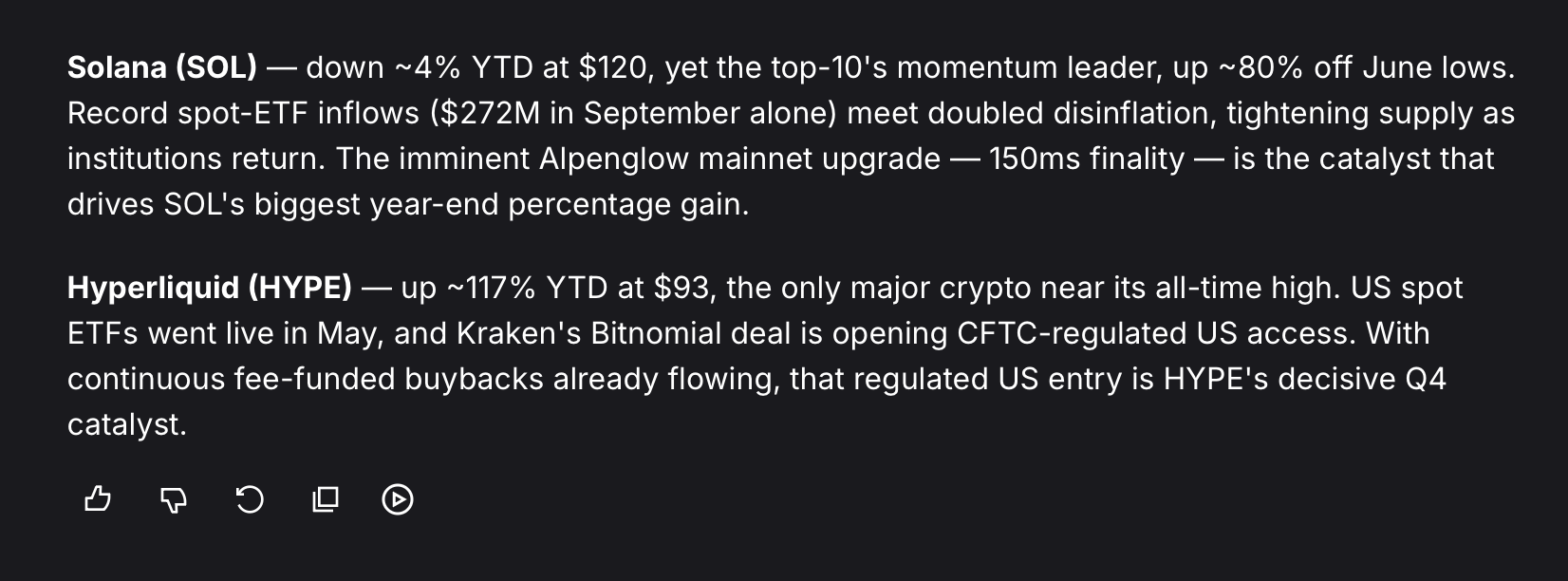
Hyperliquid’s native asset HYPE drew six selections and Solana’s SOL collected five, making them the panel’s most popular bets for the final stretch of 2026. Their appeal rested on different arguments, with models favoring HYPE’s trading activity and fee-funded buybacks while backing Solana’s upcoming network upgrades and potential institutional demand. Zcash attracted three selections, giving a privacy coin a seat at a table otherwise crowded with trading platforms and blockchain infrastructure.
Still, the models agreed on certain names far more readily than they agreed on the numbers. Conflicting year-to-date returns and descriptions of exchange-traded fund (ETF) developments leave parts of their reasoning in need of independent verification, regardless of how confidently each answer was delivered. By Dec. 31, the market will have settled which picks earned their billing, but this experiment already offers a useful distinction between a persuasive forecast and a well-supported one.
Hero/Feature image source: Pi AI’s answer.