
AI is a matter of power, infrastructure and security: TechEx North America
Although visitors to an event like TechEx North America will always want to see the cutting edge front and centre stage, the nuance and detail brought to the show by the speakers and exhibitors mean that it’s sometimes the smaller considerations that need to play big – at least, in the minds of enterprise decision-makers.
Across the different tracks of Edge Computing, IoT, Data Centre Congress, and Cyber Security, the question was about what needs to be built around AI before it takes its place in the physical, business-oriented world?
The Edge Computing track, with its roots in traditional industries, looked at latency, deployment discipline, and cybersecurity for IIoT/IT amalgams. The day-one programme positioned edge computing as a place where companies can reassess the value of their data assets, look at how decisions are made by autonomous equipment, and the required speed of processing.
Sessions looked at scaling edge deployments (in multi-site businesses, for example), agentic network operations, distributed inference – on-prem, in-cloud or hybrid – immutable edge infrastructure, and how zero-trust cybersecurity lessons can be applied to control systems.
Ed Doran of the Edge AI Foundation chaired a programme that had as its starting point that the edge is a demanding place in which to operate. The track included reps from Akamai, Spectro Cloud, Scylos, TÜV Rheinland, the OPC Foundation, and Germany’s Schneider Electric. Discussions covered issues in manufacturing and IoT, and delved into industrial automation and connected control and attenuation devices.
Moving intelligence closer to the machine changes risk profiles (in which direction was a matter for debate), and faster local decisions may reduce latency and dependence on central cloud services, but where do observability and control in decision-makers’ minds?
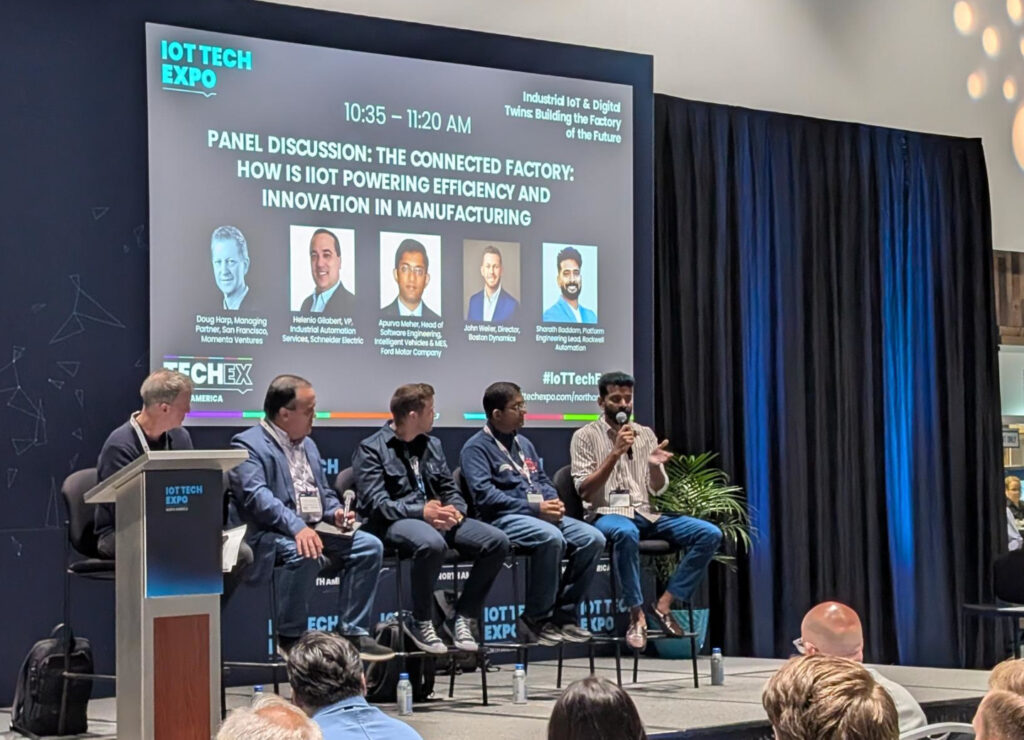
The IoT Tech Expo day-one track on Industrial IoT and Digital Twins looked at manufacturing, with sessions covering smart factory trends, AI beyond Industry 4.0, asset management, practical road-maps for escaping pilot purgatory (more on that below), physical AI in everyday ops, and digital twins.
Similar to debates on AI deployment in the knowledge sector, it was the gap between demo and deployment that was the area subject to most scrutiny. Industrial and back office AI both might work well in a presentation, but can stall when they meet old machines (or legacy software).
The alliterative pilot purgatory held considerable weight in several sessions on the various presentation stages and on the show floor, day one. The Rockwell Automation and Ford session on physical AI and connected asset intelligence looked especially hard at scaling projects that seem to work well in concept, but may fail when hitting the real world. How does intelligence enter daily operations without becoming another dashboard that nobody owns?
Digital twins received similar appraisal. The better version of the digital twin isn’t a visual replica used for demons – although they do have their uses. Instead, several speakers called for, and presented, operational models that can actually help a factory, city, or municipal facility. In addition to pre-testing decisions and improving maintenance, what should the modern digital twin be designed to achieve?
The TechEx programme linked ideas between speakers from Siemens, Korea’s LG CNS, Boston Dynamics, and others across the different show strands. The takehome everywhere was that smart systems, be they deeply embedded in engineering sites or the back office, need to be designed in concord with the people or machines that they’re designed to benefit.
Day-one sessions at the Data Centre Congress track looked at the big issues facing the sector today: construction, power, procurement, cooling, water, and the network spine needed for AI DCs. Keynote speakers and round-table discussion guests talked about construction chaos and power issues, with the event’s early visitors hearing from TechEx’s host city, Santa Clara, about its own data centre journey.
The DC issue remains central to the wider AI debate. As a technology, AI depends on compute, and dense compute at that. This in turn depends on power, cooling, land, and permits. A recurring theme in the infrastructure-focused talks was how AI economics affects the infrastructure stack, with the former rapidly changing, the latter taking years to mature.
In many ways, the TechEx event is unique, in that it brings the issues affecting a whole industry under one roof; a place where the bigger picture can be visualised. In the Data Center Congress, we learned that water and power constraints can cut through the rhetoric around the scale of AI. Sessions under the AI and Big Data roof helped temper the idea of a ‘stampede’ to AI productivity, citing their own reasons why unplanned and disorganised implementations of technology don’t fit the modern enterprise. The data centre is now one of the places where AI strategy becomes physical; the enterprise board room’s considerations are practical.
The Cyber Security and Cloud Expo track put its own take on deployment forward. Here, the day-one programme dealt with security culture, compliance, speed, ransomware, shadow AI, data exfiltration, legacy systems, open-source dependency issues, and the CISO relationship with the C-suite. There was a general consensus around AI adoption increasing a company’s attack surface, and a much-repeated message that existing security weaknesses don’t diminish when the business wants faster, smarter tools.
Sessions on shadow AI and data exfiltration were especially relevant to the wider event. Many companies’ staff use AI services inside business workflows, sometimes without approval, and usually with no facility for logging their activities. That makes data governance and cyber governance effectively the same conversation.
The benefits of one conference playing host to complementary tracks were manifest in several cases. For instance, the cybersecurity track’s concerns around legacy systems were echoed on the IoT and Edge stages, where issues were raised about modern, smart intelligence meeting older plant systems. Security in any context can sometimes become an afterthought, but critical infrastructure in the form of transport or energy means that cybersecurity has to play a central role.
The TechEx North America day-one tracks that were concerned with infrastructure gave the conference a dose of reality, at least in some respects. AI may be discussed in terms of agentic automation, but deployments depend on networks, data centre capacity, and cybersecurity. Edge and IoT sessions showed how intelligence reaches machines, and how carefully and considerately it needs to be applied. The data centre-focused sessions showed the material limits of physical construction, while the cybersecurity sessions showed how a desire for speed can be the enemy.
The day showed the thousands of attendees that putting AI in production isn’t a case of switching the software on. There’s a reliance on the mundane matters of buildings and grids, networks, and security. Companies that understand these issues are more likely to deploy the latest in technology successfully. Getting the bigger picture is what this event is all about.
(Image source: TechForge)

Want to learn more about AI and big data from industry leaders? Check out AI & Big Data Expo taking place in Amsterdam, California, and London. The comprehensive event is part of TechEx and co-located with other leading technology events. Click here for more information.
AI News is powered by TechForge Media. Explore other upcoming enterprise technology events and webinars here.