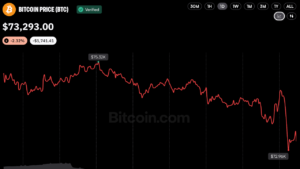

Bitcoin Could Rally Before Rate Cuts Begin, Binance Research Says
Key Takeaways
Binance Research found a -0.62 correlation between global tightening momentum and Bitcoin’s returns.Binance’s Bstocks reached $1 billion in assets, with DeFi utilization exceeding the industry average.Bitcoin’s 2027 outlook hinges on Fed policy, while tokenized stocks’ growth depends on sustained on-chain use.
Slowing Global Monetary Tightening Could Signal Bitcoin Recovery
Bitcoin (BTC) could benefit from an easing in the pace of global monetary tightening even as interest rates remain elevated, according to Binance Research. In its November 2026 Monthly Market Insights report, Binance’s research argues that the speed at which monetary tightening spreads across major economies may matter more for bitcoin than the actual level of interest rates.
According to the report, eight of the Group of 10 (G10) central banks raised interest rates over the preceding six months, while two kept rates unchanged. However, the pace at which monetary tightening spread across these economies has slowed since peaking in July.
The researchers used a monetary policy diffusion index that tracks whether central banks have raised, lowered, or maintained interest rates relative to six months earlier. Although the index remained elevated at 0.8, its six-month change had moderated from its July peak.
The report found a negative 0.62 correlation between changes in the index and bitcoin’s six-month returns since 2021, suggesting that BTC has historically performed better when the momentum of global tightening slows.
“For BTC, what matters is the speed at which tightening spreads, more than how widespread it is,” the report states.
Binance Research pointed to the previous monetary tightening cycle as evidence supporting its assessment. Bitcoin bottomed in November 2022, even though the diffusion index remained at its peak. The cryptocurrency’s six-month returns subsequently turned positive in February 2023, well before G10 central banks began easing monetary policy.
The researchers also cited the opposite trend in 2024, when widespread monetary easing coincided with bitcoin’s strongest six-month performance of that cycle, with returns exceeding 160% in March.
Fed Rate Decision Could Test Bitcoin’s Recovery Prospects
The report suggests a similar transition could be developing. Assuming no further monetary policy changes, the diffusion index would remain at 0.8 while its six-month momentum measure could decline to approximately 0.3 by January 2027.
Even additional rate increases by the remaining central banks would not necessarily reverse the slowdown, according to the researchers.
“If the historical relationship persists, the peak in tightening momentum marks a meaningful turn for BTC,” the report states.
However, the analysis does not establish that slowing tightening will necessarily trigger a sustained bitcoin recovery. Inflation, Treasury yields, and broader investor risk appetite remain important variables.
The Federal Reserve’s next policy decision could prove particularly consequential. At the time of the report, futures markets assigned an approximately 80% to 85% probability to a quarter-point rate increase in December, while the 10-year U.S. Treasury yield hovered around 5%.
A hawkish surprise could therefore prolong pressure on cryptocurrencies, even if the broader global tightening cycle continues losing momentum.
Tokenized Stocks Gain Momentum as DeFi Utilization Rises
Beyond the monetary policy outlook, Binance Research identified tokenized equities as an increasingly important area of cryptocurrency adoption, with growing evidence that investors are using blockchain-based securities for more than trading.
The report highlighted Binance’s Bstocks, which reached $1 billion in assets under management in just 125 days, less than half the time it took rival issuer Ondo to achieve the same milestone.
Since its launch in June, Bstocks has accounted for more than 60% of the growth in the tokenized stock market during the period examined, according to the researchers.However, Binance Research argued that the platform’s onchain utilization rate offers a more meaningful measure of adoption than its rapid asset growth.
As of Oct. 31, Bstocks had an onchain utilization rate of 18.54%, compared with an industry average of 13.91%. The metric measures the proportion of active assets under management deployed in DeFi applications, including lending protocols and liquidity pools.
The difference suggests that investors are increasingly putting tokenized equities to work rather than merely holding them as digital representations of traditional securities.
“The depth of utilization is even more significant than the speed of issuance,” the report states.
The researchers argued that sustained growth in DeFi utilization allows tokenized equities to support increased lending and liquidity without needing to issue more tokens or rely solely on rising asset values. Moreover, this shift moves the focus of tokenization beyond initial issuance, settlement speed, and access toward maximizing the productive use of existing capital.
Binance Research identified growing demand for around-the-clock trading as a key driver of tokenized equity adoption, with 56% of Bstocks’ trading volume occurring outside regular U.S. market hours. Investors in emerging and frontier markets accounted for approximately 70% of trading activity, highlighting tokenization’s potential to expand access to global equities.
The report emphasized that sustained onchain utilization, rather than issuance growth alone, will determine the sector’s long-term success.