
Bitcoin Is Trading Like Gold Again, Bitwise Says the Last Time Was 2020
Key Takeaways
Bitwise data through Aug. 31 shows bitcoin’s 90-day gold correlation above 0.5, a level last seen in 2020.Matt Hougan of Bitwise says own AI stocks if the U.S. grows out of $40T in debt, and bitcoin if it inflates.Treasury doubles long-bond buybacks to $4 billion from Sept. 9 as bitcoin trades near $81,000.
The Hard-Asset Handshake
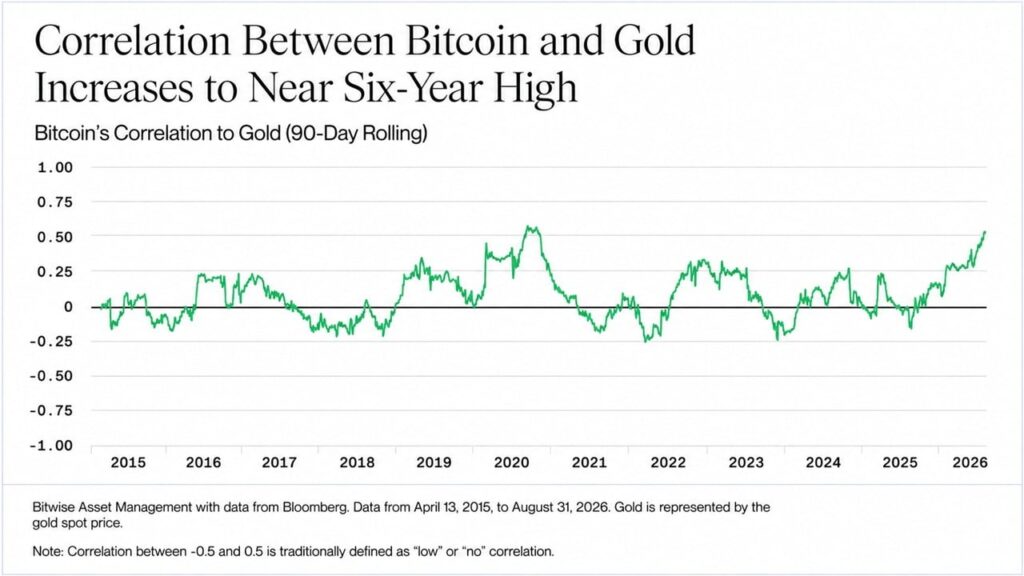
Bitwise’s chart, based on data compiled from April 2015 through Aug. 31, 2026, shows the rolling 90-day correlation between bitcoin and the gold spot price pushing above 0.5 for only the second time on record. The previous peak came in 2020. Bitwise notes that readings between -0.5 and 0.5 are traditionally classed as “low” or “no” correlation, meaning the two assets have only just crossed into meaningful co-movement.
“The last time the bitcoin-gold correlation was that high was in 2020, following the rounds of fiscal and monetary stimulus during the Covid crisis,” Bitwise Europe head of research André Dragosch wrote, adding that the shift implies “some kind of decoupling between hard assets and the stock market.” He further added:
Bitcoin has recently started to look like an amplified version of gold. When things get serious and macro forces are strong, investors are discriminating less and less between bitcoin and gold as they navigate rising currency debasement risks.
The stock-market side of that decoupling shows up in the numbers since bitcoin’s 30-day correlation with the S&P 500 fell toward zero during the August rally, while its correlation with the dollar index turned negative. Bloomberg senior ETF analyst Eric Balchunas observed that bitcoin has held a lower correlation to stocks than gold over the past six months, which he said “blows up the claim that it’s just QQQ.”
Lastly, Bitcoin.com News reported in late August that bitcoin’s 90-day link to the Nasdaq 100 had fallen from above 60% to roughly 33% as the so-called debasement trade revived.
Hougan’s Two-Scenario Map
The macro backdrop driving the shift is fiscal. U.S. national debt crossed $40 trillion on Aug. 18, more than double its 2017 level, and now stands at $40.13 trillion. A day later, the Treasury announced it would at least double its liquidity-support buybacks of 10- to 30-year bonds, from $2 billion to $4 billion per operation, starting Sept. 9.
Bitwise chief investment officer Matt Hougan postured the choice for investors in a recent post on X, noting:
If Bessent is right and we grow our way out, you want to be long AI stocks. If Bessent is wrong and we inflate our way out, you want to be long bitcoin. If you want to win in either scenario, own both.
He also added that growth strong enough to shrink the debt burden would reward the companies supplying chips and data centers, while a policy of inflating the debt away favors an asset with a fixed 21 million supply.
Dragosch’s own read is that the market has already stopped choosing. “Investors are no longer asking whether to hedge currency debasement with gold or bitcoin,” he wrote. “They’re simply hedging with both.”
Where the Two Assets Stand
Bitcoin is currently trading just above $81,000, up nearly 5% over 24 hours, after touching $82,000 yesterday. Gold rebounded about 2% on Sept. 3 to roughly $4,490 an ounce as Treasury yields and the dollar eased from multi-year highs.
Not everyone expects the pairing to last, and Glassnode analysts believe that sudden decorrelations from equities have historically been “short-lived,” reflecting local exhaustion rather than a structural regime change.
Dragosch, however, seems to be betting the other way. “Bitcoin spent its first fifteen years being priced as a risk asset,” he wrote. “If this correlation trend with gold holds, the next fifteen may look very different.” Interesting days ahead.