
BNB Chain Grows RWA Market 60% to $3.6B as Tokenized Treasuries Lead Q1
Key Takeaways
BNB Chain’s RWA market grew 60% to $3.6B in Q1, led by Circle, Blackrock, and Ondo.Stablecoin supply hit $13.4B as BSC processed 1.29B transactions and 2.71M daily users.BNB Chain cut block times to 0.45s and eyes growth in AI agents, RWAs, and stablecoins.
BNB Chain Processes 1.29B Transactions as Stablecoins and RWAs Gain Ground
BNB Chain entered 2026 with a broader story than trading. The network’s real-world asset base grew more than 60% in the first quarter to $3.6 billion, helped by deeper institutional activity from issuers including Blackrock, Franklin Templeton, and Circle.
The expansion came as speculative trading cooled from the prior quarter’s memecoin peak, suggesting BNB Chain is becoming less dependent on a single market cycle.
Tokenized Treasuries led the advance. Supply rose 65% to $3.19 billion, driven mainly by Circle’s USYC product, which climbed 81% to $2.57 billion. Franklin Templeton’s iBENJI reached $113.5 million after launching on the network, while Blackrock’s BUIDL held at $507 million.
Tokenized equities grew even faster, rising 78% to $371 million. Ondo was the standout, expanding 440% to $221 million and overtaking Backed as BNB Chain’s largest tokenized-stock issuer by quarter-end.
Nina Rong, Executive Director of Growth at BNB Chain, said 2026 is the year the network has been building toward. Rong said:
Stablecoins, RWAs, and agentic finance are now core infrastructure layers. The institutional appetite is here, and it’s serious.
Core network activity also strengthened. Daily active addresses on BSC reached a quarterly high of 2.71 million, up 16.2% from Q3. Smart contract deployments hit 4.54 million, rising 46.4% from Q3, while BNB Chain processed about 1.29 billion successful transactions during the quarter.
Stablecoins remained one of the network’s strongest pillars. Supply ended the quarter at $13.4 billion, while BNB Chain led all networks in February with about 15.1 million unique stablecoin senders.
Yield-bearing stablecoins also gained traction. United Stables’ $U grew 167% over the quarter to about $1.09 billion, nearly 200 times its size at launch in mid-December. The token is backed 1:1 by established stablecoins and was listed on Binance within a month of going live.
BNB Chain’s infrastructure improved as well. The Fermi hard fork, activated on Jan. 14, reduced average block times to 0.45 seconds from 0.75 seconds. Average transaction fees fell to about $0.027 from $0.055 in Q4, while median fees averaged $0.0038.
Rong said engineering work across BSC, opBNB, and BNB Greenfield is focused on higher throughput, sub-second finality, and predictable low-cost rails for AI-driven finance. She remarked:
The next wave of finance won’t be human-triggered trades or manual DeFi positions. It will be fully agent-driven, autonomous systems executing 24/7. Our focus stays simple: keep delivering elite tech performance so the next generation of applications can scale.
Trading stayed important, even after normalization. Spot DEX volume reached $125.4 billion in Q1, with Pancakeswap accounting for 61.4% of activity. Memecoins remained the largest trading category, but stablecoin swaps gained share as the market cooled.
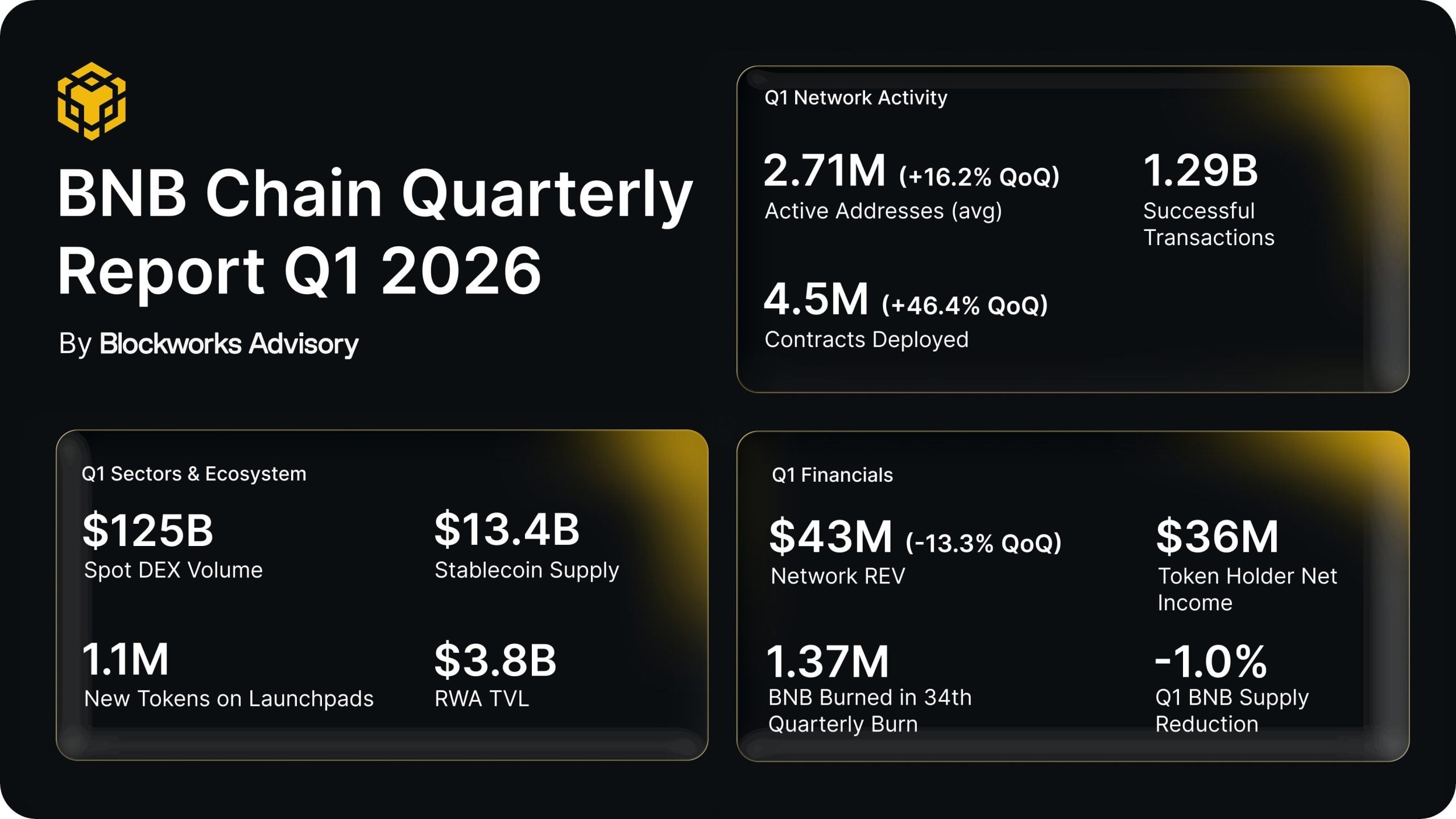
Financial results reflected that reset. Network REV fell to $43.4 million from $111.5 million in Q4, largely because fee activity eased after the prior quarter’s trading surge. BNB Chain still completed its 34th quarterly burn on Jan. 15, removing about 1.37 million BNB, worth roughly $1.28 billion at execution. Total supply fell about 1% during the quarter.
The quarter also brought new institutional signals. Tether Gold launched on BNB Chain in March, and Grayscale filed an S-1 registration statement for a potential BNB ETF.
For BNB Chain, Q1 was less about one breakout theme and more about diversification. RWAs, stablecoins, AI agents, and lower-cost execution are now shaping the network’s next growth phase.