
Despite Tradfi Headwinds, Bottom Signs Abound

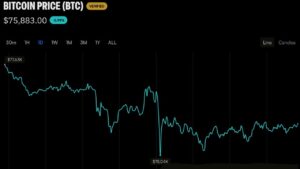
Since last Friday, Bitcoin moved from around $64,000 up past $66,500 before dropping to $65K as of early Friday morning. Bitcoin remained buoyant despite U.S. equities having been choppy and broadly lower, brought down mostly by mega-cap tech. Three risks weighed on equity markets: AI capex worries, climbing oil prices, and rising bond yields.
Whereas last week’s AI worries centered around Kimi K3, this week AI worries were squarely about capex concerns due to quarterly earnings disclosures. After posting its first quarter of negative free cash flow in at least a decade, Google (Alphabet) closed below its 100-day moving average for only the second time since April. Tesla fell 14% on AI capex spend & profit miss. Once again, the market is wrestling with the question of whether hyperscalars can fund these enormous capex commitments even as free cash flow plummets. Even if they do, how should their stocks be priced moving forward? Some see opportunities, as in the case of Google, since demand for AI still far outstrips supply, and will continue for quite some time.
Oil climbed to over $100/bb, prompting drastically higher oil price prediction fears. Oil bulls need to be careful, though, price could collapse with a single Trump announcement. Obviously, higher oil prices are inflationary at first, reducing the likelihood of interest rate cuts from the Fed.
Persistently high U.S. bond yields also make near-term Fed cuts less likely too. A headwind for risk assets when the US 30-year yield has now traded above 5% for the longest stretch since 2007. Luckily, there are signs that yield fears might have topped out, at least for the interim. Indeed, the recent bond selloff might have set up a generational buying opportunity.
Moving on to crypto, bottom-calling is increasing! Many of these calls are based on feels or spidey senses, but others are using data for bottom signals. Somewhere in the middle are the likes of DonAlt, going off of sentiment mixed with technicals. Or Algod, who is astonished at how much project quality has improved over five years ago and reckons there are a few unnoticed 1000x’s out there. Even the perpetually skeptical Pledditor appears to be getting bullish.
Before continuing with bullish bottom signals, a word of caution seems prudent. Astekz warns you’ll likely need to survive one more steep drop before the year is out before the V-shaped swing “to the heavens.” Never mind all of the equity and macro headwinds previously covered.
Moving on. The most reliable bottom signal of all might be the death of prominent Digital Asset Treasuries (DATs). Mark Moss-backed Satsuma Technology voted to sell all 668 of its remaining BTC, return capital, and shut down. Jack Maller announced he was stepping down as CEO of Twenty One, which is a DAT that raised billions and lost 92% shareholder value in 1 year. Matthew Sigel is keeping a running list of DATs abandoning their crypto accumulation strategies, not because he’s mean, but because he takes this as a good sign. Felix from Forward Guidance agrees.
Strategy is cooperating by producing its own bottom signals. For the third consecutive week, the company increased its USD Reserve, this time by $225 million.
A bullish catalyst everyone’s watching is CLARITY. Bitcoin rallied after Treasury Secretary Bessent said the bill is at the one-yard line. The complication came from the White House, which endorsed ethics requirements. Senator Lummis hailed the ethics requirements as a president choosing a higher standard than the law required. The overall response was, let’s say, not enthusiastic.
One large X account observed that Trump made billions off TRUMP and MELANIA and then pulled the ladder up behind him, while others were considerably less polite. Austin Campbell, no partisan, thinks the whole thing is a non-solution to ethics that makes CLARITY less likely to pass. Then again, it could be a win either way: CLARITY’s failure could precipitate a final capitulation wick, but if it surprises to the upside, that’s not priced in at all.
The biggest crypto-native news story of the week was about the world’s first perp DEX. BitMEX is shutting down, effective September 23. Reminiscing filled the timeline. Cobie channeled his inner boomer, musing the world you grew up in no longer exists. Some recalled their first liquidation and margin call on BitMEX, others credited BitMEX with changing their lives forever, still others harkened back to legendary stories like the time Arthur Hayes stopped Bitcoin from going to zero by turning off the liquidation engine. Not everyone was misty-eyed. BitMex did impoverish many!
Defi, by contrast, is alive and well. Almost all of the recent vitality has come not from crypto-native digital assets (e.g., BTC/ETH/SOL), but tokenized real-world assets (RWAs). Hyperliquid, for the first time ever, generated more volume from RWAs than crypto in a single week, Robinhood Chain’s RWA volume has started to go parabolic. On the topic of RWAs, Frank Chaparro noted that adoption of tokenized stocks has completely decoupled from Bitcoin. While BTC went down from $120K to $64K, tokenized stocks reached a record $2.26 billion in on-chain market capitalization.
RWAs and tradfi have had a pronounced effect on defi. Lorenzo Valente, Director of Research at ARK Invest, buckets defi founders into either legacy founders (Uniswap, Aave, etc…) or new defi founders. Legacy founders had to learn many difficult lessons and whose protocols must shoulder many of those mistakes to this day. Their protocols also catered strictly to a crypto-native user base. New founders inherited the lessons learned without any of the baggage, and increasingly are targeting tradfi institutions as customers. This is not to say tokens such as UNI can’t be valuable, but they have a tougher path to do so.
Some of these lessons are ongoing, such as those about token-equity splits. A great post this week argued that the token-equity debate keeps getting muddled because people assume an enforceable duty to maximize shareholder value that does not actually exist. The real rule is merely an orientation, not a mandate to maximize profits or be sued. Venice, fresh off its raise and ensuing firestorm, announced two tokenomics updates that seemed to please token holders.
Last weekend, Cobie, who is now in charge of Coinbase’s trading products, was refreshingly candid that Coinbase has historically been a little bit in an ivory tower and distant from users, particularly crypto natives. Brian Armstrong, fresh off the PFP debacle, addressed criticisms about Coinbase’s Ethereum L2 Base not getting enough support, and reminded everyone that treating his X account as alpha is risky.
Two days after Mr. Armstrong’s ill-advised PFP change, Vlad Tenev showed Mr. Armstrong how a CEO of a CEX should meme. Robinhood Chain, an Ethereum L2 competitor to Base, might’ve partially revived memecoins, but when folks like Bold are enticed back in, it’s usually so over.
On the topic of Ethereum, Omid Malekan posted a wonderful article laying out the case for truly decentralized networks. Ethereum for all its faults is the second most (or most, depending on who you ask) decentralized network. Erik Voorhees called it a great piece, arguing Ethereum should ditch the communist egalitarian, child’s-eighth-birthday unicorn branding and code Machiavellian, toward brutal resistance to adversaries. Hear, hear!
Finally, several stories relating to legally dubious or flat out illegal activities. Crypto payments have found a home in the exploding, untested peptides industry. Crypto payments to gray-market peptide vendors hit $32 million in Q1, some suppliers accepting nothing else. Prediction market front runner Polymarket has strengthened its insider trading surveillance via on-chain data provider Dune. Insider trading will only become a greater problem as prediction markets become more mainstream.
There’s a new flavor of crypto attack making the rounds: An attractive person asks to borrow your unlocked phone to exchange details (or some such excuse) and promptly send themselves your crypto, as one traveler learned to the tune of 189 SOL (about $14,000) at a Bali beach club. Remember, handing over your unlocked phone with crypto is akin to handing over your wallet.
Stay safe out there, even billionaires like Vlad Tenev can’t dodge the hackers. His X account was hacked, with insider wallets reportedly extracting seven figures inside fifteen minutes from memecoin speculators.
-David Sencil