

ECB Executive Calls for Central Bank Money on Blockchain
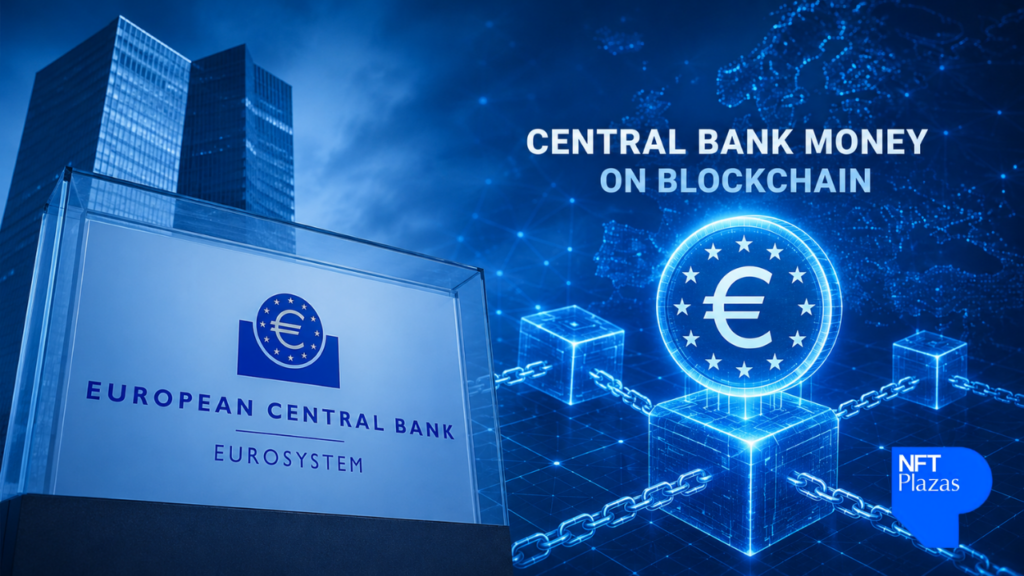
European Central Bank Executive Board member Isabel Schnabel has called on central banks to bring their money directly onto blockchain networks, arguing that doing so will be essential as financial markets move toward tokenized assets.
Speaking at the Jackson Hole Economic Policy Symposium on August 28, Schnabel said central banks must “go on-chain” to ensure public money remains at the center of the financial system. She argued that central bank reserves should eventually become native, programmable assets on distributed ledger technology (DLT), rather than simply being represented through traditional payment systems.
The proposal marks one of the ECB’s clearest signals yet that blockchain could become part of Europe’s core financial infrastructure.

ECB Executive Calls for Central Bank Money on Blockchain
Putting central bank money on-chain
Schnabel’s argument centers on the potential of programmable money. If central bank reserves were issued directly on a DLT platform, they could be used alongside tokenized financial assets and settled automatically through smart contracts.
That could make transactions more efficient by enabling so-called atomic settlement, in which the transfer of an asset and the corresponding payment occur simultaneously. Programmability could also automate parts of collateral management, liquidity provision and other financial-market processes that currently rely on multiple intermediaries and settlement systems.
Schnabel outlined three broad approaches for bringing central bank money into tokenized markets: issuing tokenized reserves directly on a programmable ledger, connecting existing payment systems to DLT platforms through bridges, or allowing private intermediaries to handle the tokenization of central bank money.
Of the three, she favors direct issuance on programmable infrastructure because it would allow central bank money to take full advantage of the technology.
The issue is becoming more pressing as banks and other financial institutions experiment with tokenized securities. Without central bank money available on the same infrastructure, tokenized markets could become increasingly dependent on private settlement assets.
Pontes and Appia shape the ECB’s blockchain strategy
The ECB is already working on infrastructure that could move the euro closer to blockchain-based settlement.
Project Pontes is expected to launch in September 2026. Its initial role will be to connect DLT platforms with the Eurosystem’s existing TARGET Services, which handle major euro payment and settlement operations.
The project also envisages a Eurosystem-operated DLT platform for settling transactions in central bank money. Over time, settlement could move directly onto that platform, with smart-contract functionality and continuous 24/7 operation forming part of the longer-term vision.
Appia is the ECB’s broader effort to determine how Europe’s tokenized financial market should ultimately be structured. The project is examining different models, including a unified ledger and systems in which multiple DLT platforms are connected and interoperable.

ECB’s blockchain strategy
A comprehensive plan is expected in 2028. The decision will be significant because the architecture chosen by the Eurosystem could determine how banks, market infrastructures and private blockchain networks interact with central bank money for years to come.
The ECB already has evidence that demand for such infrastructure is developing. Interoperability tests between DLT platforms and traditional settlement infrastructure have processed around €1.6 billion involving 64 participants across nine jurisdictions. Since 2021, European issuers have also placed almost €4 billion worth of blockchain-based financial instruments.
Since January 27, 2026, certain negotiable assets issued through DLT have been eligible as collateral in Eurosystem credit operations, further linking tokenized markets with the traditional financial system.
Why the ECB is skeptical of stablecoins
Schnabel also addressed the growing role of stablecoins, drawing a clear line between privately issued digital money and central bank reserves.
In her view, central bank money remains the superior ultimate settlement asset because it combines safety with the ability to expand liquidity when needed.
Central bank reserves are direct claims on the central bank and therefore do not carry the same credit, liquidity or redemption risks associated with private issuers. Central banks can also increase the supply of reserves during periods of financial stress, something private stablecoin issuers cannot replicate on the same scale.
That distinction matters particularly during crises, when demand for safe and liquid assets can rise sharply.
Schnabel also warned that allowing different blockchain platforms to create their own private representations of central bank money could fragment the financial system. Instead of a common settlement asset, markets could end up with multiple private claims that are only indirectly connected to central bank reserves.
The ECB therefore sees stablecoins as potential complements to central bank money rather than replacements for it in wholesale settlement.
A bigger shift for European finance
Schnabel’s remarks reflect a broader shift in how central banks view blockchain. The debate is moving beyond whether the technology has practical applications and toward who will control the infrastructure of a tokenized financial system.
For Europe, the stakes are particularly high. If tokenized securities and other financial assets grow significantly, the settlement layer supporting them could influence the competitiveness, resilience and sovereignty of the region’s financial markets.
Putting central bank money on-chain would allow the ECB to maintain the euro’s role as the foundation of settlement while giving financial institutions access to the efficiency and programmability offered by DLT.
The move would not make traditional finance or stablecoins obsolete. Instead, it could create a hybrid system in which regulated tokenized assets, private digital money and central bank reserves operate across interoperable blockchain networks.
The final architecture remains undecided, and significant questions around governance, cybersecurity, interoperability and financial stability still need to be resolved.
But Schnabel’s message from Jackson Hole was unmistakable: if financial markets move on-chain, central bank money cannot remain entirely off-chain.
With Pontes approaching and the Appia blueprint expected in 2028, the ECB is beginning to turn that principle into a concrete roadmap for the future of European finance.