
Ethereum Exchange Reserves Hit a 10-Year Low—Is a Supply Shock Brewing?

The sluggish behaviour of the Ethereum price has raised uncertainty among investors, while future traders have remained largely bullish. The price may not be attracting the required buying conviction, but underneath the token is experiencing a significant shift. Exchange reserves have dropped to their lowest level in nearly a decade, while derivatives traders continue increasing bullish exposure despite relatively muted spot demand.
The combination of shrinking exchange supply and growing futures participation is creating a unique market setup that could determine Ethereum’s next major move. Here’s what the latest data reveals.
Ethereum Exchange Reserves Continue to Decline
Ethereum held on centralized exchanges has fallen to approximately 14.5 million ETH, marking the lowest level recorded since the network’s early years. The trend has remained intact for several years, with exchange balances steadily declining from a peak of roughly 35 million ETH in 2020.
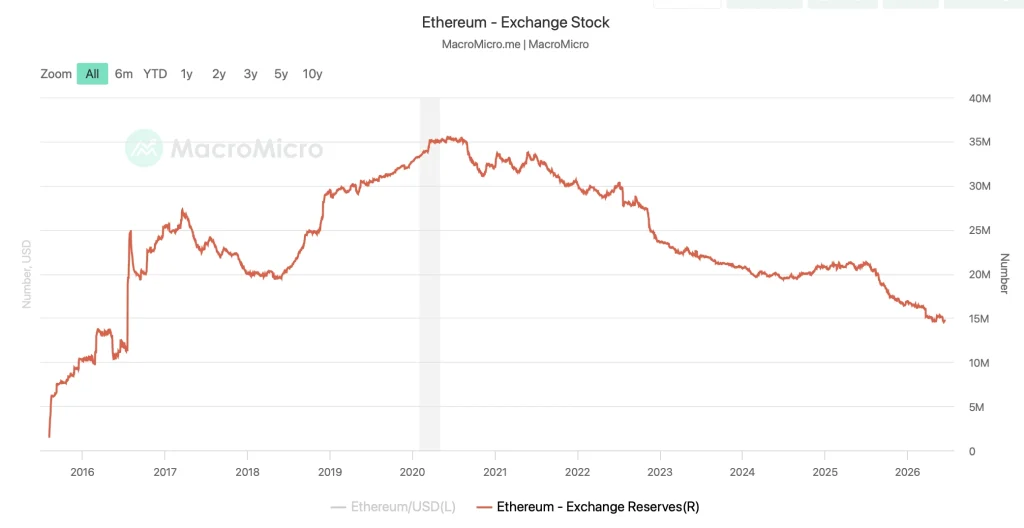
Lower exchange reserves typically indicate that investors are moving assets into self-custody, staking platforms, institutional custody solutions, or decentralized finance applications. In practical terms, fewer coins on exchanges means fewer tokens are immediately available for sale.

Futures Markets Show Growing Optimism
The second chart reveals a notable divergence between derivatives traders and spot market participants. Ethereum’s price continues to trend higher, while futures cumulative volume delta (CVD) has also been rising, indicating that leveraged traders are increasingly positioning for further upside.
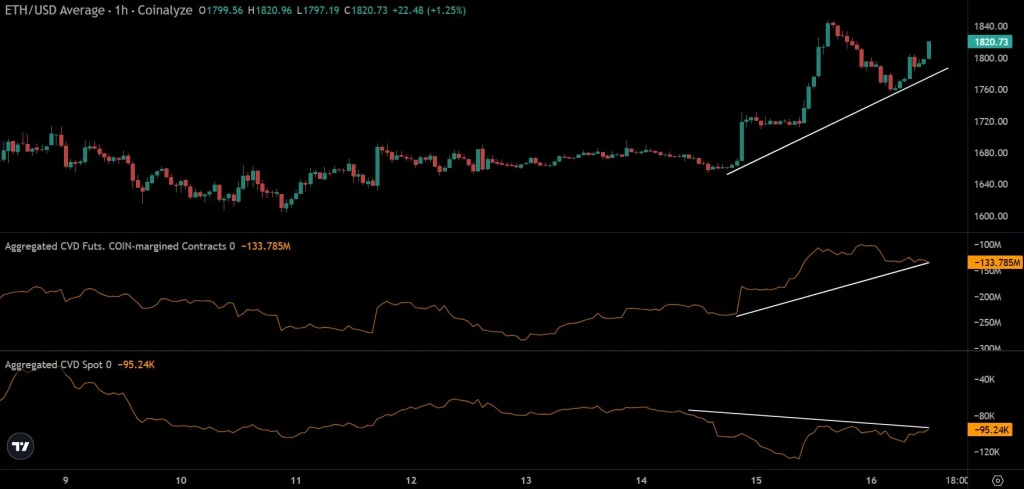
However, spot CVD tells a different story. Despite ETH’s recent recovery, spot buying activity has remained relatively weak and continues to lag behind futures demand. This suggests that leverage is currently playing a larger role in driving price action than direct spot accumulation.
For traders, this creates an important distinction. Sustainable bull markets are typically supported by both spot and futures demand. While the current rally remains constructive, a meaningful increase in spot buying would provide stronger confirmation that Ethereum’s move is backed by genuine capital inflows rather than leveraged speculation alone.
ETH Price Outlook: Is a Breakout Above $2,000 Next?
The combination of record-low exchange reserves and improving futures positioning creates a constructive backdrop for Ethereum. On one hand, declining exchange balances suggest that long-term holders remain reluctant to sell despite recent market uncertainty. On the other hand, derivatives traders are increasingly positioning for higher prices. If spot buyers begin returning to the market while exchange supply remains near decade lows, Ethereum could experience a favorable supply-demand imbalance. This may further trigger a breakout above the psychological $2,000 level.
From a technical perspective, reclaiming $2,000 would likely strengthen bullish momentum and shift focus toward the $2,200 and $2,500 resistance zones. Until then, traders should closely monitor spot market participation, as it may ultimately determine whether Ethereum’s current rally develops into a sustained breakout or remains a derivatives-driven advance.
Was this writing helpful?
Story Ends Here
Trust with CoinPedia:
CoinPedia has been delivering accurate and timely cryptocurrency and blockchain updates since 2017. All content is created by our expert panel of analysts and journalists, following strict Editorial Guidelines based on E-E-A-T (Experience, Expertise, Authoritativeness, Trustworthiness). Every article is fact-checked against reputable sources to ensure accuracy, transparency, and reliability. Our review policy guarantees unbiased evaluations when recommending exchanges, platforms, or tools. We strive to provide timely updates about everything crypto & blockchain, right from startups to industry majors.
Investment Disclaimer:
All opinions and insights shared represent the author’s own views on current market conditions. Please do your own research before making investment decisions. Neither the writer nor the publication assumes responsibility for your financial choices.
Sponsored and Advertisements:
Sponsored content and affiliate links may appear on our site. Advertisements are marked clearly, and our editorial content remains entirely independent from our ad partners.
Read the Next News