

Ethereum Price is Crashing:But Smart Money Is Making a Big Bet

Ethereum price may be crashing on the surface, but beneath the panic, some of crypto’s smartest players appear to be making a very different bet. After ETH plunged toward the critical $1,500 support zone, fear spread rapidly across the market as traders rushed to de-risk amid heavy liquidations and broader crypto weakness. Yet while retail sentiment turns increasingly bearish, on-chain data is quietly pointing in another direction.
Whale wallets are accumulating millions in ETH, staking demand continues to dwarf exit requests, and major liquidity clusters above price are fueling a growing reversal narrative. The bigger question now is whether Ethereum is nearing another breakdown, or quietly building the base for its next major recovery.
Smart Money Is Quietly Buying the Ethereum Price Crash
One of the strongest reversal signals emerging right now is whale positioning. According to recent data, a wallet linked to Ethereum co-founder Joseph Lubin reportedly moved 80,000 ETH worth roughly $123.5 million into MakerDAO-linked wallets. Rather than selling into weakness, the move appears aimed at reducing liquidation risk while maintaining long-term exposure to Ethereum.
At the same time, accumulation activity appears to be accelerating, on-chain data shows a wallet linked to Chun Wang withdrew approximately 17,560 ETH worth nearly $28.7 million from Binance within 16 hours, reducing exchange-held supply during a period of extreme panic. Historically, large exchange withdrawals often signal accumulation behavior rather than short-term selling intent.
Perhaps most notably, even opportunistic buyers are beginning to step in. Blockchain data suggests the Pando Rings hacker wallet reportedly spent nearly $10 million in DAI to purchase over 6,200 ETH near the $1,600 range, signaling confidence around current prices despite worsening sentiment. Individually, these moves may appear isolated. Together, however, they suggest large investors are increasingly positioning into weakness instead of rushing for the exit.
Ethereum Staking Demand Is Still Flashing Bullish Signals
While Ethereum’s price action looks weak, staking behavior continues telling a very different story. Current validator queue data shows approximately 3.1 million ETH worth around $5.45 billion waiting to be staked, while only about 49,700 ETH is queued for unstaking. That means staking demand currently outweighs exits by nearly 62 times.
In previous cycles, strong staking participation often helped strengthen recovery phases because fewer coins remained available for panic selling. To be fair, staking demand has moderated slightly compared to early May levels. However, the broader imbalance remains overwhelmingly bullish and suggests long-term participants are still willing to lock capital into Ethereum despite short-term volatility. Simply put, fundamentals are currently showing far more resilience than price action suggests.
Why Ethereum Price Is Still Falling
Despite these bullish undercurrents, Ethereum remains under pressure because broader market conditions continue dominating short-term sentiment. ETH’s latest decline accelerated after Bitcoin lost key support levels, triggering broader weakness across the crypto market. At the same time, liquidation pressure intensified as leveraged positions were forced out, amplifying downside momentum across major altcoins.
Technically, Ethereum also lost several key support levels during the decline, accelerating price weakness toward the $1,500 region, a zone many traders had long identified as a major demand area. In panic-driven environments, price often disconnects from fundamentals temporarily, which is precisely why many traders are beginning to watch Ethereum more closely.
Ethereum Price Analysis: Is ETH Entering a Reversal Zone?
Ethereum is approaching one of its most important crucial levels of the year. The decline toward $1,500 has pushed ETH into a historically significant demand zone where buyers previously stepped in aggressively during prior corrections. Rather than viewing the current move as confirmation of another collapse, some traders now see signs of seller exhaustion beginning to emerge.
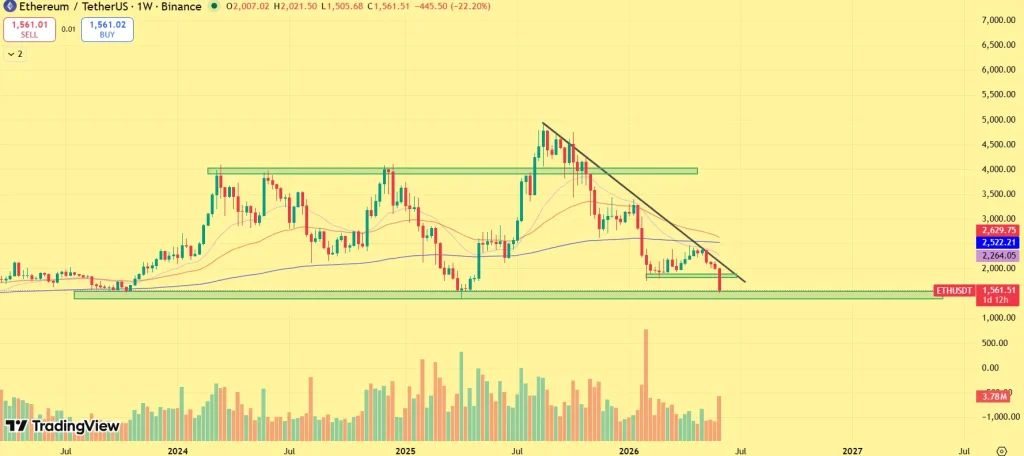
More importantly, liquidation heatmaps reveal heavy liquidity sitting above current price, particularly around the $1,500–$1,700 range. This matters because crypto markets are often drawn toward liquidity clusters, especially after sharp deleveraging events. If Ethereum stabilizes near current levels and begins reclaiming resistance, sidelined capital and short liquidations could quickly fuel a stronger rebound attempt.
However, the reversal thesis depends heavily on one condition: ETH must defend the $1,500 support region. Failure to hold this zone would weaken the recovery narrative and potentially expose Ethereum to another leg lower before any sustainable trend reversal begins.
Bottom Line
Ethereum price may be crashing, but beneath the panic, smart money behavior suggests the market narrative is becoming far more nuanced than price action alone implies. While retail sentiment remains fragile, whale accumulation, rising staking demand, and improving positioning data are quietly beginning to build a stronger reversal case around ETH.