
Fed’s Inflation Problem ‘Unambiguously Worse’ as It Forecasts 3 Rate Hikes in 2026
Key Takeaways
Bank of America forecasts three 25-basis-point Fed hikes in September, October, and December of this year.BofA Economist Aditya Bhave believes the Fed’s inflation problem has gotten “unambiguously worse” over the last couple of years.The projected hikes would lift the federal funds rate to 4.25%-4.5%, a headwind for crypto.
A Sharp Reversal
Bank of America’s economics team made the hawkish call this week, abandoning a forecast it had held as recently as the prior week that the Fed would leave rates unchanged through 2026. The bank now sees three consecutive quarter-point increases at the September, October, and December meetings, which would lift the federal funds rate to a range of 4.25% to 4.5%.
The driver, the bank said, is an inflation backdrop that has deteriorated under new Fed Chair Kevin Warsh, with BofA economist Aditya Bhave putting things as bluntly as possible:
“The Fed’s inflation problem has gotten unambiguously worse. Core PCE could reach 3.5% in May, nearly 70bp higher than it was a year ago. The pickup has been partly due to tariffs and other one-offs. The Fed was willing to look through the tariffs, but it is losing patience after the latest round of supply shocks.
He further added that housing-driven disinflation has now mostly run its course, even though other core services remain “very sticky.”
Inflation That Won’t Quit
BofA has argued that the disinflation that helped cool prices in prior years has largely run its course. “Housing-driven disinflation has now mostly run its course, while other core services remain very sticky,” Bhave subsequently wrote, pointing to the persistent price pressures that have frustrated policymakers.
The new Fed leadership has signaled it shares those concerns and following his first meeting as chair, Warsh referred to the importance of “price stability” roughly a dozen times, a repetition markets read as a clear hawkish signal. At that June 17 meeting, the Federal Open Market Committee (FOMC) held the benchmark rate at 3.5% to 3.75% but flagged that further increases could be warranted.
Energy costs tied to the Iran war have added to the pressure, and roughly half of Fed officials have now indicated that rate increases could be appropriate in 2026. Bank of America’s call effectively bets that the hawks will win the internal debate.
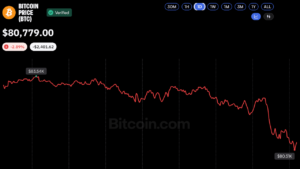
Lastly, higher interest rates are generally a headwind for bitcoin and other digital assets because when safe-haven yields rise, investors have less incentive to hold non-yielding, higher- volatility assets, and liquidity tends to drain from speculative markets. That said, not everyone agrees with the three-hike call, with some analysts questioning whether the Fed will move that aggressively given the risk to growth and employment.