Foundation Raises $6.4M to Build Hardware That Authorizes AI Agents in Real Time
Key Takeaways
Foundation raises $6.4M led by Fulgur Ventures, bringing total funding to $16.5M since its 2021 launch.Passport Prime launches at $349, targeting over 1M Cake Wallet users with KeyOS cold storage integration.Foundation plans a KeyOS app store by end of Q2 2026, expanding into AI agent and identity security.
Fulgur Ventures Backs Foundation $6.4M to Secure the Agentic Era With Passport Prime
Arche Capital also participated in the round, which brings Foundation’s total funding to approximately $16.5 million, according to the firm’s release on Thursday. The company previously raised a roughly $2 million pre-seed in 2021 and a $7 million seed round in 2022 led by Polychain Capital.
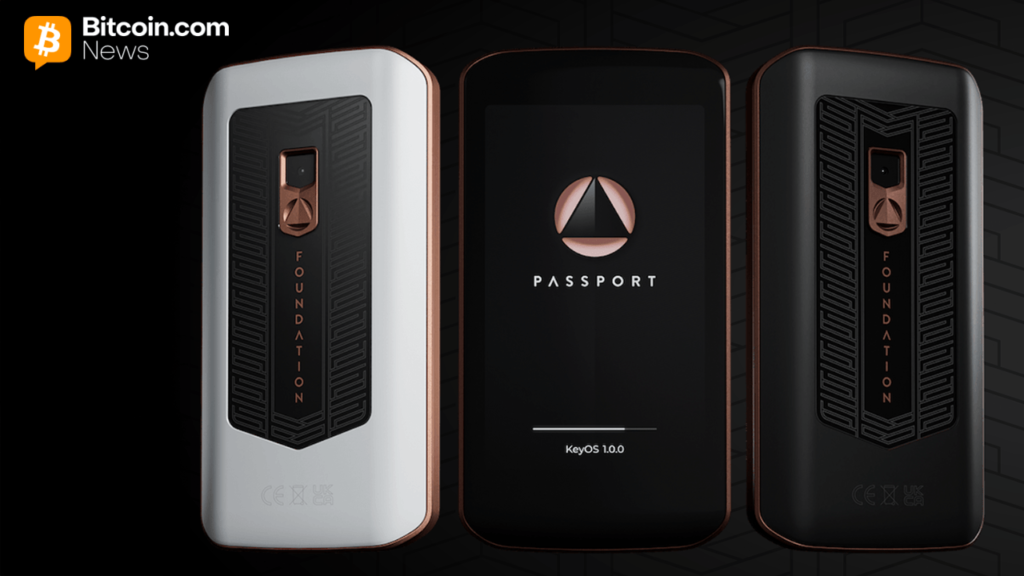
Alongside the funding, Foundation announced general availability of Passport Prime, its flagship security device, and opened the KeyOS developer platform to outside builders. Passport Prime began shipping to pre-order customers in March 2026 and is now available to the public starting at $349.
Passport Prime functions as a bitcoin hardware wallet, FIDO security key, two-factor authentication storage device, secrets vault, and 50GB encrypted file storage unit in a single handheld device. It runs KeyOS, a Rust-based microkernel operating system Foundation developed over three years, and communicates via QuantumLink, a post-quantum encrypted Bluetooth protocol using ML-KEM and ChaCha20-Poly1305 over an isolated chip. The device is manufactured in the United States at an ITAR-compliant facility.
Foundation CEO Zach Herbert said the company built Passport Prime to address a security gap that hardware wallets and FIDO keys were never designed to fill. “Every era has its key management problem. For bitcoin it was self-custody. For the agentic era it is who actually authorizes the decisions an AI agent takes on someone’s behalf,” Herbert said. “It has to be answered on dedicated hardware, with a display you can trust and an operating system you can inspect.”
The company calls this category “Human Authority Hardware,” dedicated devices that sit outside the software environment where an AI agent operates. The argument is that a browser prompt or phone notification running on the same machine as an agent cannot serve as a reliable checkpoint for high-stakes actions involving money, credentials, or sensitive data.
Fulgur Ventures Partner Oleg Mikhalsky said the firm backed Foundation because it applies self-custody principles at a broader scale. “Foundation is taking the discipline of self-custody, open source software, dedicated hardware, and explicit user approval, and extending it beyond bitcoin into identity, multi-factor authentication, and AI agent authorization,” Mikhalsky disclosed. “We are proud to support Foundation since their early stage.”
CTO Ken Carpenter described the shift in terms of what the device is actually doing. “A hardware wallet is a calculator. KeyOS is a computer,” Carpenter said. “The device stops being a box your keys sit in and becomes the trust layer for everything you do online.”
The KeyOS developer platform is now open. Developers can access the full SDK, CLI tooling, documentation, a simulator, and a USB-connected MCP server that lets AI coding agents build and test applications directly on Passport Prime hardware. Foundation plans to launch a KeyOS app store for all users by the end of Q2 2026.
Cake Wallet is the first outside team to ship on KeyOS, giving its more than one million users a cold storage option through the platform. Foundation said additional integrations across bitcoin, identity, and AI agent workflows are expected throughout 2026.
Arche Capital Partner Will Wolf, who led Foundation’s 2022 seed round while at Polychain Capital, said the KeyOS release delivers on the original thesis. “The long game was never just signing devices. It was secure hardware paired with a secure operating system that lets users manage their entire digital lives.”
The company positions Passport Prime against a gap in the existing hardware security market. Standard hardware wallets sign cryptocurrency transactions. FIDO keys authenticate users but do not provide a trusted display for reviewing what is being approved. Enterprise hardware security modules live in server infrastructure. None of those devices were built to sit in a user’s hand and approve actions taken by autonomous software agents.
Foundation’s expansion puts it alongside other hardware security companies exploring the intersection of AI agents and on-device authorization, a category that has grown as AI systems gain the ability to move money, access accounts, and execute actions across digital services at machine speed.
Foundation finds itself navigating a fiercely contested hardware wallet sector, where firms such as Trezor and Ledger continue benefiting from early-market positioning. Ledger has moved assertively to roll out a dedicated AI infrastructure roadmap, while Trezor has remained firmly committed to foundational hardware security and quantum resilience, seemingly choosing for the time being to keep AI at a measured distance.