Google Cloud’s Always-On Memory Agent Replaces RAG and Embeddings With Continuous LLM Consolidation on Gemini 3.1 Flash-Lite
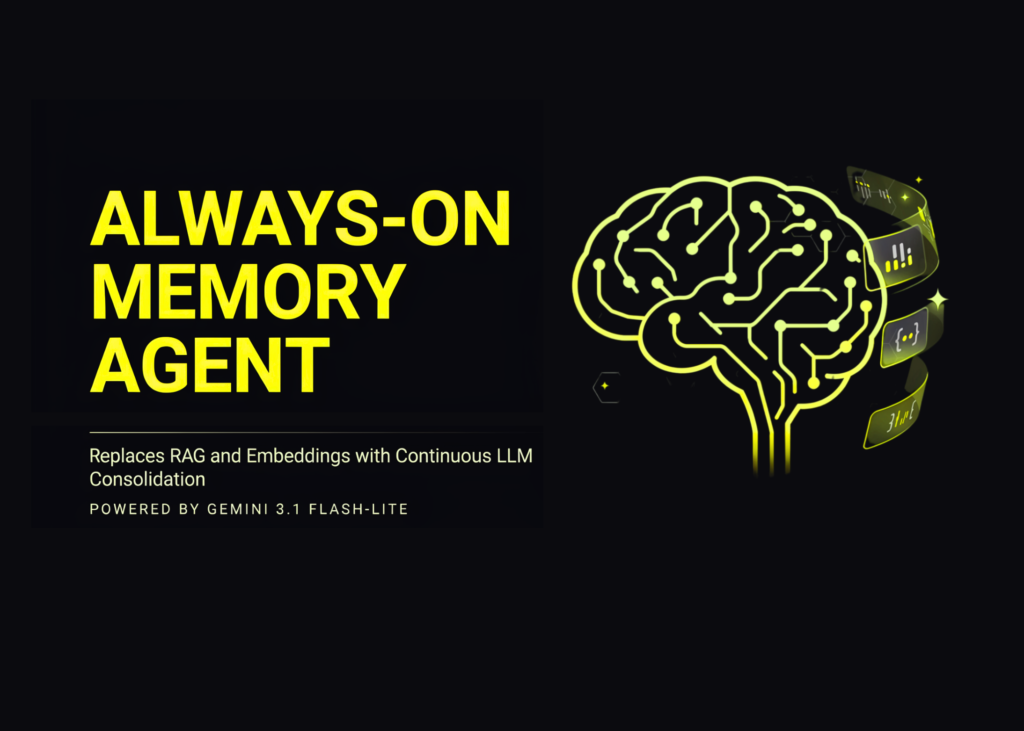
Most AI agents forget. They process a request, answer it, then drop the context. Google Cloud’s generative-ai repository now ships a sample that tackles this directly. It is the Always-On Memory Agent, a reference implementation that treats memory as a running process.
Always-On Memory Agent
Fundamentally, the project is a lightweight background agent that never stops. It runs 24/7 as a continuous process, not a one-shot call. It is built with Google ADK (Agent Development Kit) and Gemini 3.1 Flash-Lite. Notably, it uses no vector database and no embeddings. Instead, an LLM reads, thinks, and writes structured memory into SQLite. The model choice targets low latency and low cost for continuous background work.
How It Works: Ingest, Consolidate, Query
Architecturally, an orchestrator routes every request to one of three specialist sub-agents. Each sub-agent owns its own tools for reading or writing the memory store.
First, the IngestAgent handles incoming content. It uses Gemini’s multimodal capabilities to extract a summary, entities, topics, and an importance score. That structured record then lands in the memories table.
Next, the ConsolidateAgent runs on a timer, every 30 minutes by default. Like sleep cycles, it reviews unconsolidated memories and finds connections between them. Then it writes a synthesized summary, one key insight, and those connections to the database. Consequently, the agent builds new understanding while idle, with no prompt.
Finally, the QueryAgent answers questions. It reads all memories and consolidation insights, then synthesizes a response. Importantly, it cites the memory IDs it used as sources.
Supported Inputs
Beyond text, the IngestAgent accepts 27 file types across five categories. Simply drop any supported file into the ./inbox folder for automatic pickup.
How It Compares to RAG, Summaries, and Knowledge Graphs
To clarify the difference, it frames three common memory approaches. Each solves part of the problem, yet leaves a gap.
Unlike RAG, this agent processes memory actively, not only on retrieval.
Use Cases With Examples
Practically, the pattern fits any workload needing durable, evolving context. Consider three examples.
A research assistant ingests PDFs, meeting audio, and screenshots all week. Later, it links a cost target to a reliability problem on its own.
A personal knowledge base absorbs notes, articles, and images continuously. Over time, consolidation surfaces themes you never explicitly connected.
A support agent stores past tickets as structured memories. Then it answers new questions with cited references to earlier cases.
Getting Started
With the design clear, setup stays minimal for early-level engineers. Install dependencies, set your key, then start the process.
export GOOGLE_API_KEY=”your-gemini-api-key”
python agent.py
Once running, the agent watches ./inbox, consolidates every 30 minutes, and serves an HTTP API on port 8888. Therefore, you can also feed it over HTTP.
curl -X POST http://localhost:8888/ingest \
-H “Content-Type: application/json” \
-d ‘{“text”: “AI agents are the future”, “source”: “article”}’
# Ask a question
curl “http://localhost:8888/query?q=what+do+you+know”
Additionally, the API exposes /status, /memories, /consolidate, /delete, and /clear. An optional Streamlit dashboard adds ingest, query, browse, and delete controls. CLI flags change the watch folder, port, and consolidation interval.
Key Takeaways
No vector DB, no embeddings — an LLM reads, thinks, and writes structured memory into SQLite.
Runs 24/7 on Google ADK + Gemini 3.1 Flash-Lite as a lightweight background process.
Three sub-agents under one orchestrator: Ingest, Consolidate, and Query.
Consolidates every 30 minutes — links related memories and writes new insights while idle.
Ingests 27 file types across text, images, audio, video, and PDFs, dropped into ./inbox.
Check out the FULL CODES here. Also, feel free to follow us on Twitter and don’t forget to join our 150k+ML SubReddit and Subscribe to our Newsletter. Wait! are you on telegram? now you can join us on telegram as well.
Need to partner with us for promoting your GitHub Repo OR Hugging Face Page OR Product Release OR Webinar etc.? Connect with us
Michal Sutter is a data science professional with a Master of Science in Data Science from the University of Padova. With a solid foundation in statistical analysis, machine learning, and data engineering, Michal excels at transforming complex datasets into actionable insights.