
Gradium Launches stt-translate and s2s-translate, Real-Time Speech Translation Models Beating gpt-realtime-translate on Accuracy and Latency
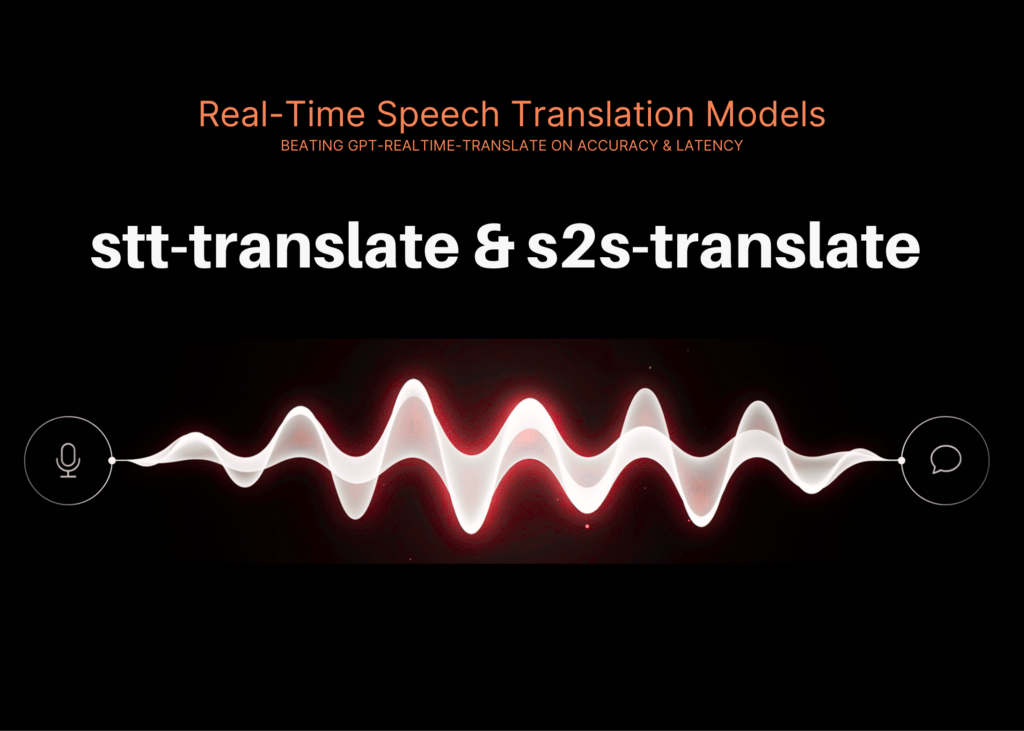
Gradium today released two real-time speech translation models: stt-translate and s2s-translate. Both run across five languages and stream results live in the browser.
Gradium claims a better accuracy-latency tradeoff than gpt-realtime-translate and gemini-3.5-live-translate. It also adds output voice control, including cloning, that gpt-realtime-translate lacks.
TL;DR
Gradium launched two real-time speech translation models: stt-translate (speech → text) and s2s-translate (speech → speech).
They cover five languages (EN, FR, DE, ES, PT) and 20 pairs, collapsing the usual 3-model cascade into 2.
Accuracy leads gemini-3.5-live-translate on BLEU and MetricX, and beats gpt-realtime-translate on BLEU (comparable on MetricX).
Latency averages 3.0s — ahead of gpt-realtime-translate (3.6s), just behind gemini-3.5-live-translate (2.9s).
Unlike gpt-realtime-translate, you pick the output voice or clone your own, all over one duplex WebSocket.
stt-translate
stt-translate takes speech in one language and returns text in another. It supports English (EN), French (FR), German (DE), Spanish (ES), and Portuguese (PT).
Any source maps to any target across that set. That is 20 language pairs in total, in every direction.
The key design choice is collapsing two steps into one. Transcription and translation happen in a single pass, inside the speech model. There is no intermediate transcript to wait on and no handoff between systems.
According to Gradium: the approach draws on the Hibiki-Zero framework. The model optimizes low latency and high accuracy jointly through Reinforcement Learning. This means fewer moving parts in the pipeline.
s2s-translate
s2s-translate turns spoken audio in one language into spoken audio in another, end to end. It builds on stt-translate and pairs it with a Gradium TTS model in one service.
You stream audio in over a WebSocket. You receive both the synthesized output audio and the translated transcript as they are produced.
That removes integration work. You do not wire STT and TTS together yourself or manage two connections. The server runs the pipeline and streams results back.
Input audio is PCM at 24 kHz, 16-bit signed mono. Output audio is PCM at 48 kHz, 16-bit signed mono. WAV, Opus, mu-law, and A-law are also supported.
How Gradium Measures Quality: BLEU and MetricX
Translation quality is not one number, so Gradium reports two complementary metrics:
BLEU (Bilingual Evaluation Understudy) is the long-standing machine translation standard (Papineni et al.). It measures n-gram overlap between model output and human reference translations. It runs from 0 to 100, where higher is better.
BLEU is fast, reproducible, and comparable across systems. Its limit is that it rewards surface word matching. A correct translation using different wording can be penalized.
MetricX is a learned, neural quality metric developed by Google (Juraska et al.). It predicts how a human would rate a translation. It is an error score, so lower is better, and it tracks human judgment more closely than BLEU.
The two catch different failures. BLEU checks lexical fidelity; MetricX checks semantic adequacy.
Benchmark
Gradium benchmarks on a proprietary dataset of conversational speech. The data reflects everyday topics like work, travel, and weather, rather than scripted text.
Against gemini-3.5-live-translate, Gradium leads on both BLEU and MetricX. Against gpt-realtime-translate, Gradium leads on BLEU and is comparable on MetricX.
Accuracy (BLEU and MetricX) is measured on stt-translate‘s translation; latency is for the full s2s-translate pipeline. Read it as a tradeoff, not a clean sweep. Gemini is fractionally faster; Gradium is more accurate and adds voice control.
Why Two Models Beat Three
The standard speech-to-speech stack uses three models: Speech-To-Text, then Text-To-Text translation, then Text-To-Speech. Each stage is a separate inference call. Each adds processing time and a handoff.
Gradium uses two. stt-translate performs transcription and translation in a single pass. The dedicated Text-To-Text stage disappears entirely.
That removes one full model from the critical path, along with its latency and handoff. The end-to-end path is shorter than a three-model cascade at equivalent quality.
The numbers back the design. s2s-translate averages 3.0s across all language pairs. That beats gpt-realtime-translate at 3.6s and sits near gemini-3.5-live-translate at 2.9s.
Use Cases With Examples
Live dubbing and localization: Clone a presenter’s voice once. Translate a French keynote into Spanish that still sounds like the original speaker.
Multilingual voice agents: Route a support call through s2s-translate. An English agent hears a German caller in English, and replies stream back in German.
Real-time meetings: Pipe microphone audio in over the WebSocket. Each participant receives translated speech and transcript in their own language.
Accessibility and captioning: Use stt-translate alone when you only need text. Render live translated captions without generating audio.
Translate in a Few Lines of Code
The Python SDK streams audio through the Speech-To-Speech endpoint and returns translated audio plus transcript.
import numpy as np
from gradium import client as gradium_client
grc = gradium_client.GradiumClient() # reads GRADIUM_API_KEY from the environment
setup = {
“model_name”: “s2s-translate”,
“input_format”: “pcm_24000”, # 24 kHz, 16-bit signed mono input
“output_format”: “pcm_48000”, # 48 kHz, 16-bit signed mono output
“voice_id”: “cLONiZ4hQ8VpQ4Sz”, # must be a voice in the target language
“stt_model_name”: “stt-translate”,
“tts_model_name”: “default”,
“target_language”: “en”,
}
# Raw 24 kHz, 16-bit mono PCM bytes (from a file, buffer, or microphone).
with open(“input_24k_mono.pcm”, “rb”) as f:
pcm = f.read()
async def main() -> np.ndarray:
audio_out: list[bytes] = []
async with grc.s2s_realtime(wait_for_ready_on_start=True, **setup) as s2s:
async def send_loop():
for i in range(0, len(pcm), 1920): # 1920 bytes = 40 ms at 24 kHz
await s2s.send_audio(pcm[i : i + 1920])
await s2s.send_eos() # signal end of input
async def recv_loop():
async for msg in s2s:
if msg[“type”] == “audio”:
audio_out.append(msg[“audio”]) # translated speech (bytes)
elif msg[“type”] == “text”:
print(msg[“text”], end=” “, flush=True) # translated transcript
elif msg[“type”] == “end_of_stream”:
break
async with asyncio.TaskGroup() as tg:
tg.create_task(send_loop())
tg.create_task(recv_loop())
return np.frombuffer(b””.join(audio_out), dtype=np.int16) # 48 kHz mono PCM
translated_pcm = asyncio.run(main())
The SDK exposes three ways to drive S2S. Use s2s_realtime for live sources, s2s_stream for finite iterables, and s2s for buffered files. All three talk to wss://api.gradium.ai/api/speech/s2s.
Strengths and Weaknesses
Strengths
Single-pass stt-translate removes one model from the latency path
Leads gemini-3.5-live-translate on both BLEU and MetricX
Output voice choice and cloning, which gpt-realtime-translate lacks
One duplex WebSocket replaces a hand-wired STT-plus-TTS pipeline
Weaknesses
Five languages at launch, with 20 pairs only across that set
gemini-3.5-live-translate is fractionally lower latency at 2.9s
MetricX is only comparable to, not ahead of, gpt-realtime-translate
Benchmarks use a proprietary dataset, so external replication is limited
Interactive Explainer
You can test real-time translation in the browser at gradium.ai/translate, with integration details in the API docs. Also, feel free to follow us on Twitter and don’t forget to join our 150k+ML SubReddit and Subscribe to our Newsletter. Wait! are you on telegram? now you can join us on telegram as well.
Need to partner with us for promoting your GitHub Repo OR Hugging Face Page OR Product Release OR Webinar etc.? Connect with us