
Harvey Introduces Harvey Tenet: A Kimi K3 Base Post-Trained with Fireworks for Long-Horizon Legal Agent Work
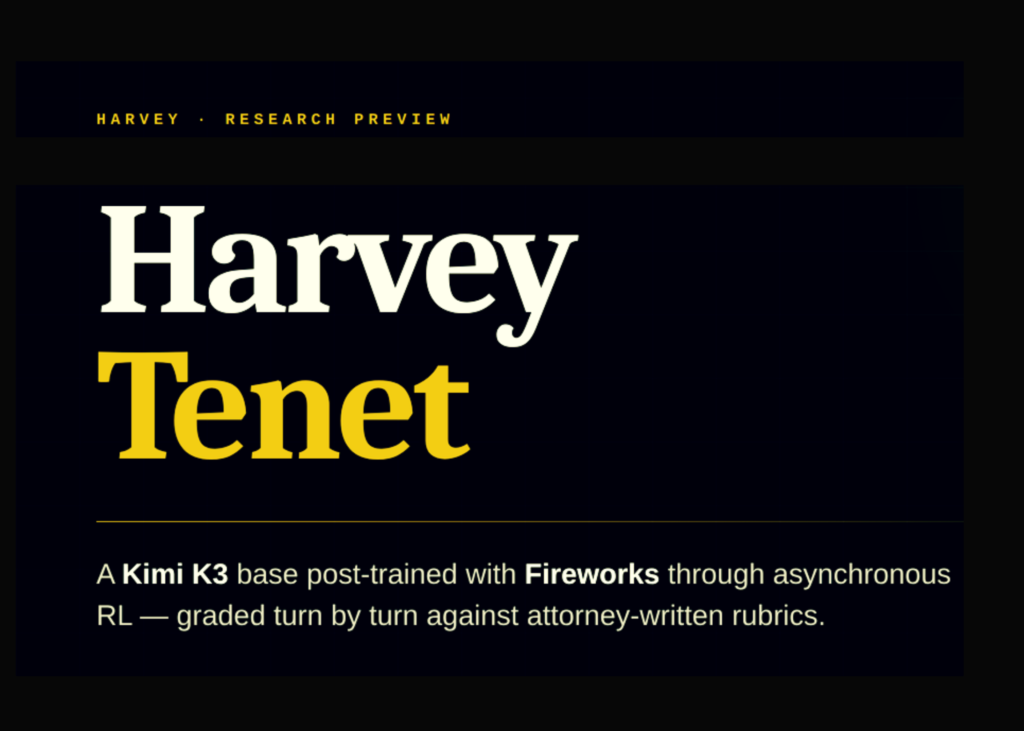
Harvey has released Harvey Tenet, its first post-trained model, as a research preview as of today. Tenet is a Kimi K3 base post-trained with Fireworks through asynchronous reinforcement learning on long-horizon legal work. The training corpus combined synthetic data, publicly available legal data, and human expert data. Harvey states no customer data was used. Against the base K3 model, Tenet completes almost twice as many held-out tasks on Harvey’s Legal Agent Benchmark (LAB) and 20% more on LAB: Contracts, raising all-pass rate by 9 and 2 percentage points respectively. Harvey reports state-of-the-art on LAB: Contracts and second place on LAB. The gains also transferred, untrained, to Mercor’s APEX Agents and Crosby’s Redline Bench. The stated goal is twofold: build frontier legal intelligence on open-weight models, and give law firms a path to own their own specialized models.
Is it deployable?
Not yet, Harvey Tenet is a research preview announced on August 20, 2026. Harvey has not published weights, a model card, or an API endpoint. The base model is open-weight; Tenet itself is Harvey’s own checkpoint, and the company says the work will move “from research to production” inside Harvey’s products over time. What ships today is the recipe, not the artifact.
Company tier: Enterprise only. Access runs through Harvey’s platform, which is sold to law firms, mid-sized firms, and in-house legal teams. A lab with an RL stack could reproduce the method; training used roughly 150 NVIDIA B300 GPUs over two months.
Industries: Legal services, corporate in-house legal, private equity and investment banking (M&A diligence), plus regulated sectors where contract volume drives cost — insurance, financial services, healthcare, energy.
Applications: M&A due diligence memos over datarooms, contract drafting, review and redlining, structured extraction across up to 10,000 documents, and precedent search over a firm’s accumulated knowledge.
What the numbers say
Against the base K3 model, Tenet completes almost twice as many held-out tasks on Harvey’s Legal Agent Benchmark (LAB) and 20% more on LAB: Contracts, lifting all-pass rate by 9 and 2 percentage points respectively. Harvey reports state-of-the-art on LAB: Contracts and second place on LAB, using base-model scores from Vals.
The more interesting result is transfer. Tenet also improves substantially on Mercor’s APEX Agents (corporate law) and Crosby’s Redline Bench — neither seen during training — while holding performance on knowledge benchmarks including LegalBench, CUAD, MAUD, and Scale’s PRBench. Agentic training did not erode textbook legal reasoning.
Cost is co-optimized rather than traded away. Open weights lower price per token; reward shaping that prefers shorter trajectories at equal quality lowers tokens consumed. Harvey reports significant quality gains at stable cost.
How it was trained
Training used asynchronous reinforcement learning in sandboxed legal environments built like LAB tasks: a partner-style instruction averaging about 50 words, a client matter of key and peripheral documents, and an expert rubric of atomic pass/fail criteria — roughly 50 per task, hundreds at the extreme. A single rollout can exceed 1,000 turns.
Rollouts are graded by LLM-as-a-judge; ablations settled on Kimi 2.6. Reward combines the fraction of rubric criteria satisfied, a holistic count of legal issues solved, and an all-pass bonus. The policy is optimized with GSPO using a rank-64 LoRA over the full K3 network, eight task groups of eight rollouts per optimizer step, across ~1,750 environments and >10,000 rollouts per epoch. Fireworks co-built trainer and rollout deployments at the kernel level, with token-in-token-out and router replay, to keep a large MoE numerically aligned across training and inference.
Three capabilities trained separately
Harvey team also post-trained specialist models that Tenet can route to as tools or sub-agents:
M&A diligence: On LAB: Diligence, a single task can traverse up to 80M tokens; no baseline passed more than 43.8% of criteria. With Baseten, Harvey moved to a Recursive Language Model harness where a root agent holds the dataroom in a REPL and delegates to sub-agents. A GLM-5.2 orchestrator alone reached 46.1%; post-training it in that harness via self-distillation reached 60.1%.
Review Table: With Applied Compute, a post-trained GLM-5.2 improved answer quality by 3.6 points and citation quality by 12.1 points at roughly one-tenth the cost per cell, learning to abstain when a question does not apply.
Firm knowledge: With Engram, a Qwen3.8-27B model studies ~100M tokens of client matters into 1M tokens of structured knowledge plus parametric memory. Criteria pass rate rose more than 15%, tokens in completed trajectories fell 58%, and cost per query dropped roughly 90% — 190.8 intelligence-per-token versus 129.3 for the best frontier configuration.
Marktechpost Independent Test Facts
19Claims
1Verified
10Self-reported
6Flagged
2Unverifiable
Nothing Harvey published was contradicted. The score is high because Tenet appears on no public leaderboard — not Vals, not Artificial Analysis, not Mercor. Score formula: (8 × 6 flags) + (15 × 0 contradicted) + (3 × 10 self-reported) = 78.
Claim table
ClaimNumberIndependent checkVerdict
Completes ~2× more LAB held-out tasks than Kimi K3 base
≈ 2×
Not on any public board
Self-reported
LAB all-pass rate lift
+9 pts
Same result stated as “+82%” on X
Flag F1
LAB: Contracts all-pass lift
+2 pts
No public leaderboard exists
Self-reported
State-of-the-art on LAB: Contracts
SOTA
Benchmark owned, run and graded by Harvey
Flag F2
Places second on LAB
#2
Vals #1 is Muse Spark 1.1 at 20.00%; Harvey-run, tool delta never quantified
Flag F3
Kimi K3 base on APEX Agents, corporate law
58.8%
58.8% (Kimi K3 Max) — matches exactly
Verified
Tenet substantially beats K3 base on APEX Agents
—
Harvey harness alone: 58.8% → 67.5%
Flag F4
Beats K3 base on Crosby Redline Bench
Not given
Absent from the public leaderboard
Self-reported
APEX v1 Big Law Associate held — a knowledge benchmark, not the agentic board
Not given
Blind run commissioned from Mercor; not posted to the public v1 board
Self-reported
Holds on LegalBench, CUAD, MAUD
“strong”
Non-canonical metrics, applied to all models
Self-reported
PRBench hard subset
36.0 → 36.8%
Harvey calls it not statistically significant
Self-reported
LAB: Diligence criteria pass rate
43.8 → 60.1%
No public leaderboard
Self-reported
Review Table cost per cell
≈ 1/10
Baseline model never named
Flag F6
Firm Knowledge intelligence-per-token
190.8
Engram write-up; metric is Harvey’s own
Self-reported
“Our first post-trained open-weight model”
—
Business Insider: proprietary, in-house
Flag F5
“Less than a fourth the cost of leading foundation models”
< 25%
X only; comparators unnamed
Flag F7
≈150 NVIDIA B300 GPUs, 2 months, GSPO + rank-64 LoRA
—
Unverifiable by construction
Not checkable
No customer data used in post-training
—
Unverifiable by construction
Not checkable
Flags explained
F1 · Denominator gameThe blog reports +9 and +2 percentage points. The X thread reports the same result as +82% and +22%. Both true; the social number sounds nine times larger.
F2 · Self-report as fact“SOTA on LAB: Contracts” is a win on Harvey’s own benchmark. Harvey states there is no public leaderboard for it and that all scores are internal Harvey runs. LAB launched deliberately without a leaderboard.
F3 · Settings mismatchHarvey disclosed this plainly: Tenet ran in the standard public harness plus a finish tool carried over from training, while rival scores came from Vals. The flag is about comparability, not concealment — Harvey never published LAB with and without the tool, so its value is unquantified. Harvey’s own APEX figures show a harness change moving bare K3 by 8.7 points, and the LAB claim is a rank where Vals’ leaders sit between 12% and 20%.
F4 · Settings mismatchOn APEX Agents, Tenet ran in Harvey’s internal bash harness while rivals used Mercor’s published numbers. Harvey discloses the harness lifts bare K3 from 58.8% to 67.5% — within 0.1 pt of leader Fable 5 at 67.4%, before any training.
F5 · Framing“Open-weight” describes the Kimi K3 base, not Tenet. No weights, model card or API were published, yet multiple outlets ran headlines calling Tenet itself an open-weight release.
F6 · Denominator game“Roughly one-tenth the cost per cell” is measured against unnamed “strongest baselines,” with no serving config, precision or hardware given for either side.
F7 · Denominator game“Less than a fourth the cost of leading foundation models” appears only on X. The comparators are unnamed and list price is not separated from measured token consumption.
Credit where dueHarvey had Mercor run APEX v1 blind, without disclosing runs, tasks or task-level scores back to Harvey — the strongest verification method in the post, though it evidences knowledge retention rather than agentic skill. Harvey also volunteered a null result on PRBench, documented its divergences from Artificial Analysis and Vals, and disclosed the harness effect in F4 that undercuts its own APEX framing.
Key Takeaways
Tenet is a post-trained Kimi K3 checkpoint, not a public open-weight release — no weights, no API.
Gains transferred untrained to APEX Agents and Redline Bench, suggesting learned behavior, not benchmark fitting.
Reward shaping on trajectory length made quality and cost improve together instead of trading off.
The specialist stack — RLM diligence, Review Table, firm memory — is where the largest deltas landed.
Check out the TECHNICAL DETAILS here. Also, feel free to follow us on Twitter and don’t forget to join our 150k+ML SubReddit and Subscribe to our Newsletter. Wait! are you on telegram? now you can join us on telegram as well.
Need to partner with us for promoting your GitHub Repo OR Hugging Face Page OR Product Release OR Webinar etc.? Connect with us
Asif Razzaq is the CEO of Marktechpost Media Inc.. As a visionary entrepreneur and engineer, Asif is committed to harnessing the potential of Artificial Intelligence for social good. His most recent endeavor is the launch of an Artificial Intelligence Media Platform, Marktechpost, which stands out for its in-depth coverage of machine learning and deep learning news that is both technically sound and easily understandable by a wide audience. The platform boasts of over 2 million monthly views, illustrating its popularity among audiences.