
Onchain Data Locks In Satoshi’s 1.1M BTC Hoard — 3 Theories on Why It Never Moves
Key Takeaways
Researcher Sergio Lerner’s Patoshi Pattern mapped roughly 1.1M BTC to Satoshi across 22,000 addresses with statistical near-certainty.Satoshi’s last recorded bitcoin transfer was 32.51 BTC to developer Mike Hearn, approximately 16 years ago.If Satoshi’s 5.47% share of the total BTC supply ever moves, market observers expect immediate market disruption and potential identity exposure.
What the Numbers Show
The estimate places Satoshi‘s holdings at approximately 1.09 million to 1.1 million BTC, representing about 5.47% of bitcoin’s fixed 21 million supply cap. The coins are distributed across an estimated 22,000 distinct wallet addresses, each holding exactly 50 BTC from early block rewards.
No address in this cluster has recorded an outbound transaction in over 15 years, according to onchain data reviewed by analysts at Arkham Intelligence and other independent blockchain researchers.
The Patoshi Pattern
The holdings were not self-reported. They were reconstructed through cryptographic forensics, most notably by blockchain researcher Sergio Demian Lerner, who published his initial findings in 2013 and updated them in 2020.
Lerner’s method centered on an anomaly he called the Patoshi Pattern, named after his designation for the dominant early miner. In Bitcoin’s first year, the network was small enough that one entity accounted for roughly 22% of all blocks mined.
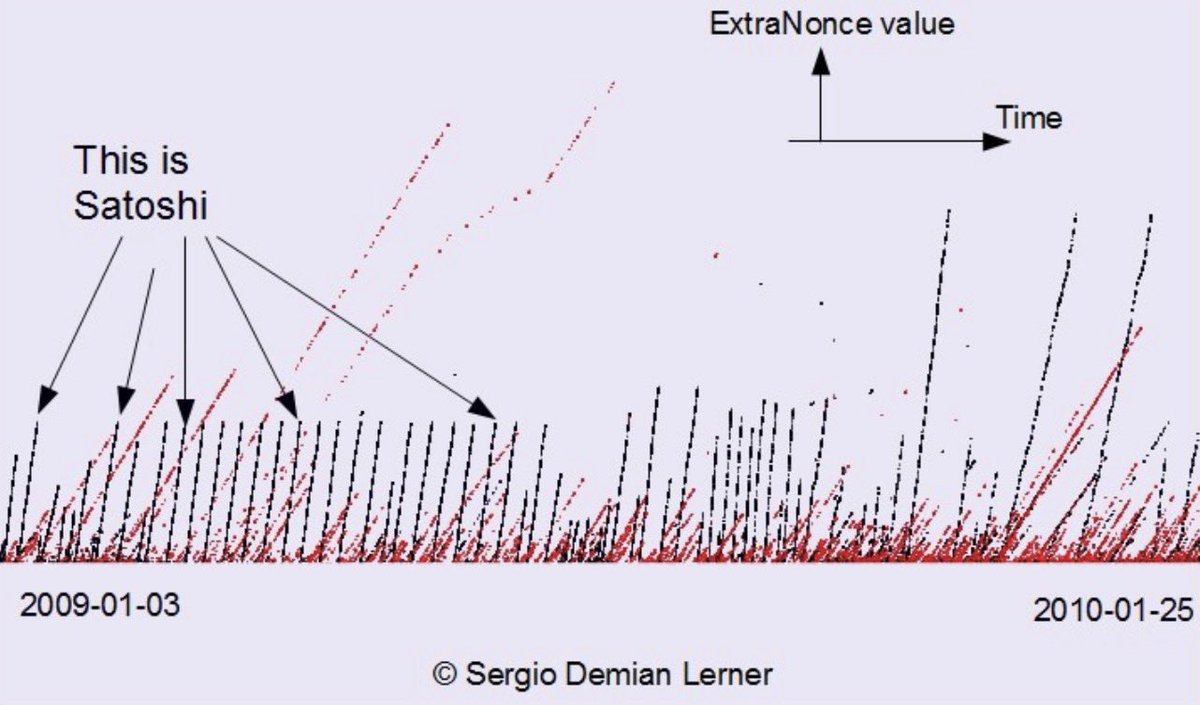
Lerner extracted the ExtraNonce field from the coinbase transaction of the first 50,000 blocks and plotted those values against block height. While most early miners produced scattered, irregular distributions, one miner left steep, contiguous linear segments, indicating a single machine, or cluster of synchronized machines, finding blocks with exceptional speed and consistency.
The pattern traces directly to Block 0, the Genesis Block mined on January 3, 2009.
Custom Software, Not the Public Client
Further analysis of nonce values confirmed the dominant early miner was not running the public Bitcoin v0.1 client. Standard software scanned the 32-bit nonce space sequentially. Patoshi’s blocks showed a constrained distribution in the Least Significant Byte (LSB) of the nonce.
Analysts determined this reflected a custom multi-threaded setup. Each thread was assigned a specific LSB sub-range to scan, preventing redundant work across parallel processes. This architecture left a non-random fingerprint permanently etched into the blockchain.
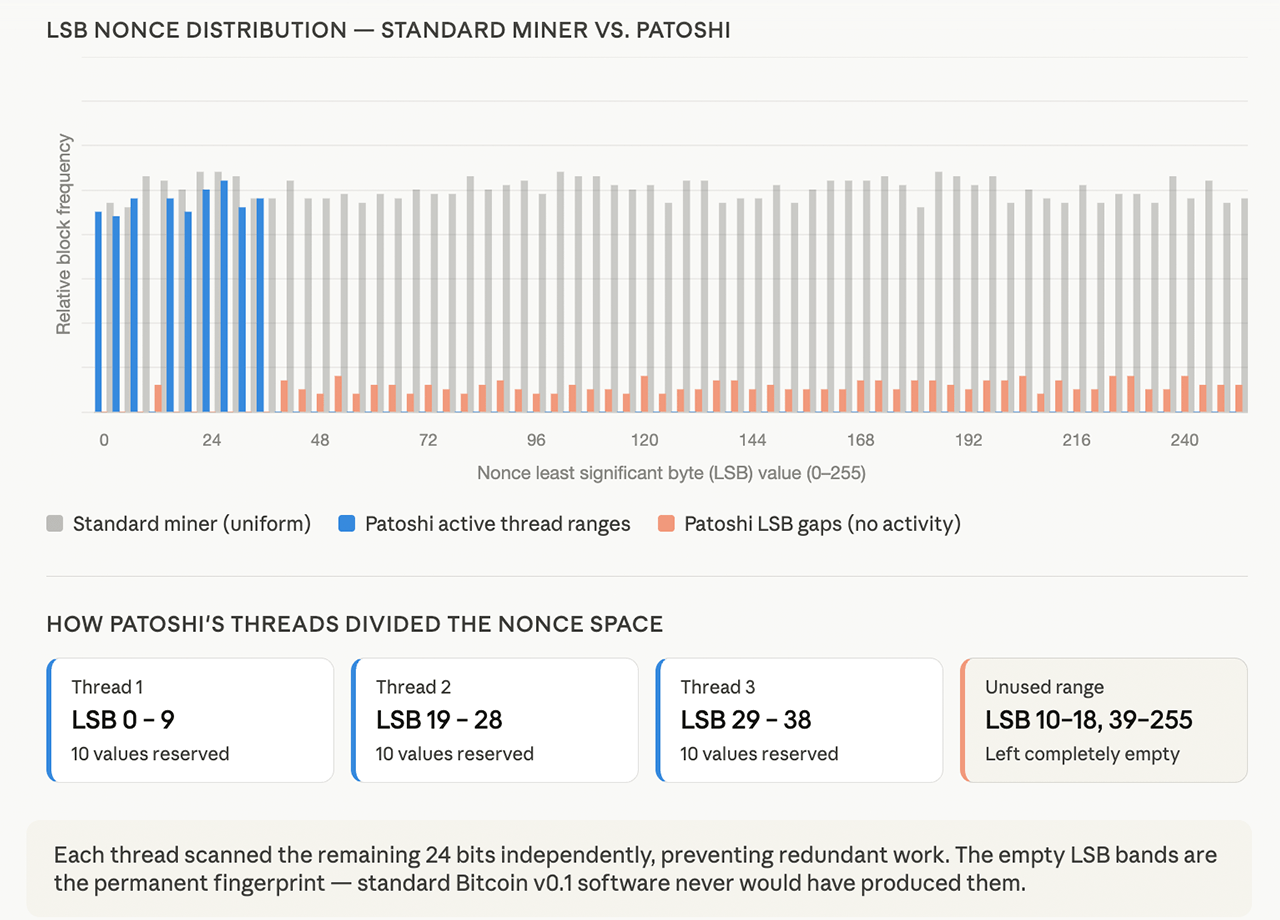
The combination of ExtraNonce slope clustering and LSB threading restrictions has led researchers to conclude, with high statistical confidence, that one entity mined approximately 1.1 million BTC during the network’s earliest phase. Around block 54,000, in late 2010, the Patoshi signature disappears entirely, aligning with Satoshi’s exit from the project.
The Genesis Address
The most widely recognized address in the cluster is 1A1zP1eP5QGefi2DMPTfTL5SLmv7DivfNa, which received the 50 BTC reward for the Genesis block. Due to how the first block was coded, those original coins cannot be spent. The community has since sent additional BTC to the address as a tribute. No outbound transfer has ever been recorded from it.
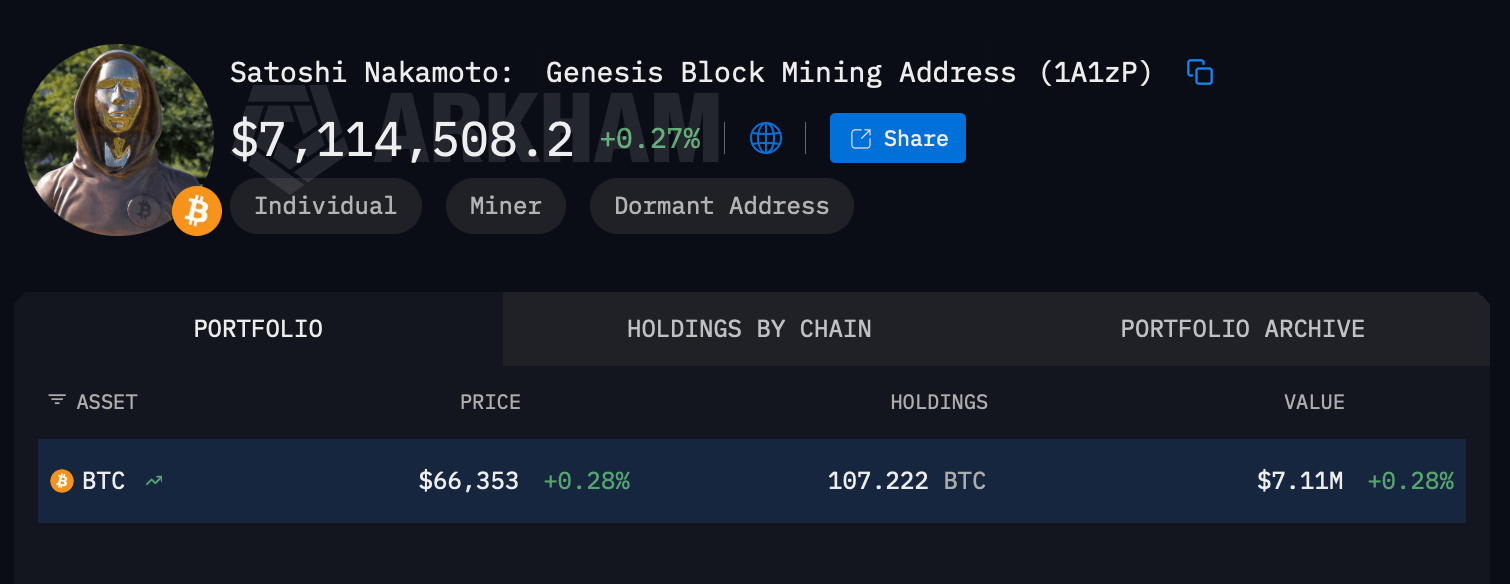
The Genesis block mining address as of June 16, 2026, holds approximately 107.22210303 BTC valued at $7.11 million today.
The Two Known Transactions
Satoshi sent bitcoin on two documented occasions while still active on the network.
On January 12, 2009, nine days after the Genesis Block, Satoshi sent 10 BTC to cryptographer Hal Finney to test the network. Arkham has also noted that Satoshi’s last known outflow, recorded approximately 16 years ago, involved a 32.51 BTC transfer to developer Mike Hearn.
“Hi Satoshi, I sent you 32.51 coins, my bitcoin address is 1JuEjh9znXwqsy5RrnKqgzqY4Ldg7rnj5n,” Hearn wrote on April 18, 2009. “I sent back 32.51 and 50.00,” Satoshi replied. “I badly wanted to find some way to include a comment with indirect transfers, but there just wasn’t a way to do it.”
Nakamoto added:
“ Bitcoin uses EC-DSA, which was essential for making the block chain compact enough to be practical with today’s technology because its signatures are an order of magnitude smaller than RSA. But EC-DSA can’t encrypt messages like RSA, it can only be used to verify signatures.”
Satoshi sent a final email in April 2011 stating they had “moved on to other things.” The coins have not moved since.
Why the Coins Stay Put
Three explanations dominate the conversation among researchers and long-term bitcoin holders.
Lost keys: In 2009, bitcoin had no monetary value and no standardized key management tools. Private keys stored on a hard drive could have been deleted or lost before the network gained traction. Death: If Satoshi was an individual who has since died, including candidates such as Hal Finney and cypherpunk Len Sassaman, both deceased, the keys may no longer exist. Ideological choice: A third theory holds that Satoshi is alive and deliberately refraining from moving the coins to protect the network’s decentralization narrative.
What a Move Would Mean
If any bitcoin from the Patoshi cluster were transferred, the market impact would be immediate and severe. The event would remove a widely held assumption that this supply is permanently out of circulation, introducing a major liquidity shock.
It would also trigger chain analysis. Any outbound transfer would expose routing data, potentially linking Satoshi’s identity to a known exchange or wallet service requiring KYC verification.
For now, the dormant coins remain where they have always been, mapped and visible on the public ledger, but unreachable by anyone other than whoever, if anyone, still holds the keys.