
PolyAI Releases Dialog-RSN-1: An Audio-Native Dialog Model That Fuses Turn-Taking, Speech Recognition, Function Calling, And Response
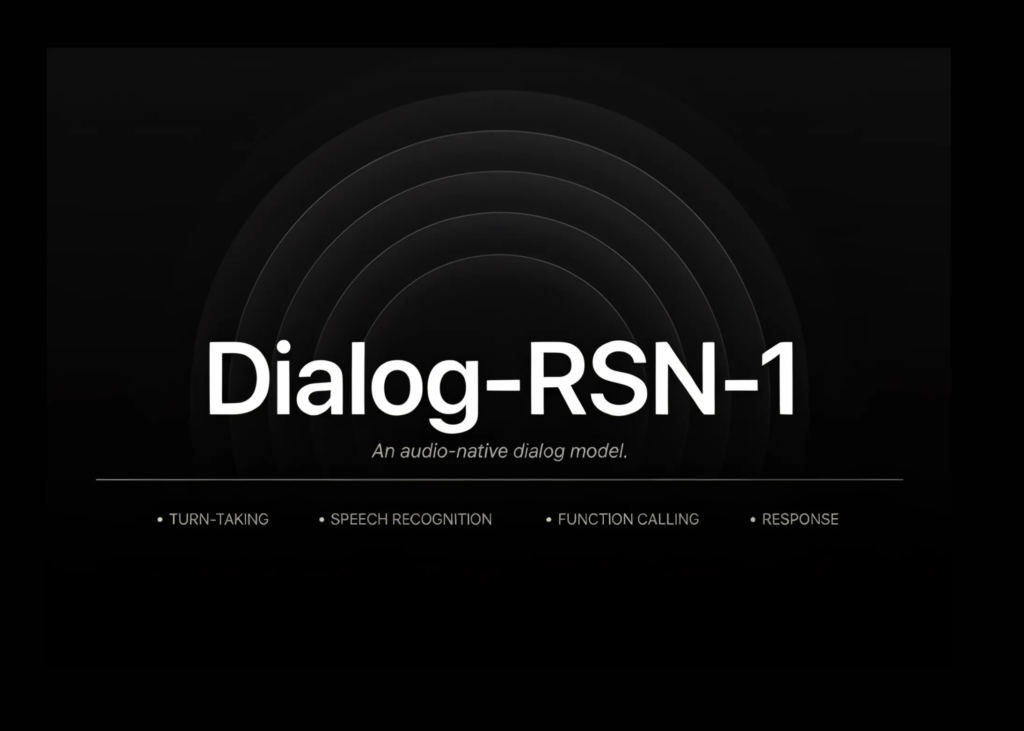
PolyAI has introduced Dialog-RSN-1, a dialog model that perceives the caller’s audio directly instead of reading a transcript. It fuses turn-taking, speech recognition, function calling and response generation into one audio-native model, and is already handling live production calls.
Key Takeaways
Dialog-RSN-1 is audio-aware on the input side only; TTS stays separate, so the output voice remains controllable.
It runs as a request-based LLM probed on demand, not an always-on stream that pins a GPU.
Turn-taking is the model’s first output token: EMPTY, ONGOING or COMPLETE.
PolyAI reports sub-300ms responses, +11% relative containment at a restaurant group, and −37% latency at an insurer.
English only at launch, delivered through PolyAI’s platform rather than open weights or a public API.
Is it deployable, and by whom?
Yes, but only through PolyAI: no open weights, no public API yet. Existing customers can enable it today; new customers can request early access.
Company level: large, high-call-volume enterprises. PolyAI reports 100+ enterprise customers and 2,000+ live deployments at its $86M Series D in December 2025. Self-serve developers and SMBs are not the target.
Industries: restaurants, insurance, financial services, healthcare, hotels, retail, telecom, travel and utilities.
Applications: booking and reservations, billing and payments, authentication, call routing, order management and troubleshooting.
The architecture
Two architectures dominate, and each concedes something. A cascaded stack sends only the ASR’s best guess to the LLM, so tone, hesitation and recognition uncertainty are gone before the LLM sees anything. Tuning means hand-adjusting end-pointing parameters and ASR biasing that rarely generalize across use cases. Speech-to-speech models such as GPT Realtime and Gemini Live keep the audio but bake the voice into the model, limiting pronunciation control, and always-on full-duplex variants pin a GPU for the entire call.
Dialog-RSN-1 is audio-aware on input only: one model reasons over raw audio and hands generation to a separate, promptable TTS system. It is probed on demand rather than streamed: a high-recall VAD plus a few timers decide when to run it, and the first token of the reply settles whether the agent should speak. Cheap acoustic cues only choose when to ask; the model, with full context, makes the actual turn-taking call.
How it was built
PolyAI post-trained open-weight multimodal models with supervised and reinforcement finetuning on in-house data. The pipeline is broadly base-model agnostic; PolyAI evaluated Gemma, GPT-OSS, Qwen and Mistral. Targeting sub-300ms on A100 GPUs puts candidates in the 8B dense to 30B sparse range. Latency work includes prefilling the attention cache while the user speaks, an append-only prompt template to minimize cache invalidation, routing each caller to the same GPU, a finetuned speculative drafter with mean acceptance of 3.9 tokens, and auto-reasoning learned during RFT. Transcription runs last, after the response or tool call, in parallel with speech generation.
Results
PolyAI evaluated on Dialog-Eval, an internal benchmark it plans to open-source. Each example is a call truncated at one decision point, scoring a single atomic next step rather than a full rollout. PolyAI reports Dialog-RSN-1 as the highest-scoring real-time capable model, puts the cascaded Audio-score ceiling near 77, and notes GPT Realtime 2.1 scoring on par with cascades on audio-aware examples. On transcription, gpt-4o-transcribe’s WER improved from 7.8% to 6.9% once given the same context, with Dialog-RSN-1 lower still.
For this release PolyAI focused on English; Raven 3.5 remains its recommendation for non-English and rich web chat. A technical report and a Dialog-Eval paper are planned.
Check out the Technical details here. Also, feel free to follow us on Twitter and don’t forget to join our 150k+ML SubReddit and Subscribe to our Newsletter. Wait! are you on telegram? now you can join us on telegram as well.
Need to partner with us for promoting your GitHub Repo OR Hugging Face Page OR Product Release OR Webinar etc.? Connect with us
Michal Sutter is a data science professional with a Master of Science in Data Science from the University of Padova. With a solid foundation in statistical analysis, machine learning, and data engineering, Michal excels at transforming complex datasets into actionable insights.