
Polymarket Gives Eisenkot 55% Odds to Unseat Netanyahu
Key Takeaways
Polymarket odds give Gadi Eisenkot a 56% chance to unseat Prime Minister Netanyahu in the Oct. 27 election.Traditional polls show Eisenkot leading but lacking a majority, meaning his victory requires a coalition.The Israel Democracy Institute urged regulators to restrict publishing these betting odds before elections.
Prediction Markets Face Yet Another Test In Upcoming Israel Elections
Prediction markets are signaling that Israel will elect a new Prime Minister in October’s 27 elections, predicting an upset victory that would unseat Benjamin “Bibi” Netanyahu, the nation’s longest-serving prime minister.
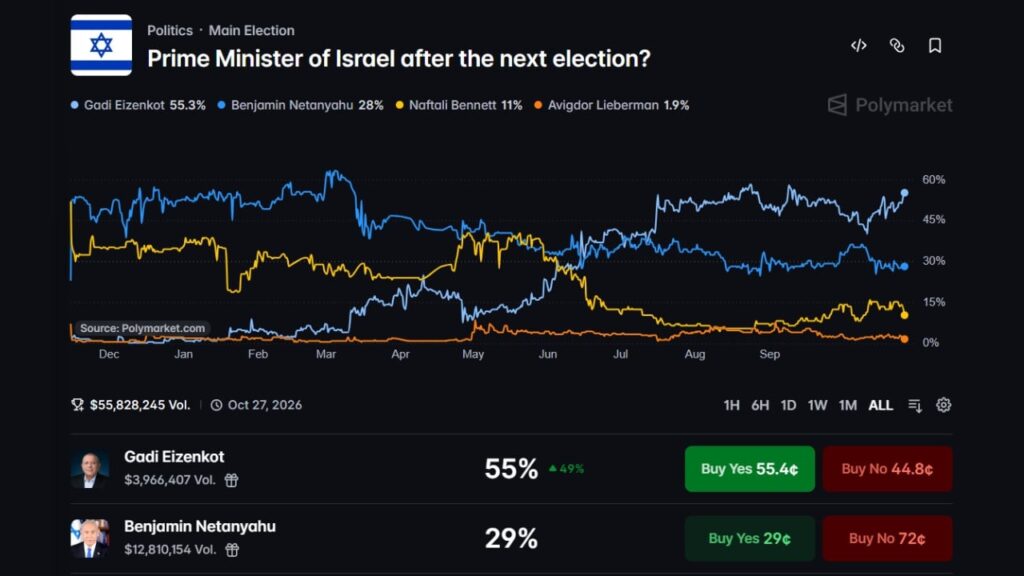
Polymarket’s “Prime Minister of Israel after the next election?” event contract, which has moved over $55 million in volume, gives a clear edge to Gadi Eisenkot, Bibi’s main opponent, leader of the Yashar party, and a general who has previously served as chief of staff of the Israel Defense Forces (IDF).
At the time of writing, Eisenkot, who recently criticized Netanyahu’s plan to rely on crypto to avoid possible economic sanctions on Israel, has a 55% chance of becoming Israel’s next Prime Minister. Conversely, Netanyahu has a 29% chance, while candidates Bennett and Lieberman both trail.
Traditional polls give Eizenkot’s bloc a 6-seat advantage over Netanyahu’s bloc, but show no party reaching a majority on its own. Eizenkot’s path to victory will depend on making concessions and bringing unaligned parties under a single coalition.
The rules specify that the market “will resolve to the next individual who is officially appointed and sworn in as Prime Minister of Israel following the 2026 parliamentary election. If an election is called early, this market will immediately resolve to the individual who is officially appointed and sworn in after that election.”
Prediction markets have been regarded as a useful tool to forecast the outcome of political events since they nailed President Trump’s victory over traditional pollsters in 2024. Nonetheless, these same platforms recently failed in Brazil’s runoff election, where Senator Flavio Bolsonaro had an 80% chance of winning but President Lula finally won with an advantage of over 4 million votes.
The use of prediction markets in Israel has been criticized, with the Israel Democracy Institute calling on the Central Elections Committee to treat them as polls, banning the publication of results at the end of the Friday before the polls open, and highlighting the need for the modernization of the Propaganda Law to address these worries and to protect election integrity.