
Prop Firms USA 2026: Check Before You Pay

Being “open to US traders” and being open on every platform a firm sells are two different claims, and most roundups only check the first one. A firm can answer yes to the country dropdown and still lock a US applicant out of the specific platform its marketing leads with. This piece checks that second layer for five firms that trade crypto and take US applicants in 2026, Crypto Fund Trader among them, reading each firm’s own terms rather than its homepage tagline. The pattern that shows up across all five: US access is usually real, but it’s platform-by-platform, not blanket.
Crypto Fund Trader
Crypto Fund Trader admits US traders on Bybit or Match-Trader; MetaTrader 5 is off-limits by its own Terms and Conditions.
Crypto Fund Trader is a simulated trading evaluation firm and Bybit partner. Its Terms and Conditions, §7.3: “Access to this platform is not available to users residing in the United States,” referring to MetaTrader 5; §7.1.xvi extends that to MT5 “resets or migrations” for new US users. That leaves Match-Trader, “no country restrictions,” and Bybit, where CFT “does not impose any country restrictions” though traders stay “fully responsible for complying with Bybit Terms of Service and jurisdictional restrictions” on their own account. Bybit evaluations run against more than 550 crypto futures pairs, no markup on Bybit’s own price. Programs scale to $300,000 in simulated funded allocation, no time limit, no minimum trading days. Traders may become eligible to receive up to 80% of simulated profits, 90% with an add-on. KYC isn’t required to start the Bybit evaluation, but is mandatory before any scholarship reward. CFT reports more than $21 million paid to traders to date, a self-reported figure with no third-party audit.
Breakout
Breakout is a Kraken-linked prop firm that lists the US as an accepted jurisdiction outright, with no platform carved out.


Breakout operates as Breakout Trading Group, LLC, headquartered in Tampa, Florida, per Finance Magnates’ coverage of Kraken’s September 2025 acquisition (read 2026-09-15). Its own restricted-countries page, read the same day, doesn’t list the US or UK, and states any country left off it is “generally accepted.” That list runs to roughly two dozen sanctioned or high-risk jurisdictions: Iran, North Korea, Russia, Syria, and similar. None of it is platform-specific, unlike CFT’s, HyroTrader’s, or BrightFunded’s MetaTrader 5 restriction. Evaluations run on Breakout’s own terminal across roughly 60 crypto pairs, with leverage up to 5x on BTC and ETH. Splits run 80% to 90%, and traders can request rewards on demand. Breakout is the simplest US case of the five: one country check, no platform-level gate behind it.
HyroTrader
HyroTrader splits itself in two: a Bybit track closed to US traders, and a Cleo track built to work around that.
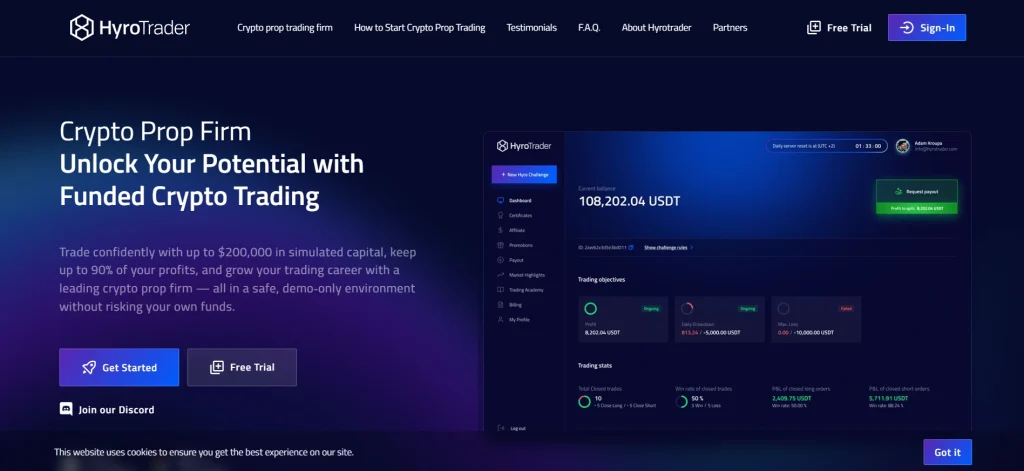
HyroTrader runs Bybit-linked evaluations by API, and Bybit itself “restricts access for US and Canadian residents,” per Velotrade’s review of the firm’s own FAQ (read 2026-09-15). HyroTrader’s answer is a second, proprietary platform: Cleo, which the same FAQ describes as having “no country restrictions,” fully accessible to US traders using Binance market data instead of a live Bybit feed. That’s the reverse of CFT’s setup, where the exchange-linked leg (Bybit) is the one open to US traders and the older third-party platform (MT5) is the one closed. Splits start at 80%, rising to 90%. Account sizes run $5,000 to $200,000. A US applicant needs to know which of the two platforms, Bybit or Cleo, they’re buying before assuming the whole firm is open.
RebelsFunding
RebelsFunding accepts US applicants under its own compliance clause, not a blanket yes the way Breakout does.
RebelsFunding‘s own Terms and Conditions, section 1.10 (read 2026-09-15), state: “Residents of the United States of America may be accepted only for simulated trading Evaluation where permitted by applicable law and where they satisfy the Provider’s internal compliance requirements.” The same section disclaims providing brokerage, retail forex, securities, or live trading services to US residents specifically, and reserves discretion to refuse an application on “federal or state legal, regulatory, payment, sanctions, tax or internal compliance risk.” RebelsFunding runs evaluations on its own RF-Trader platform rather than a named exchange. This is the most conditional of the four competitors here: a US application can be accepted, reviewed, or declined case by case, not the standing yes Breakout, HyroTrader, and BrightFunded each give.
BrightFunded
BrightFunded takes US traders but keeps them off MetaTrader 5, the same platform CFT restricts, for the same reason.
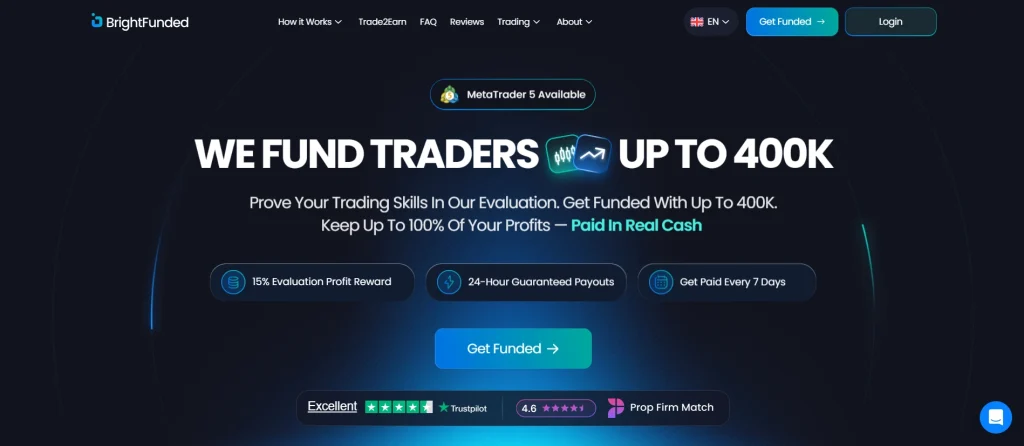
BrightFunded‘s own Terms and Conditions (read 2026-09-15) state: “services related to MetaTrader 5 (MT5)… are not intended for residents or citizens of the United States.” cTrader is also unavailable to US accounts, per the firm’s platform documentation. That leaves DXTrade as the one platform open to every trader regardless of location, US included, a multi-asset terminal covering forex, CFDs, and a smaller crypto set than a Bybit- or Kraken-linked evaluation. BrightFunded’s structure is the closest parallel to CFT’s own: one legacy platform gated by residency, one platform built to carry the US business instead. The difference is which platform plays each role.
Platform Access, Side by Side
The country a prop firm accepts and the platform it opens to that country are two separate lines in its terms.
What “Available in the US” Actually Means
The same three words cover three different arrangements once a firm’s terms are read past the yes. Breakout is the plainest case: it names the US as a permitted country with no platform carved out, so an applicant reads one clause, not two. Crypto Fund Trader, HyroTrader, and BrightFunded all gate one specific platform instead, MetaTrader 5 for CFT and BrightFunded, Bybit for HyroTrader, while a substitute stays fully open to US traders. RebelsFunding’s own terms go further still, accepting a US application only where it clears an internal compliance review, a narrower promise than the other four make.
None of this changes what a US trader can eventually do; it changes which document answers the question, and which platform name to check before paying an evaluation fee.
FAQ
Does “accepts US traders” mean every platform a prop firm sells works from a US address? No. Three of the five close at least one platform to US residents even after accepting the country.
Why does MetaTrader 5 keep being the platform that narrows for US residents? A licensing change, not a choice CFT or BrightFunded made alone. Offering MT5 to US clients needs NFA, CFTC, or FINRA authorization, which most evaluation firms lack. MetaQuotes enforced that on February 2, 2024, pulling a major grey-label provider’s MT4/MT5 licenses; other unauthorized firms lost US access in the same sweep, per Velotrade’s review of the episode (read 2026-09-15). CFT and BrightFunded both restrict MT5 and route US business elsewhere.
Does CFT require KYC before a US trader can start the Bybit evaluation? No. KYC “is not required to participate in the evaluation with demo capital” on Bybit, but is mandatory before any scholarship reward.
Is a restricted-countries list the same as a restricted-platforms list? No. Breakout has only the first; CFT, HyroTrader, and BrightFunded have both, gating different platforms for different reasons.
Conclusion
Read past the country field, and “US traders welcome” splits into at least three setups. CFT keeps MetaTrader 5 closed under T&C §7.3, leaving Bybit and Match-Trader open; BrightFunded runs the identical pattern. Breakout accepts the US with no carve-out at all; HyroTrader’s split runs the other direction, closing Bybit and opening Cleo. RebelsFunding’s US access depends on an internal compliance review, decided case by case. None of the five is more or less “for US traders”; each answers on a different platform. Find that clause before paying an evaluation fee. For prop firms in the USA, CFT’s own FAQ states it plainly; its marketing pages don’t.