
Protect your enterprise now from the Shai-Hulud worm and npm vulnerability in 6 actionable steps
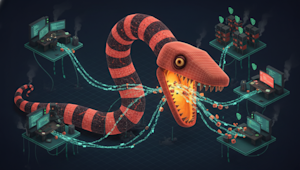
Any development environment that installed or imported one of the 172 compromised npm or PyPI packages published since May 11 should be treated as potentially compromised. On affected developer workstations, the worm harvests credentials from over 100 file paths: AWS keys, SSH private keys, npm tokens, GitHub PATs, HashiCorp Vault tokens, Kubernetes service accounts, Docker configs, shell history, and cryptocurrency wallets. For the first time in a TeamPCP campaign, it targets password managers including 1Password and Bitwarden, according to SecurityWeek.
It steals Claude and Kiro AI agent configurations, including MCP server auth tokens for every external service an agent connects to. And it does not leave when the package is removed.
The worm installs persistence in Claude Code (.claude/settings.json) and VS Code (.vscode/tasks.json with runOn: folderOpen) that re-execute every project open, plus a system daemon (macOS LaunchAgent / Linux systemd) that survives reboots. These live in the project tree, not in node_modules. Uninstalling the package does not remove them. On CI runners, the worm reads runner process memory directly via /proc/pid/mem to extract secrets, including masked ones, on Linux-based runners. If you revoke tokens before isolating the machine, Wiz’s analysis found a destructive daemon wipes your home directory.
Between 19:20 and 19:26 UTC on May 11, the Mini Shai-Hulud worm published 84 malicious versions across 42 @tanstack/* npm packages. Within 48 hours the campaign expanded to 172 packages across 403 malicious versions spanning npm and PyPI, according to Mend’s tracking. @tanstack/react-router alone receives 12.7 million weekly downloads. CVE-2026-45321, CVSS 9.6. OX Security reported 518 million cumulative downloads affected. Every malicious version carried a valid SLSA Build Level 3 provenance attestation. The provenance was real. The packages were poisoned.
“TanStack had the right setup on paper: OIDC trusted publishing, signed provenance, 2FA on every maintainer account. The attack worked anyway,” Peyton Kennedy, senior security researcher at Endor Labs, told VentureBeat in an exclusive interview. “What the orphaned commit technique shows is that OIDC scope is the actual control that matters here, not provenance, not 2FA. If your publish pipeline trusts the entire repository rather than a specific workflow on a specific branch, a commit with no parent history and no branch association is enough to get a valid publish token. That’s a one-line configuration fix.”
Three vulnerabilities chained into one provenance-attested worm
TanStack’s postmortem lays out the kill chain. On May 10, the attacker forked TanStack/router under the name zblgg/configuration, chosen to avoid fork-list searches per Snyk’s analysis. A pull request triggered a pull_request_target workflow that checked out fork code and ran a build, giving the attacker code execution on TanStack’s runner. The attacker poisoned the GitHub Actions cache. When a legitimate maintainer merged to main, the release workflow restored the poisoned cache. Attacker binaries read /proc/pid/mem, extracted the OIDC token, and POSTed directly to registry.npmjs.org. Tests failed. Publish was skipped. 84 signed packages still reached the registry.
“Each vulnerability bridges the trust boundary the others assumed,” the postmortem states. Published tradecraft from the March 2025 tj-actions/changed-files compromise, recombined in a new context.
The worm crossed from npm into PyPI within hours
Microsoft Threat Intelligence confirmed the mistralai PyPI package v2.4.6 executes on import (not on install), downloading a payload disguised as Hugging Face Transformers. npm mitigations (lockfile enforcement, –ignore-scripts) do not cover Python import-time execution.
Mistral AI published a security advisory confirming the impact. Compromised npm packages were available between May 11 at 22:45 UTC and May 12 at 01:53 UTC (roughly three hours). The PyPI release mistralai==2.4.6 is quarantined. Mistral stated an affected developer device was involved but no Mistral infrastructure was compromised. SafeDep confirmed Mistral never released v2.4.6; no commits landed May 11 and no tag exists.
Wiz documented the full blast radius: 65 UiPath packages, Mistral AI SDKs, OpenSearch, Guardrails AI, 20 Squawk packages. StepSecurity attributes the campaign to TeamPCP, based on toolchain overlap with prior Shai-Hulud waves and the Bitwarden CLI/Trivy compromises. The worm runs under Bun rather than Node.js to evade Node.js security monitoring.
The attacker treated AI coding agents as part of the trusted execution environment
Socket’s technical analysis of the 2.3 MB router_init.js payload identifies ten credential-collection classes running in parallel. The worm writes persistence into .claude/ and .vscode/ directories, hooking Claude Code’s SessionStart config and VS Code’s folder-open task runner. StepSecurity’s deobfuscation confirmed the worm also harvests Claude and Kiro MCP server configurations (~/.claude.json, ~/.claude/mcp.json, ~/.kiro/settings/mcp.json), which store API keys and auth tokens for external services. This is an early but confirmed instance of supply-chain malware treating AI agent configurations as high-value credential targets. The npm token description the worm sets reads: “IfYouRevokeThisTokenItWillWipeTheComputerOfTheOwner.” It is not a bluff.
“What stood out to me about this payload is where it planted itself after running,” Kennedy told VentureBeat. “It wrote persistence hooks into Claude Code’s SessionStart config and VS Code’s folder-open task runner so it would re-execute every time a developer opened a project, even after the npm package was removed. The attacker treated the AI coding agent as part of the trusted execution environment, which it is. These tools read your repo, run shell commands, and have access to the same secrets a developer does. Securing a development environment now means thinking about the agents, not just the packages.”
CI/CD Trust-Chain Audit Grid
Six gaps Mini Shai-Hulud exploited. What your CI/CD does today. The control that closes each one.
Audit question
What your CI/CD does today
The gap
1. Pin OIDC trusted publishing to a specific workflow file on a specific protected branch. Constrain id-token: write to only the publish job. Ensure that job runs from a clean workspace with no restored untrusted cache
Most orgs grant OIDC trust at the repository level. Any workflow run in the repo can request a publish token. id-token: write is often set at the workflow level, not scoped to the publish job.
The worm achieved code execution inside the legitimate release workflow via cache poisoning, then extracted the OIDC token from runner process memory. Branch/workflow pinning alone would not have stopped this attack because the malicious code was already running inside the pinned workflow. The complete fix requires pinning PLUS constraining id-token: write to only the publish job PLUS ensuring that job uses a clean, unshared cache.
2. Treat SLSA provenance as necessary but not sufficient. Add behavioral analysis at install time
Teams treat a valid Sigstore provenance badge as proof a package is safe. npm audit signatures passes. The badge is green. Procurement and compliance workflows accept provenance as a gate.
All 84 malicious TanStack versions carry valid SLSA Build Level 3 provenance attestations. First widely reported npm worm with validly-attested packages. Provenance attests where a package was built, not whether the build was authorized. Socket’s AI scanner flagged all 84 artifacts within six minutes of publication. Provenance flagged zero.
3. Isolate GitHub Actions cache per trust boundary. Invalidate caches after suspicious PRs. Never check out and execute fork code in pull_request_target workflows
Fork-triggered workflows and release workflows share the same cache namespace. Closing or reverting a malicious PR is treated as restoring clean state. pull_request_target is widely used for benchmarking and bundle-size analysis with fork PR checkout.
Attacker poisoned pnpm store via fork-triggered pull_request_target that checked out and executed fork code on the base runner. Cache survived PR closure. The next legitimate release workflow restored the poisoned cache on merge. actions/cache@v5 uses a runner-internal token for cache saves, not the workflow’s GITHUB_TOKEN, so permissions: contents: read does not prevent mutation. Kennedy: 'Branch protection rules don’t apply to commits that aren’t on any branch, so that whole layer of hardening didn’t help.'
4. Audit optionalDependencies in lockfiles and dependency graphs. Block github: refs pointing to non-release commits
Static analysis and lockfile enforcement focus on dependencies and devDependencies. optionalDependencies with github: commit refs are not flagged by most tools.
The worm injected optionalDependencies pointing to a github: orphan commit in the attacker’s fork. When npm resolves a github: dependency, it clones the referenced commit and runs lifecycle hooks (including prepare) automatically. The payload executed before the main package’s own install step completed. SafeDep confirmed Mistral never released v2.4.6; no commits landed and no tag exists.
5. Audit Python dependency imports separately from npm controls. Cover AI/ML pipelines consuming guardrails-ai, mistralai, or any compromised PyPI package
npm mitigations (lockfile enforcement, –ignore-scripts) are applied to the JavaScript stack. Python packages are assumed safe if pip install completes. AI/ML CI pipelines are treated as internal testing infrastructure, not as supply-chain attack targets.
Microsoft Threat Intelligence confirmed mistralai PyPI v2.4.6 executes on import, not install. Injected code in __init__.py downloads a payload disguised as Hugging Face Transformers. –ignore-scripts is irrelevant for Python import-time execution. guardrails-ai@0.10.1 also executes on import. Any agentic repo with GitHub Actions id-token: write is exposed to the same OIDC extraction technique. LLM API keys, vector DB credentials, and external service tokens all in the blast radius.
6. Isolate and image affected machines before revoking stolen tokens. Do not revoke npm tokens until the host is forensically preserved
Standard incident response: revoke compromised tokens first, then investigate. npm token list and immediate revocation is the instinctive first step.
The worm installs a persistent daemon (macOS LaunchAgent / Linux systemd) that polls GitHub every 60 seconds. On detecting token revocation (40X error), it triggers rm -rf ~/, wiping the home directory. The npm token description reads: 'IfYouRevokeThisTokenItWillWipeTheComputerOfTheOwner.' Microsoft reported geofenced destructive behavior: a 1-in-6 chance of rm -rf / on systems appearing to be in Israel or Iran. Kennedy: 'Even after the package is gone, the payload may still be sitting in .claude/ with a SessionStart hook pointing at it. rm -rf node_modules doesn’t remove it.'
Sources: TanStack postmortem, StepSecurity, Socket, Snyk, Wiz, Microsoft Threat Intelligence, Mend, Endor Labs. May 12, 2026.
Security director action plan
Today: “The fastest check is find . -name 'router_init.js' -size +1M and grep -r '79ac49eedf774dd4b0cfa308722bc463cfe5885c' package-lock.json,” Kennedy said. If either returns a hit, isolate and image the machine immediately. Do not revoke tokens until the host is forensically preserved. The worm’s destructive daemon triggers on revocation. Once the machine is isolated, rotate credentials in this order: npm tokens first, then GitHub PATs, then cloud keys. Hunt for .claude/settings.json and .vscode/tasks.json persistence artifacts across every project that was open on the affected machine.
This week: Rotate every credential accessible from affected hosts: npm tokens, GitHub PATs, AWS keys, Vault tokens, K8s service accounts, SSH keys. Check your packages for unexpected versions after May 11 with commits by claude@users.noreply.github.com. Block filev2.getsession[.]org and git-tanstack[.]com.
This month: Audit every GitHub Actions workflow against the six gaps above. Pin OIDC publishing to specific workflows on protected branches. Isolate cache keys per trust boundary. Set npm config set min-release-age=7d. For AI/ML teams: check guardrails-ai and mistralai against compromised versions, audit CI pipelines for id-token: write exposure, and rotate every LLM API key and vector DB credential accessible from CI.
This quarter (board-level): Fund behavioral analysis at the package registry layer. Provenance verification alone is no longer a sufficient procurement criterion for supply-chain security tooling. Require CI/CD security audits as part of vendor risk assessments for any tool with publish access to your registries. Establish a policy that no workflow with id-token: write runs from a shared cache. Treat AI coding agent configurations (.claude/, .kiro/, .vscode/) as credential stores subject to the same access controls as cloud key vaults.
The worm is iterating. Defenders must, as well
This is the fifth Shai-Hulud wave in eight months. Four SAP packages became 84 TanStack packages in two weeks. intercom-client@7.0.4 fell 29 hours later, confirming active propagation through stolen CI/CD infrastructure. Late on May 12, malware research collective vx-underground reported that the fully weaponized Shai-Hulud worm code has been open-sourced. If confirmed, this means the attack is no longer limited to TeamPCP. Any threat actor can now deploy the same cache-poisoning, OIDC-extraction, and provenance-attested publishing chain against any npm or PyPI package with a misconfigured CI/CD pipeline.
“We’ve been tracking this campaign family since September 2025,” Kennedy said. “Each wave has picked a higher-download target and introduced a more technically interesting access vector. The orphaned commit technique here is genuinely novel. Branch protection rules don’t apply to commits that aren’t on any branch. The supply chain security space has spent a lot of energy on provenance and trusted publishing over the last two years. This attack walked straight through both of those controls because the gap wasn’t in the signing. It was in the scope.”
Provenance tells you where a package was built. It does not tell you whether the build was authorized. That is the gap this audit is designed to close.