Stablecoin Yield Fight Nears Resolution as Tillis, Alsobrooks Finalize Draft Language – Regulation Bitcoin News
Key Takeaways:
Sen. Thom Tillis plans to release revised CLARITY Act draft language this week, targeting a Senate Banking Committee markup in late April 2026. The proposed Tillis-Alsobrooks framework bans passive stablecoin yield but permits activity-based rewards, splitting a dispute between banks and Coinbase. Prediction markets give the CLARITY Act a 59% chance of passage in 2026, down from 82% earlier this year, as unresolved DeFi and ethics provisions remain.
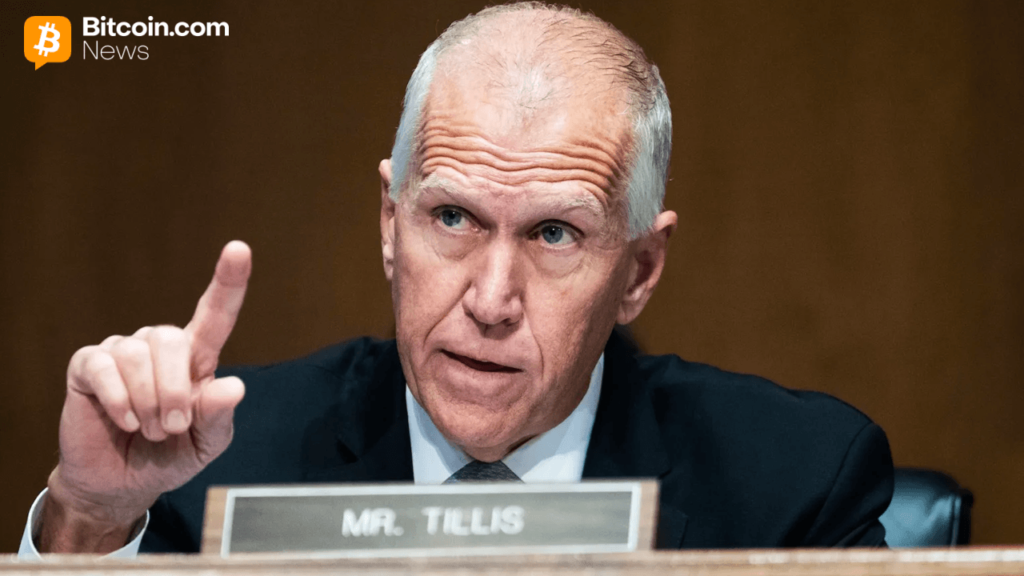
Tillis Targets Late April Markup for CLARITY Act After Stablecoin Yield Deal in Principle
According to a report from Politico Pro, the North Carolina Republican has been working alongside Sen. Angela Alsobrooks (D-Md.) to finalize language for the Digital Asset Market Clarity Act, a bipartisan bill seeking a broad regulatory framework for the crypto sector. The stablecoin yield dispute has stalled the bill in the Senate Banking Committee since January 2026.
Stablecoins are dollar-pegged digital assets such as USDT and USDC used across trading platforms, payment networks, and as a cash equivalent in crypto markets. That market currently sits at roughly $321 billion.
The fight centers on whether third-party platforms, including exchanges and wallet providers like Coinbase, can offer rewards or yield on users’ idle stablecoin balances. The GENIUS Act, passed in 2025, already bars stablecoin issuers themselves from paying yield directly.
Banking groups argue that allowing any yield on stablecoins would pull money out of traditional savings accounts, creating deposit flight and what they describe as structural disruption to the financial system. Their position is that crypto platforms would effectively be offering bank-style interest products without equivalent regulatory oversight.
Crypto firms counter that restricting rewards stifles competition and limits platform growth. Coinbase, one of the most vocal critics of earlier drafts, withdrew its support for the CLARITY Act over strict yield restrictions and has pushed for rules that leave room for activity-tied incentives.
Tillis and Alsobrooks, with White House involvement, reached an agreement in principle in March 2026. A private draft circulated to industry representatives in early April generally bans passive yield, meaning interest paid simply for holding a stablecoin balance, while permitting activity-based rewards tied to transactions, payments, or platform engagement.
The draft also calls on the SEC, CFTC, and Treasury to jointly define permissible reward structures and issue anti-evasion rules within 12 months of enactment. Exact definitions for qualifying activity remain under discussion.
Tillis told Politico:
“I think the language has come together well. If things proceed the way they are now, we’ll probably release the text publicly later this week.”
He indicated he remains open to further changes. Neither side is fully on board. Crypto groups, including Coinbase, have raised concerns about caps on balances and transaction volumes in earlier versions. Banking groups are now privately pushing back on the latest draft, though specific objections have not been made public.
The Senate returned from Easter recess on April 13. Senate Banking Committee Chairman Tim Scott (R-S.C.) is targeting a markup session for late April, though no date has been formally set.
Other unresolved issues include DeFi provisions, ethics rules that would bar government officials from personally profiting from crypto, and potential additions tied to community bank deregulation.
If the bill does not reach the Senate floor by May, it risks being pushed past the 2026 midterm elections. Prediction markets on Polymarket currently give the CLARITY Act a 59% chance of being signed into law this year, down from more than 82% earlier in 2026.
A deal on stablecoin yield would clear a significant obstacle toward passing the first major U.S. crypto market structure law, a goal both the industry and the White House have backed for more than a year.