
Thorchain Faces Heat as Bitget Hack Revives Bybit Controversy – Bitcoin News
Key Takeaways
Bitget CEO Gracy Chen wants Thorchain to block the hackers who stole $387.5 million from her exchange on Sept. 24.OKX founder Star Xu argues Thorchain isn’t truly decentralized, while Dashpay’s Joel Valenzuela fiercely disagrees.Thorchain faces renewed scrutiny after previously facilitating $1.2 billion in stolen funds following Bybit’s 2025 hack.
Thorchain Pushes Back as Crypto Figures Clash Over Chen’s Request
Earlier this week on Sept. 24, hackers attacked the CEX Bitget and managed to steal $387.5 million from the exchange’s coffers. Bitcoin.com News reported on Saturday that the attacker has been leveraging several different rails to move the stolen funds and Thorchain, the decentralized exchange (DEX) service, is one of those vehicles. Chen posted on X and tagged Thorchain’s official account and requested that the platform block the attackers’ wallets.
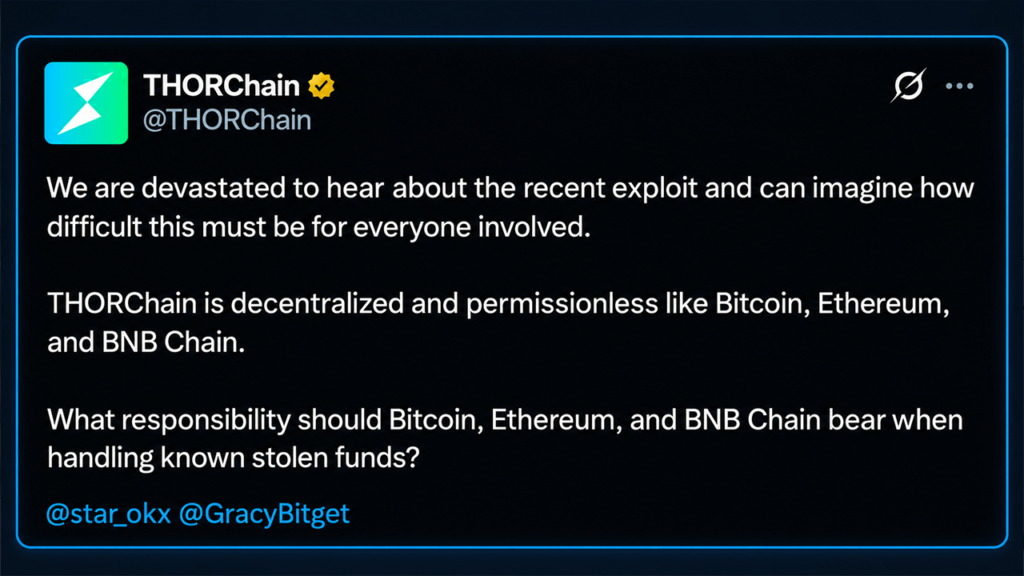
Thorchain responded by expressing sympathy over the Bitget hack but maintained that its protocol was “decentralized and permissionless like Bitcoin, Ethereum, and BNB Chain.” The X account then posed a pointed question about what responsibility Bitcoin, Ethereum and BNB Chain bear in the matter. Meanwhile, a growing chorus of crypto KOLs has entered the debate, with some siding against Thorchain while others vehemently oppose Chen’s formal request.
Joel Valenzuela, business development and marketing lead for Dashpay, was not impressed by Chen’s request. “Shame on you, Gracy Chen,” Valenzuela said on X, replying to her post. “I get that it’s a very stressful and unfortunate time, buy this is an incredibly unfair thing to ask. NO ONE asks Bitcoin or Ethereum to reverse transactions, yet both have in the past rolled back the chain, Ethereum explicitly to reverse an exploit.”
OKX Founder Challenges Thorchain’s Decentralization Claims
Others disagreed with Valenzuela’s perspective. Star Xu, the founder and CEO of OKX went on social media and argued that he doesn’t think Thorchain’s TSS + validator model “represents true decentralization.” The OKX founder added that the “selected validators set collectively controls the underlying assets in the TSS vaults. Once the signing threshold is reached, those validators can move the funds.”
He added:
“So from a custody perspective, Thorchain is not comparable to Bitcoin or Ethereum base-layer consensus — it effectively acts as an intermediary between users and the native chains.”
The OKX founder also engaged in a back-and-forth exchange with Dashpay’s Valenzuela. “There is no central authority and no censorship mechanism,” Valenzuela said to him. “Stop coping because your failed centralized model can’t protect users,” the Dashpay exec added. “False,” Star responded. “Thorchain effectively proved that it is not truly decentralized. In May, when its own vaults were drained, node operators paused the entire network within minutes and kept it offline for 13 hours.”
The OKX founder continued:
“A network that can stop when its own funds are at risk, but refuses to do so when someone else’s funds are at risk, is not ‘like Bitcoin.’ Bitcoin cannot be stopped. Thorchain can—it simply chooses when to do so.”
Bybit’s $1.2 Billion Hack Returns to the Spotlight
This is not Thorchain’s first rodeo with controversy associated with stolen funds. In February 2025, after Bybit was hacked, the DEX platform became the primary conduit for the North Korean Lazarus Group to move an estimated $1.2 billion. Even with pressure from the FBI, Thorchain did not block Bybit hack swaps. After Bitget was attacked, Bybit’s founder Ben Zhou told Chen that Bybit would be on standby to help in any way the exchange could.
“Bitget helped us when we had the hack,” Zhou said. We are updating lazarusbounty.com to help Bitget to capture and trace the stolen fund movement.”
To many observers, Thorchain makes a fair point that truly decentralized protocols shouldn’t be expected to censor transactions like bitcoin miners wouldn’t. But the saving of their own vaults in May somewhat undermines the “we can’t intervene” defense, according to some KOLs who believe it is like selective morality.