
US Government Targets $1.17B as Circle Offers to Reissue Binance’s Frozen USDC
Key Takeaways
Federal prosecutors seek $1.17 billion in USDC associated with 36 blockchain address entries spanning 18 networks.Investigators attribute Binance’s Oct. 29 theft to North Korea’s Lazarus Group/APT38.Circle has blocklisted the affected addresses and agreed to issue replacement USDC if a forfeiture order is granted.
Federal Complaint Exposes How Binance’s $6 Billion Hack Unfolded
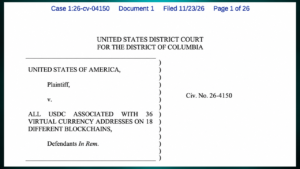
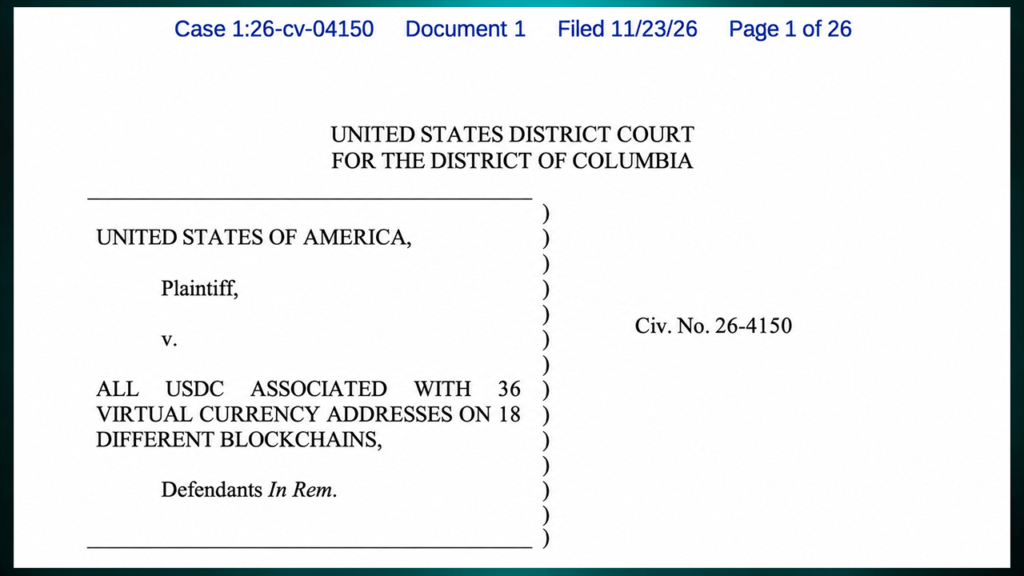
Federal prosecutors are pursuing one of the largest cryptocurrency forfeiture actions associated with North Korean cybercrime, according to a 26-page complaint filed in the U.S. District Court for the District of Columbia.
The filing, designated case 1:26-cv-04150, follows an investigation involving the FBI, U.S. Secret Service, and IRS Criminal Investigation. Authorities allege that North Korea’s Lazarus Group/APT38 orchestrated the Oct. 29 attack, stealing approximately $6.3 billion in digital assets from Binance.
Bitcoin.com News previously reported that the Justice Department secured court authorization on Nov. 12, targeting more than $1.2 billion in stolen Binance assets, part of a broader recovery effort that froze over $2.7 billion in funds following the North Korean-linked heist.
In the latest complaint filing, investigators describe an elaborate intrusion beginning with a seemingly ordinary employment opportunity. A Binance employee was approached by someone posing as a recruiter and subsequently instructed to download software during a job interview. The application secretly contained malware, compromising the employee’s device and providing attackers an opening into Binance’s infrastructure.
According to the disclosure, the intruders exploited Ethereum’s EIP-7702 functionality, introduced in 2025, to manipulate wallet authorizations and execute malicious transactions. The attackers allegedly deployed automated sweeper contracts capable of transferring assets immediately upon receipt, effectively hijacking Binance-controlled hot wallets.
Federal investigators traced approximately $780 million in USDC transferred at 20:41 UTC on Oct. 29, followed by another $43 million just 18 minutes later. Both transactions reached the same Ethereum address. Additional stolen assets traveled through bridges, swapping services, and intermediary wallets, complicating investigators’ efforts to reconstruct their movements.
Circle Agrees to Replace Frozen USDC Following Court Order
The complaint identifies USDC across Ethereum, Solana, Polygon, Arbitrum, Base, and numerous additional networks. Circle voluntarily blocklisted the affected addresses around Oct. 29, preventing further USDC transfers. Crucially, Circle cannot directly retrieve the frozen tokens because the compromised addresses remain under the attackers’ control.
Instead, the stablecoin issuer has agreed to mint an equivalent amount of replacement tokens, designated “Substitute USDC,” and transfer them to the U.S. government following a forfeiture order. Investigators also uncovered connections to September’s $387 million Bitget breach, identifying wallets that allegedly received proceeds from both attacks.
The filing places the Binance theft within a broader campaign of cryptocurrency intrusions attributed to the state-sponsored hacking syndicate Lazarus, including the $1.5 billion Bybit exploit in February 2025. The U.S. government’s forfeiture request remains subject to judicial approval, meaning the assets have not yet been permanently awarded to federal authorities.
The Justice Department’s announcement on Monday confirms that the action is intended to help Binance recover stolen assets, rather than simply confiscate money for unrelated government purposes.
The case illustrates an unusual enforcement mechanism: Rather than recovering stolen tokens directly, prosecutors are relying on a centralized stablecoin issuer’s ability to immobilize compromised balances and replace them through a court-supervised process.