NVIDIA DSX Boosts AI Factory Efficiency with 24% Token Gain
Alvin Lang
Sep 15, 2026 19:28
NVIDIA’s DSX platform improves AI factory efficiency, achieving 24% more token throughput in fixed power budgets, reshaping industrial AI.
NVIDIA’s push into industrial-scale AI continues to deliver measurable results. At the 2026 AI Infra Summit, the company revealed that its DSX MaxLPS platform increased token throughput by 24% at cloud provider Lambda’s AI factory, all within a fixed power budget. This breakthrough underscores NVIDIA’s vision for ‘AI factories’ as next-generation infrastructure where power efficiency defines productivity.
Lambda’s test environment, which spanned a 19-node NVIDIA HGX B200 GPU cluster, demonstrated how dynamic power allocation and workload optimization recover stranded capacity. By running 19 nodes at 85% power instead of 16 nodes at full power, the system boosted token throughput from 4 million to 5 million tokens per second, with performance per watt improving by 23%. This efficiency gain could scale up to 40% more GPU capacity in future facilities using NVIDIA’s Vera Rubin NVL72 architecture, set for deployment in 2027.
Power constraints are a growing issue for AI infrastructure. NVIDIA’s DSX suite—introduced earlier this year—addresses this challenge by optimizing energy use across compute, cooling, and grid interaction. DSX MaxLPS focuses on maximizing token production from a fixed energy supply, while DSX Flex integrates AI factories with grid signals to adjust power usage dynamically in response to demand. These technologies are designed to ensure high-priority AI workloads remain uninterrupted, even when the grid is under stress.
A real-world example of DSX Flex’s potential comes from Silicon Valley Power’s Flexible Load Interconnect Program. During a recent test, Emerald AI’s Conductor platform, a precursor to DSX Flex, automatically reduced an AI factory’s power consumption from 4 megawatts to 3 megawatts within a minute, maintaining critical workloads. This approach not only supports grid stability but allows AI factories to scale without waiting for expensive new energy infrastructure.
“The ability to reclaim stranded capacity is a game-changer,” said Dave Ward, president of cloud services at Lambda. “DSX MaxLPS enables a leap in compute density without increasing energy consumption, which is critical as the industry faces power and cooling limits.”
NVIDIA’s broader strategy positions AI factories as a new industrial model, designed to convert energy into AI tokens for applications like training large models, robotics, and digital twins. By emphasizing ‘tokens per megawatt’ as a core metric, NVIDIA is aligning its full-stack approach—from GPUs to orchestration software—with the reality that energy efficiency will dictate the pace of AI infrastructure growth.
The company’s September 10 partnership with Palantir to enhance supply-chain intelligence further underscores this shift away from merely selling GPUs. Instead, NVIDIA is moving toward becoming a full-stack provider, integrating compute, networking, power management, and digital-twin simulations into cohesive AI production ecosystems.
For the market, NVIDIA’s advancements strengthen its competitive edge in the AI sector. Its stock (currently trading at $212.06, up 0.52% over 24 hours) reflects investor confidence in its ability to innovate beyond hardware, particularly as power constraints become a bottleneck for scaling AI infrastructure globally. The continuous rollout of DSX technologies and upcoming deployments of the Vera Rubin architecture could provide additional catalysts for future growth.
As the AI industry increasingly measures efficiency in ‘work per gigawatt,’ NVIDIA’s DSX platform sets a new standard for what AI factories can achieve. The question is no longer whether AI infrastructure can adapt to power limits, but how efficiently it can convert those limits into productive output.
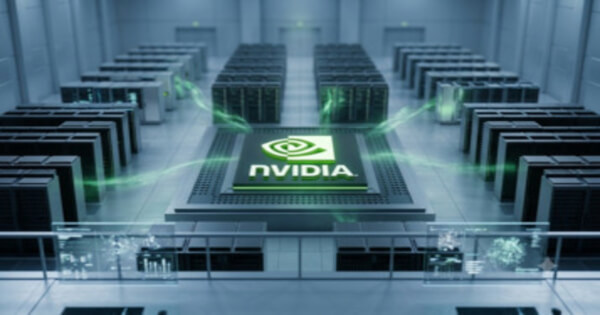
Image source: Shutterstock